Opinion / Politics & accountability
Democrats’ Outrage Industry
Big Money, Mass Messaging and the Campaign to Take Back Power
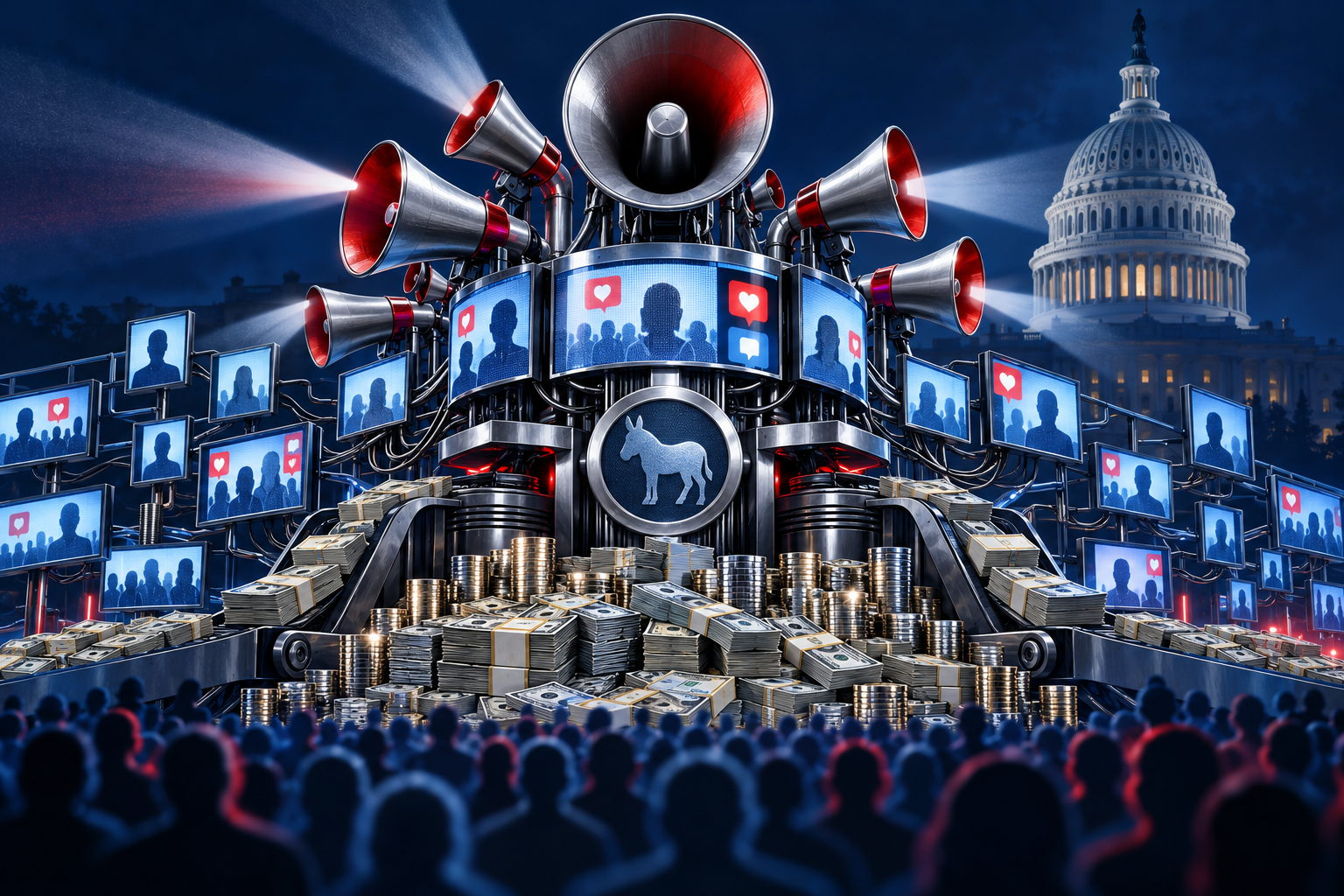
Democrats’ campaign to take out everything related to economic excellence and American sovereignty draws on methods refined over decades: make conservatives, Republicans, and their policies appear dangerous, organize the response, and repeat the message until it becomes familiar. Today they are enlarging that operation to defeat us. They want to recover Congress and obstruct the America First agenda. The machinery deserves serious attention. Its claim to moral superiority deserves considerably less respect.
01 / The foundations
Methods refined over decades
The history is instructive. Lyndon Johnson’s 1964 “Daisy” advertisement paired a child with nuclear destruction during his campaign against Barry Goldwater. In 1992, James Carville’s Clinton accelerated coordinated responses to a rapidly moving news cycle. Later, George Lakoff’s moral-framing work reached Democratic campaigns and congressional caucuses. Different people, different circumstances—but a recurring emphasis on shaping how voters interpret the opponent before the opponent can answer.
Permanent institutions followed. Media Matters began systematic conservative-media monitoring in 2004. Democracy Alliance, established in 2005, organized long-term investment in progressive policy, communications, voter data and organizing. It now reports mobilizing more than $2 billion since its founding. That is a cumulative institutional figure, not an attack-ad budget. But it helps explain why today’s operation arrives with infrastructure already built.
02 / The distribution system
Money, reach and research
Look at the current money. House Majority PAC’s July 27 memo reported $283.48 million in television and digital advertising reservations, with nearly 80% in districts it intended to capture. Senate Majority PAC separately announced television reservations exceeding $215 million. Together, those dated announcements represent roughly half a billion dollars in reserved advertising—not an audited total already spent, and not a measured “misinformation budget.” The electoral ambition is unmistakable.
Now consider how the old rapid-response model reaches people. In June, DNC influencer director Matt Rein described a messaging group of 550 creators, a combined following exceeding 75 million, and 25 sponsored events. His program supplies daily clips and guidance. Its November goal: identify and engage 10,000 creators, including voices in lifestyle and sports.
By September, the DNC claimed its broader influencer network had 165 million cumulative followers, while FactPost had generated 2.1 billion impressions during 2026. Followers overlap; impressions include repeated exposure; neither measures votes changed. Still, this is substantial distribution capacity.
The has acquired a ring light. Apparently, spontaneous political enthusiasm now comes with a partnerships director and daily guidance.
The ground operation reinforces that reach. The DNC reports more than 400 volunteers making 448,295 calls, producing nearly 10,000 extended conversations across 61 battleground congressional districts. NextWave staff training carries a seven-figure investment; When We Count voter registration announced another. In September, the party reported providing more than $1 million monthly to state parties, plus additional support in Republican-controlled states. These programs have different accounting boundaries; their figures should not be casually added together.
Opposition research has become a standing production system too. American Bridge emerged in 2010–2011 to build a permanent progressive counterweight to Republican outside groups. Today, Pat Dennis’s organization has launched files covering 37 Republican candidates, with AI tools designed to help produce press releases, email scripts and rapid responses. The technology has advanced; the business of assembling ammunition against Republicans is well established.
03 / Technology and authority
AI and questions of power
AI adds another question of power. On March 25, Senator Bernie Sanders and Representative Alexandria Ocasio-Cortez proposed a federal moratorium on new AI data centers. On September 23, Sanders and Representative Greg Casar introduced legislation to ban artificial superintelligence, pause advanced AI development and create a cabinet-level Department of Artificial Intelligence. Sanders is an independent who caucuses with Democrats. Their sponsors invoke safety, workers and public protection. The authority they seek is nevertheless substantial: government would decide which advanced systems may be developed and released.
This is an attempt by leading figures on the left to seize control of a tool equal to the greatest inventions of our time yielding the power solve economic crisis, provide medical correlation and guidance for the most deadly of diseases and resolve conflicts around the globe. Americans should examine who would exercise that power, how decisions could be challenged and what useful research might be delayed. The familiar promise to protect the public should not exempt the proposed gatekeepers from scrutiny.
04 / Images and policy
The border and emotional messaging
The border presents a different opportunity for emotional messaging. The Fe y Esperanza con Dios caravan left Honduras on September 20 and moved north through southern Mexico. Allen West’s October 5 Townhall column described roughly 600 migrants and argued that its timing could embarrass the administration before the midterms. La Jornada’s October 2 reporting placed about 350 people in Mapastepec and recorded differing destinations: some sought the United States, others intended to stay in Mexico. Its September 27 report included a previously deported migrant hoping to rejoin his family in the United States.
Images of migrants en route to the border can be used to create sympathy and support for Democrats’ fight against the Trump administration’s deportation policies, ICE and the America First border agenda. Compassion for people in hardship does not settle questions of lawful entry, enforcement or sovereignty. This is another familiar political method: make the emotionally compelling image carry the policy argument. We can only currently speculate that Democrats organized or financed this caravan and timed it for the election, however a coincidence of timing that repeats more than twice, is twice as likely to be the truth.
05 / The accountability test
Institutions and public authority
Organization alone proves no wrongdoing. The revealing question is what the machinery distributes—and whether institutions entrusted with public authority maintain their independence.
There are documented reasons to ask. In 2017, DOJ described IRS scrutiny and delays that disproportionately harmed conservative organizations. In 2019, its inspector general identified 17 significant inaccuracies and omissions in the Carter Page surveillance applications, including failures involving Steele reporting. Separately, the FEC imposed reporting penalties on the Clinton campaign and DNC for opposition-research payments through Perkins Coie. These are concrete institutional failures and disclosure violations. They do not establish that the DNC directed every agency action; but of course (wink wink), the inspector general found no evidence that political bias drove the decision to open the FBI investigation.
Federal research grants aren’t solely a tool for Democrats and their campaign funding, but interestingly, in 2021 a $3 million NSF grant was provided to UW and Stanford for disinformation research. Its existence establishes public funding, but while it’s not a traced payment for partisan attacks, the connection is stronger when actual abuse is identified.
That standard brings us back to a current example of messaging against Republican leadership. The DNC presented President Trump’s financial remarks as general indifference to Americans’ hardship. The underlying exchange concerned preventing an Iranian nuclear weapon despite economic costs. Voters can reject that tradeoff. They should first be allowed to see it. Instead, the defining context is left behind, kicked to the side, hidden.
06 / The concluding argument
The case for complete context
That is the objection to this familiar style of political packaging: encourage a sweeping judgment while withholding what would complicate it. Money purchases repetition. Creators lend familiarity. Selective framing can acquire the appearance of widespread agreement. An old method becomes more powerful when the delivery system follows people into nearly every spare moment.
Most troubling is the burden this places on ordinary people. They are juggling work, bills and family responsibilities. They cannot investigate every clip or reconstruct every interview. Their limited time is no excuse for treating them as raw material for campaign messaging.
Republicans spend heavily and frame events for advantage too. That objection deserves acknowledgment. It does not give Democrat’s a messaging exemption with immunity from examination, especially when its producers present themselves as democracy’s rescuers. Buying advertising is lawful. Omitting material context still deserves an answer.
Republicans and supporters of the America First agenda should be alert, organized and optimistic, free of complacency and ready to respond. Show the complete exchange. Identify the sponsor. Answer specific accusations with records and results. The history of these methods is a reason to prepare, not a reason to surrender.
An expensive accusation remains an accusation. A billion impressions cannot restore omitted context. Democrats’ outrage industry has had decades to develop its methods; that makes scrutiny more necessary, not less.
Its machinery is formidable. Its moral superiority remains a campaign claim.
Sources
- Historical methods and source ledger
- Democracy Alliance funding
- House Majority PAC July memo
- Senate Majority PAC July reservations
- DNC creator program
- DNC September reach and state support
- DNC organizing and training
- When We Count
- American Bridge research books
- IRS settlements
- FISA inspector general testimony
- FEC reporting penalties
- NSF grant announcement
- DNC advertisement
- Original interview transcript
- Sanders–Ocasio-Cortez AI data-center moratorium proposal
- Sanders–Casar advanced-AI ban and federal department proposal
- Allen West: caravan timing argument (opinion)
- La Jornada: caravan size, route and differing destinations
- La Jornada: caravan departure and deported participant’s account
This is a reference to the Clinton campaign’s 1992 “War Room”—its coordinated political messaging operation
Project, Research, Analysis, Editorial by Patrick Russell; assisted by ChatGPT (OpenAI).