Political Counteroffensive / Deep Dive 1
Strategy, Networks & Influences
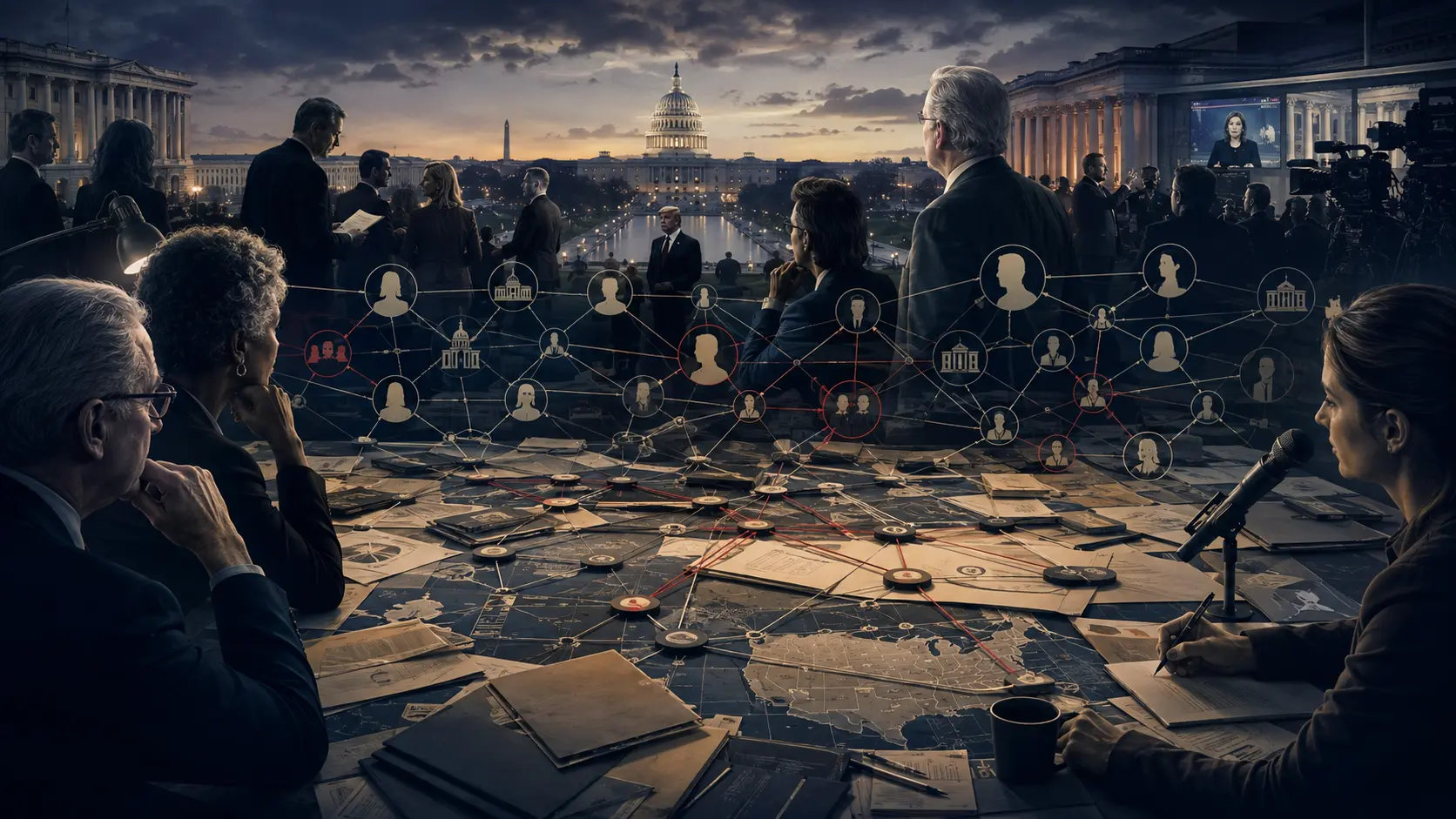
Who built the political infrastructure, how Democrats, progressives and democratic socialists overlapped without becoming one ideology, which officials exercised institutional power, who assisted Trump's broader counteroffensive, and where documented coordination ends and allegation begins.
Project, Research, Analysis, Editorial by Patrick Russell; assisted by ChatGPT (OpenAI).
Historical evidence / Reviewed October 5, 2026
Decades of Democratic messaging methods and strategic influences
These selected examples establish older methods and institutional development through 2024. They do not identify one uninterrupted command structure. Current 2026 cases belong to Political Narrative Watch; funding and government abuses retain separate owning investigations.
Proven1964: fear and the Republican alternativeJohnson's Daisy advertisement placed a child, a countdown and nuclear destruction within an appeal to re-elect Johnson against Goldwater. The original campaign artifact establishes an emotional danger frame.Review full evidence
Johnson's Daisy advertisement placed a child, a countdown and nuclear destruction within an appeal to re-elect Johnson against Goldwater. The original campaign artifact establishes an emotional danger frame.
Sources: Library of Congress — Johnson's Daisy advertisement (September 7, 1964)Supported1992: coordinated rapid responseCarville describes the Clinton War Room as a command structure built to act quickly under compressed news cycles, including preparing a response to Bush's acceptance speech before delivery.Review full evidence
Carville describes the Clinton War Room as a command structure built to act quickly under compressed news cycles, including preparing a response to Bush's acceptance speech before delivery.
Sources: PBS American Experience — James Carville interviewSupported1990s–2000s: moral framing and cognitive linguisticsLakoff's political biography links his framing work to Howard Dean's 2004 campaign and presentations to House and Senate Democratic retreats and caucuses. This documents a stated intellectual influence on Democratic communication.Review full evidence
Lakoff's political biography links his framing work to Howard Dean's 2004 campaign and presentations to House and Senate Democratic retreats and caucuses. This documents a stated intellectual influence on Democratic communication.
Sources: George Lakoff — Political BiographyProven2004 onward: continuous conservative-media monitoringMedia Matters describes its May 2004 launch and systematic real-time monitoring of conservative media. Its institutional mission shows opposition-oriented communications capacity extending beyond one election.Review full evidence
Media Matters describes its May 2004 launch and systematic real-time monitoring of conservative media. Its institutional mission shows opposition-oriented communications capacity extending beyond one election.
Sources: Media Matters — About UsProven2005 onward: durable donor-funded institutionsDemocracy Alliance's 2016 account says it was formed in 2005 to build lasting progressive infrastructure supporting election victories and progressive governance. Its policy, communications, data and organizing partners illustrate the broader institutional strategy.Review full evidence
Democracy Alliance's 2016 account says it was formed in 2005 to build lasting progressive infrastructure supporting election victories and progressive governance. Its policy, communications, data and organizing partners illustrate the broader institutional strategy.
Sources: Democracy Alliance — 2016 strategyProven2010–2011 onward: permanent opposition-research productionAmerican Bridge's early announcement sought a permanent progressive counterweight to Republican outside groups following the 2010 election. Research, video tracking and rapid response became standing organizational functions.Review full evidence
American Bridge's early announcement sought a permanent progressive counterweight to Republican outside groups following the 2010 election. Research, video tracking and rapid response became standing organizational functions.
Sources: American Bridge — President and campaign director announcement (2011)01 / Institutional foundations
The network predates Trump
Progressive politics entered the Trump era with established donor, legal, media, advocacy and organizing institutions. Overlap proves infrastructure and cooperation; it does not prove one command directing every participant.
ProvenDemocracy AllianceBeginning in 2004, major progressive donors coordinated long-term investment in Democratic-aligned policy, advocacy and electoral infrastructure.Review full evidence
Beginning in 2004, major progressive donors coordinated long-term investment in Democratic-aligned policy, advocacy and electoral infrastructure.
Sources: Democracy AllianceProvenDavid Brock networkMedia Matters, American Bridge and related organizations supplied media monitoring, opposition research and rapid response against Republicans.Review full evidence
Media Matters, American Bridge and related organizations supplied media monitoring, opposition research and rapid response against Republicans.
ProvenGeorge Soros and Open SocietySoros-funded institutions supported progressive civil society, criminal-justice reform and policy advocacy over decades.Review full evidence
Soros-funded institutions supported progressive civil society, criminal-justice reform and policy advocacy over decades.
ProvenMarc Elias and election litigationElias and Democracy Docket developed a large, openly Democratic-aligned election-litigation operation.Review full evidence
Elias and Democracy Docket developed a large, openly Democratic-aligned election-litigation operation.
ProvenEric Holder and NDRCNDRC built a long-term strategy around governors, courts, secretaries of state and legislatures that shape redistricting.Review full evidence
NDRC built a long-term strategy around governors, courts, secretaries of state and legislatures that shape redistricting.
Sources: National Democratic Redistricting Committee — Electoral Priorities02A / Democratic and progressive influences
People and Ideas That Shaped Democratic Strategy
The anti-Trump coalition crossed an ideological spectrum: establishment and centrist Democrats, institutional liberals, progressives, democratic socialists and activists influenced by more explicitly socialist traditions. Party identification and ideology must therefore be measured separately. Their views and effects differ substantially; inclusion identifies a documented line of influence, not membership in one unified ideology or command structure.
SupportedSaul AlinskyCommunity organizing, power mapping and pressure tactics influenced later progressive organizers.Review full evidence
Community organizing, power mapping and pressure tactics influenced later progressive organizers.
SupportedAntonio Gramsci and the New LeftIdeas about cultural and institutional power influenced academic and activist movements that later affected progressive politics.Review full evidence
Ideas about cultural and institutional power influenced academic and activist movements that later affected progressive politics.
ProvenFDR and Lyndon JohnsonThe New Deal coalition, civil-rights legislation and expanded federal administration became durable Democratic governing models.Review full evidence
The New Deal coalition, civil-rights legislation and expanded federal administration became durable Democratic governing models.
ProvenBill and Hillary ClintonBill Clinton advanced triangulation and professionalized donor politics; Hillary Clinton's 2016 campaign adopted the documented Pied Piper approach.Review full evidence
Bill Clinton advanced triangulation and professionalized donor politics; Hillary Clinton's 2016 campaign adopted the documented Pied Piper approach.
ProvenBarack ObamaObama campaigns modernized voter data, digital fundraising, field organization and coalition turnout.Review full evidence
Obama campaigns modernized voter data, digital fundraising, field organization and coalition turnout.
ProvenBernie Sanders and DSASanders normalized democratic-socialist language while DSA used Democratic primaries to expand influence.Review full evidence
Sanders normalized democratic-socialist language while DSA used Democratic primaries to expand influence.
Sources: Democratic Socialists of America — Political PlatformProvenDemocratic identity and socialist alignment overlappedSome prominent Trump opponents operated electorally as Democrats while identifying as democratic socialists, holding DSA membership or receiving DSA backing. Alexandria Ocasio-Cortez and Rashida Tlaib were identified by DSA as members elected to Congress; Cori Bush and Jamaal Bowman were DSA-backed Democratic officeholders; and Bernie Sanders pursued the Democratic presidential nomination with an independent DSA mobilization behind him.Review full evidence
Some prominent Trump opponents operated electorally as Democrats while identifying as democratic socialists, holding DSA membership or receiving DSA backing. Alexandria Ocasio-Cortez and Rashida Tlaib were identified by DSA as members elected to Congress; Cori Bush and Jamaal Bowman were DSA-backed Democratic officeholders; and Bernie Sanders pursued the Democratic presidential nomination with an independent DSA mobilization behind him.
Sources: Democratic Socialists of America — Members and Democratic Electoral Strategy; Democratic Socialists of America — Political Platform; Democratic Socialists of America — Beyond BernieProvenThe anti-Trump alliance was ideologically mixedDSA described defeating Trump as imperative while declining to endorse Joe Biden in 2020 and sharply distinguishing its socialist project from corporate Democrats. The official Democratic platform, meanwhile, defended regulated and competitive capitalism. Opposition to Trump therefore joined groups that shared an immediate objective but disagreed over the economic system and the party's long-term direction.Review full evidence
DSA described defeating Trump as imperative while declining to endorse Joe Biden in 2020 and sharply distinguishing its socialist project from corporate Democrats. The official Democratic platform, meanwhile, defended regulated and competitive capitalism. Opposition to Trump therefore joined groups that shared an immediate objective but disagreed over the economic system and the party's long-term direction.
Sources: Democratic Socialists of America — Beyond Bernie; Democratic Party — National Platform02B / Intelligence and law-enforcement actors
Officials Who Shaped the Institutional Campaign Against Trump
Senior intelligence and law-enforcement officials exercised powers and used credentials that materially shaped the Russia narrative, surveillance, investigations and the 2020 information environment. The record supports serious failures and anti-Trump conduct by particular people; it does not prove that every CIA or FBI employee joined one partisan operation.
ProvenJohn Brennan and James ClapperAs CIA director and director of national intelligence, Brennan and Clapper held central roles in the post-election intelligence process that produced the January 2017 assessment. Later declassified records and congressional reviews sharply dispute how intelligence was selected and characterized.Review full evidence
As CIA director and director of national intelligence, Brennan and Clapper held central roles in the post-election intelligence process that produced the January 2017 assessment. Later declassified records and congressional reviews sharply dispute how intelligence was selected and characterized.
Sources: ODNI — 2016–2017 Intelligence Assessment RecordsProvenJames Comey and FBI leadershipComey led the FBI as Crossfire Hurricane, confidential-source operations and Carter Page surveillance moved forward. The inspector general documented major supervisory and accuracy failures, while Durham concluded the FBI failed to apply appropriate analytical rigor.Review full evidence
Comey led the FBI as Crossfire Hurricane, confidential-source operations and Carter Page surveillance moved forward. The inspector general documented major supervisory and accuracy failures, while Durham concluded the FBI failed to apply appropriate analytical rigor.
Sources: DOJ Inspector General — Crossfire Hurricane Review; Department of Justice — Durham ReportProvenAndrew McCabe, Peter Strzok and Lisa PageSenior FBI participants had operational roles in the investigation, and Strzok-Page messages documented intense anti-Trump views. Their conduct became central evidence of institutional bias and damaged confidence in investigative neutrality.Review full evidence
Senior FBI participants had operational roles in the investigation, and Strzok-Page messages documented intense anti-Trump views. Their conduct became central evidence of institutional bias and damaged confidence in investigative neutrality.
Sources: DOJ Inspector General — Crossfire Hurricane Review; Department of Justice — Durham ReportProvenBrennan and Clapper's media campaignAfter leaving government, Brennan and Clapper became recurring television and media commentators who used the authority of their former offices to attack Trump's honesty, fitness, legitimacy and relationship with Russia. Brennan accused Trump of conduct exceeding the threshold of high crimes and misdemeanors, called his Helsinki performance treasonous and said he was in Putin's pocket. Clapper said American institutions were under internal assault by Trump and publicly questioned his fitness for office.Review full evidence
After leaving government, Brennan and Clapper became recurring television and media commentators who used the authority of their former offices to attack Trump's honesty, fitness, legitimacy and relationship with Russia. Brennan accused Trump of conduct exceeding the threshold of high crimes and misdemeanors, called his Helsinki performance treasonous and said he was in Putin's pocket. Clapper said American institutions were under internal assault by Trump and publicly questioned his fitness for office.
Sources: Brennan — Public Accusations Against Trump; CNN — James Clapper on Trump and Institutional AssaultProvenBrennan, Clapper and the 2020 intelligence letterThe laptop statement was one episode within that broader media role. Brennan and Clapper joined former intelligence officials in saying the Hunter Biden email story had characteristics of a Russian information operation. It influenced coverage and was cited by Biden during the final presidential debate.Review full evidence
The laptop statement was one episode within that broader media role. Brennan and Clapper joined former intelligence officials in saying the Hunter Biden email story had characteristics of a Russian information operation. It influenced coverage and was cited by Biden during the final presidential debate.
Sources: House Judiciary — Former Intelligence Officials and the Hunter Biden StatementUnprovenCIA and FBI as uniformly anti-Trump institutionsDocumented conduct supports a finding that influential officials and investigative teams helped obstruct or politically damage Trump. It does not establish that the agencies as a whole—or every employee—participated in one coordinated partisan plan.Review full evidence
Documented conduct supports a finding that influential officials and investigative teams helped obstruct or politically damage Trump. It does not establish that the agencies as a whole—or every employee—participated in one coordinated partisan plan.
DisputedA single criminal intelligence conspiracyTrump administration officials and congressional investigators allege coordinated manipulation of intelligence; former officials and other reviews contest that characterization.Review full evidence
Trump administration officials and congressional investigators allege coordinated manipulation of intelligence; former officials and other reviews contest that characterization.
Sources: ODNI — 2016–2017 Intelligence Assessment Records02C / Republican and counteroffensive influences
The Coalition That Built and Sustained Trump's Counteroffensive
Trump was the indispensable center, but the counteroffensive was built by a much larger coalition. Campaign managers, lawyers, congressional investigators, executive officials, party organizers, donors, media figures and grassroots leaders performed different functions at different times. Inclusion documents a material contribution; it does not imply equal authority, agreement on every issue or membership in one centrally directed operation.
ProvenPolitical leadership — Donald Trump, JD Vance, Susie Wiles, Chris LaCivita and Stephen MillerTrump set the strategy and converted prosecution into a voter-mobilizing argument. Wiles and LaCivita imposed campaign discipline and operational focus; Vance defended the movement and extended its populist case; Stephen Miller developed the immigration, administrative-power and America First policy architecture carried into the second term.Review full evidence
Trump set the strategy and converted prosecution into a voter-mobilizing argument. Wiles and LaCivita imposed campaign discipline and operational focus; Vance defended the movement and extended its populist case; Stephen Miller developed the immigration, administrative-power and America First policy architecture carried into the second term.
Sources: Reuters — Inside Trump's 2024 Election TeamProvenCampaign operations and message control — Dan Scavino, Jason Miller, Steven Cheung, Brian Jack and Tony FabrizioThe campaign's wider senior team managed social media, rapid response, political relationships, polling, communications and daily execution. Their less-visible work helped keep the legal cases, policy message and electoral coalition inside one coordinated campaign strategy.Review full evidence
The campaign's wider senior team managed social media, rapid response, political relationships, polling, communications and daily execution. Their less-visible work helped keep the legal cases, policy message and electoral coalition inside one coordinated campaign strategy.
Sources: Reuters — Inside Trump's 2024 Election TeamProvenParty and election operations — Michael Whatley, Lara Trump, Harmeet Dhillon and Republican election-law teamsRNC leadership integrated fundraising, turnout, early-vote adaptation, poll watching and election litigation with the Trump campaign. Dhillon and other Republican election lawyers had also built challenges to voting rules, platform restrictions and institutional policies before entering or advising the second-term administration.Review full evidence
RNC leadership integrated fundraising, turnout, early-vote adaptation, poll watching and election litigation with the Trump campaign. Dhillon and other Republican election lawyers had also built challenges to voting rules, platform restrictions and institutional policies before entering or advising the second-term administration.
Sources: Department of Justice — Harmeet Dhillon; Supreme Court — Trump v. AndersonProvenCourtroom and appellate defense — Todd Blanche, Emil Bove, John Sauer, Will Scharf, Alina Habba and other Trump lawyersMultiple legal teams defended Trump across the New York, federal, Georgia, civil and Supreme Court matters. Their motions, appeals, immunity arguments and public defense preserved legal options, delayed or defeated some proceedings and helped prevent the combined cases from incapacitating the campaign.Review full evidence
Multiple legal teams defended Trump across the New York, federal, Georgia, civil and Supreme Court matters. Their motions, appeals, immunity arguments and public defense preserved legal options, delayed or defeated some proceedings and helped prevent the combined cases from incapacitating the campaign.
Sources: Supreme Court — Trump v. Anderson; United States CodeProvenCongressional investigation and exposure — Jim Jordan, James Comer, Devin Nunes, Chuck Grassley, Ron Johnson and Jason SmithAcross different Congresses, these lawmakers used committee authority, hearings, subpoenas, reports, whistleblower material and declassification pressure to challenge the Russia investigation, federal-platform contacts, Biden-family influence allegations and claimed double standards in enforcement. Their work supplied much of the counteroffensive's documentary record.Review full evidence
Across different Congresses, these lawmakers used committee authority, hearings, subpoenas, reports, whistleblower material and declassification pressure to challenge the Russia investigation, federal-platform contacts, Biden-family influence allegations and claimed double standards in enforcement. Their work supplied much of the counteroffensive's documentary record.
Sources: House Judiciary — Weaponization and Political-Prosecution Oversight; House Oversight — Biden Family and Executive-Branch Investigations; DOJ Inspector General — Crossfire Hurricane Review; Department of Justice — Durham ReportProvenSecond-term institutional execution — Pam Bondi, Kash Patel, Tulsi Gabbard, John Ratcliffe, Russell Vought and Harmeet DhillonThese officials translated the counteroffensive from campaign argument into departmental action involving Justice Department priorities, FBI leadership, intelligence declassification and accountability, executive control, civil-rights enforcement and administrative restructuring.Review full evidence
These officials translated the counteroffensive from campaign argument into departmental action involving Justice Department priorities, FBI leadership, intelligence declassification and accountability, executive control, civil-rights enforcement and administrative restructuring.
Sources: Department of Justice — Pamela Bondi; Federal Bureau of Investigation — Director Kash Patel; ODNI — Task Force to Restore Trust in the Intelligence Community; Department of Justice — Harmeet Dhillon; White House — EO 14147SupportedMovement, media and direct voter access — Steve Bannon, Elon Musk, Tucker Carlson, Joe Rogan, Charlie Kirk and Donald Trump Jr.Bannon supplied an enduring institutional-confrontation framework; Musk's ownership of X altered the information environment; Carlson, Rogan and other long-form hosts gave Trump access outside legacy media; Kirk and Turning Point expanded youth and field mobilization; Donald Trump Jr. served as a bridge to online media, activists and the next generation of the movement.Review full evidence
Bannon supplied an enduring institutional-confrontation framework; Musk's ownership of X altered the information environment; Carlson, Rogan and other long-form hosts gave Trump access outside legacy media; Kirk and Turning Point expanded youth and field mobilization; Donald Trump Jr. served as a bridge to online media, activists and the next generation of the movement.
ProvenConservative legal and policy infrastructure — Leonard Leo, Mike Davis, America First Legal, the Federalist Society and allied organizationsLong-built judicial, litigation, personnel and policy networks provided judges, lawyers, nominees, research and institutional capacity that no three-person political team could have created during one campaign.Review full evidence
Long-built judicial, litigation, personnel and policy networks provided judges, lawyers, nominees, research and institutional capacity that no three-person political team could have created during one campaign.
SupportedCoalition realignment — Robert F. Kennedy Jr., Tulsi Gabbard, Vivek Ramaswamy and other former rivals or nontraditional alliesEndorsements and appointments by former Democrats, independents and primary rivals widened the public case that the counteroffensive was not simply a restoration of the pre-Trump Republican establishment.Review full evidence
Endorsements and appointments by former Democrats, independents and primary rivals widened the public case that the counteroffensive was not simply a restoration of the pre-Trump Republican establishment.
03 / Preferred-opponent strategy
The Pied Piper calculation backfired
The campaign strategy was real. The broader claim that Democrats created Trump's candidacy is false.
Proven2015 memorandumClinton strategists recommended elevating Trump, Cruz and Carson as candidates believed easier to defeat.Review full evidence
Clinton strategists recommended elevating Trump, Cruz and Carson as candidates believed easier to defeat.
FalseCreation of Trump's candidacyMedia attention may have helped Trump, but Republican voters, his campaign and wider political conditions produced his nomination.Review full evidence
Media attention may have helped Trump, but Republican voters, his campaign and wider political conditions produced his nomination.
ProvenStrategic resultThe preferred opponent defeated Clinton, turning a short-term tactical calculation into a historic strategic failure.Review full evidence
The preferred opponent defeated Clinton, turning a short-term tactical calculation into a historic strategic failure.
Proven2022 repetitionDemocratic groups spent approximately $19 million promoting selected Republican primary candidates; six assisted nominees lost general elections.Review full evidence
Democratic groups spent approximately $19 million promoting selected Republican primary candidates; six assisted nominees lost general elections.
Supported2026 symmetryRepublican-linked groups have also promoted controversial Democratic candidates, showing that preferred-opponent intervention has become bipartisan.Review full evidence
Republican-linked groups have also promoted controversial Democratic candidates, showing that preferred-opponent intervention has become bipartisan.
Evidence and reporting
Sources for This Deep Dive
These records directly support the findings above. The master ledger includes the complete source collection.
Preserved advertisement connecting a child and nuclear destruction; historical evidence reviewed October 5, 2026.
Carville explains the 1992 command structure, compressed news cycles and early rebuttal of Bush's acceptance speech; participant account.
Moral framing, Howard Dean's use of Moral Politics, Democratic retreats and caucus presentations; author-reported influence.
May 2004 launch and permanent real-time monitoring of conservative media; self-described mission.
Permanent research infrastructure intended as a counterweight to outside Republican groups after 2010.
2005 establishment, long-term institutional investment and named policy, data and organizing partners.
Clinton campaign and DNC reporting settlements and civil penalties.
Carter Page FISA errors, omissions and investigative findings.
FBI handling of Crossfire Hurricane, investigative standards and intelligence analysis.
Declassified records and the disputed official assessment of Brennan, Clapper, Comey and the January 2017 ICA.
Origins, signatories and political use of the October 2020 former-intelligence-officials statement.
Brennan's public allegations of high crimes, treasonous conduct and subordination to Putin.
Clapper's claim that American institutions were under internal assault by President Trump.
State authority to enforce Fourteenth Amendment Section 3 against federal candidates.
Official socialist, police and prison policies.
DSA's identification of Alexandria Ocasio-Cortez and Rashida Tlaib as members elected to Congress through Democratic contests, and its broader electoral strategy.
DSA's stated imperative to defeat Trump while withholding endorsement from Joe Biden and distinguishing socialist strategy from corporate Democratic politics.
The official party program, including its defense of regulated and competitive capitalism, demonstrating that Democratic affiliation is not synonymous with socialism.
Weaponization review and executive-branch directives.
Long-term state-office and redistricting strategy.
Progressive donor coordination and long-term institutional investment.
The roles of Susie Wiles, Chris LaCivita, Dan Scavino, Jason Miller, Steven Cheung, Brian Jack and the campaign's core operating team.
Jim Jordan's committee investigations of federal-platform pressure, politically sensitive enforcement, FBI conduct and prosecutions involving Trump.
James Comer's investigative program, subpoenas, hearings, bank-record review and referrals conducted with other House committees.
Kash Patel's appointment and institutional authority as FBI director beginning in February 2025.
Tulsi Gabbard's intelligence-community transparency and accountability initiative.
Pam Bondi's leadership role in the second-term Justice Department.
Harmeet Dhillon's leadership of the Civil Rights Division beginning in April 2025.
Federal campaign, civil-service, election, appropriations and criminal-law authorities.