
CHAPTER 5
Truth and responsible human direction
Judge technical gains alongside human capability, then put responsibility, readiness and the closing argument in one sequence.
Facts and truth over time
Facts, Truth, and Their Effects on Society Over Time
AI enters a society whose relationship with facts was already under strain. To understand AI’s human impact, the investigation must examine how societies behave when citizens possess reliable common facts, when competing groups inhabit incompatible versions of events, and when people no longer trust the institutions responsible for establishing what happened.
A fact is a proposition that can be tested against reality and evidence. Evidence is the material used to test it. An interpretation explains what facts mean. An opinion expresses a judgment or preference. A narrative arranges selected facts and interpretations into a larger story. Truth is not established merely by popularity, institutional agreement, repetition, or algorithmic visibility. Conversely, widespread distrust does not make a well-supported fact untrue.
The central hypothesis is that durable self-government and social cooperation require enough shared factual ground for people to disagree about values and policy without disagreeing about every underlying event. This hypothesis must itself be tested. A society can possess abundant information while lacking trustworthy methods for distinguishing fact from persuasion, error, secrecy, propaganda, or fabrication.
A Longitudinal Investigation
Compare successive information environments rather than treating the AI era as historically unique:
- Oral, handwritten, and early print cultures, where information moved slowly and authority was concentrated
- Mass newspapers and industrial printing, which widened access while enabling sensationalism and organized propaganda
- Radio, film, and television, which created common national experiences but concentrated editorial power
- Cable news and talk radio, which expanded choice and ideological segmentation
- Search engines, social networks, and smartphones, which accelerated publication, personalization, virality, and direct participation
- Calculators, spell-checkers, navigation systems, and search tools, which expanded everyday capability while changing which skills people practiced and retained
- Generative AI and synthetic media, which make explanation and creation widely accessible while lowering the cost of persuasive fabrication
For each period, examine who could publish, who controlled distribution, how quickly falsehood and correction traveled, how sources were authenticated, what business model rewarded attention, and what remedies existed for error or deception.
What Should Be Measured
Track factual integrity and social outcomes separately before examining their relationship.
Indicators of the information environment may include the accuracy and completeness of official statements; frequency and reach of corrected claims; media concentration; source transparency; exposure to opposing information; prevalence of fabricated documents or media; public knowledge; correction speed; censorship or suppression; and confidence in government, news, science, business, courts, education, and other institutions.
Potential societal outcomes include civic participation, polarization, interpersonal trust, institutional legitimacy, public-health behavior, financial fraud losses, violence, protest, crime reporting, compliance with law, electoral confidence, economic expectations, educational performance, emergency response, and willingness to cooperate across groups.
Changes in these measures may move together without one causing the other. Economic insecurity, war, demographic change, political leadership, institutional failure, technology, education, crime, and cultural conflict may influence both trust and belief. The investigation should use long-running surveys, archival records, official statistics, contemporaneous documents, natural experiments, interrupted time series, and comparisons between similar communities or countries. It should state where only correlation is established and where stronger causal evidence exists.
Case-Study Ledger
For each selected episode, record:
- The factual question and what evidence was available at the time
- What later evidence established, corrected, or left unresolved
- Who made, amplified, challenged, suppressed, or corrected each claim
- The authority, incentives, funding, and access to evidence of those actors
- How different groups encountered and understood the information
- Observable behavior before and after disclosure or correction
- Immediate consequences and longer-term effects on trust and institutions
- Alternative explanations and the confidence of the conclusion
Possible fields of comparison include wartime information, public-health emergencies, financial crises, elections, crime, scientific controversies, corporate misconduct, intelligence failures, and major technological transitions. Cases should be chosen by transparent criteria and should include examples that challenge the investigators’ own expectations.
Truth, Error, and Institutional Credibility
An institution can lose credibility by knowingly deceiving the public, hiding material evidence, overstating certainty, refusing correction, or applying inconsistent standards. It can also lose credibility after making an honest mistake in a genuinely uncertain situation. The investigation must distinguish deception, negligence, premature certainty, ordinary error, later learning, and politically motivated allegations of dishonesty.
Corrections do not automatically restore trust. Timing, visibility, accountability, prior reputation, personal identity, repetition, and whether the original claim produced material harm all affect correction. The inquiry should test whether visible admission of error strengthens credibility over time or whether institutions are rewarded for concealing uncertainty.
Related analysis
See how AI should evaluate scientific authority, uncertainty, and contested claims without confusing institutional agreement with verified fact.
Read the complete evidence standard →14
AI’s Double Effect
AI can strengthen factual understanding by translating technical material, comparing claims, retrieving evidence, detecting anomalies, reconstructing timelines, exposing contradictions, and making archives more accessible. It can also generate plausible falsehoods, synthetic evidence, personalized propaganda, citation laundering, endless low-cost repetition, and confident summaries that separate readers from original sources.
The greatest risk may not be that every person believes the same falsehood. It may be that people conclude no evidence can be trusted, that every authentic recording could be artificial, and that truth is only a weapon used by opposing groups. This “liar’s dividend” can protect wrongdoers by making genuine evidence easier to deny.
The investigation should therefore ask whether AI increases the proportion of claims people can verify, shortens or lengthens the correction cycle, strengthens or weakens institutional accountability, and improves or degrades the shared factual foundation required for collective action.
↑ Back to chapterPromise compared with present reality
AI’s Promise Compared With Today’s Reality
AI promises faster scientific discovery, personalized education, better medical support, greater productivity, safer infrastructure, improved accessibility, stronger defense, and wider access to expertise. Present reality is more uneven.
Current systems can be extraordinarily capable while remaining brittle, opaque, expensive, energy-intensive, vulnerable to manipulation, and dependent upon imperfect data. They can outperform people on selected tests yet fail at ordinary context, source verification, or reliable execution. Many organizations announce AI programs before establishing adequate data, training, security, evaluation, or accountability.
The investigation should compare every promise with measurable evidence:
- What capability exists today rather than in a demonstration?
- Under what conditions does it work?
- How often does it fail, and how serious are the failures?
- Does it improve outcomes or merely reduce labor and cost?
- Who receives the benefit, and who bears the risk?
- Can results be independently reproduced?
- What infrastructure, education, energy, and institutional reform are required?
- Does the system preserve human freedom and responsibility?
The human standard
What AI must strengthen—not replace
Artificial intelligence should be evaluated not only by what it can produce, but by what its use causes human beings to retain, develop, surrender or lose. The standard is whether AI deepens inquiry, competence, creativity, truthfulness and responsible action without exchanging those capacities for speed, convenience, certainty or the appearance of wisdom.
Reasoning
Does AI strengthen a person’s ability to examine evidence and explain a conclusion—or bypass the reasoning the task was meant to develop?
Authorship
Can the person distinguish assistance from substitution and honestly identify which knowledge, language, judgment and choices remain their own?
Judgment
Does the system improve human judgment, including the ability to recognize uncertainty and challenge error, or merely accelerate a decision?
Responsibility
Does an identifiable person or institution retain authority, accountability and the duty to correct harm?
Relationships
Does AI support human communication, teaching and care—or substitute for relationships on which development, trust and belonging depend?
Independent capability
After assistance is removed, can the person still understand, explain, verify, choose and act without the system?
GIB determination
A polished product, faster completion or improved assisted score does not by itself establish human improvement. Durable capability must be demonstrated after assistance ends, and consequential decisions must remain subject to meaningful human authority.
↑ Back to chapterProductivity and human flourishing
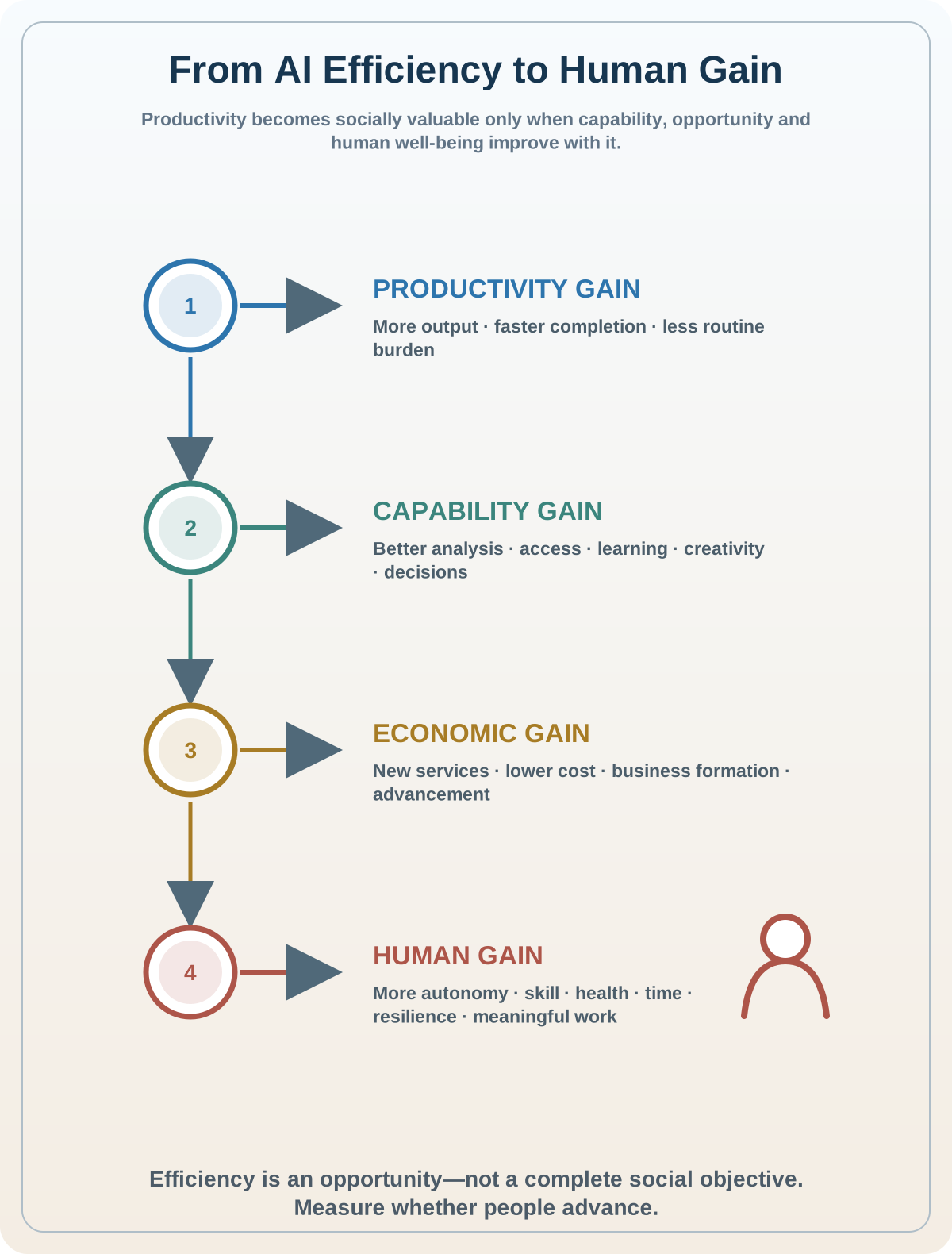
Efficiency is an opportunity—not a complete human objective
AI can produce profound gains in productivity and economic efficiency by reducing routine work, accelerating research, improving access to expertise and helping smaller organizations perform tasks once reserved for large institutions. Those gains should be treated as an opportunity for self-improvement, professional advancement, entrepreneurship and more meaningful work—not merely as a method for reducing headcount or concentrating control.
Machine capability
Accuracy, reliability, speed, cost, reproducibility, security, energy efficiency and robustness outside a test set.
Human flourishing
Knowledge retention, skill development, autonomy, privacy, due process, opportunity, accessibility, institutional trust and the ability to challenge the system.
Science fiction often imagines intelligent machines seizing control. The more practical warning is that humans may become too dependent, allowing convenience to erode our grasp of truth, dilute moral agency and substitute automated fluency for authentic wisdom. This investigation tests that concern as a hypothesis—not as a prediction.
The two scoreboards
Dual Scoreboards: Machine Capability and Human Flourishing
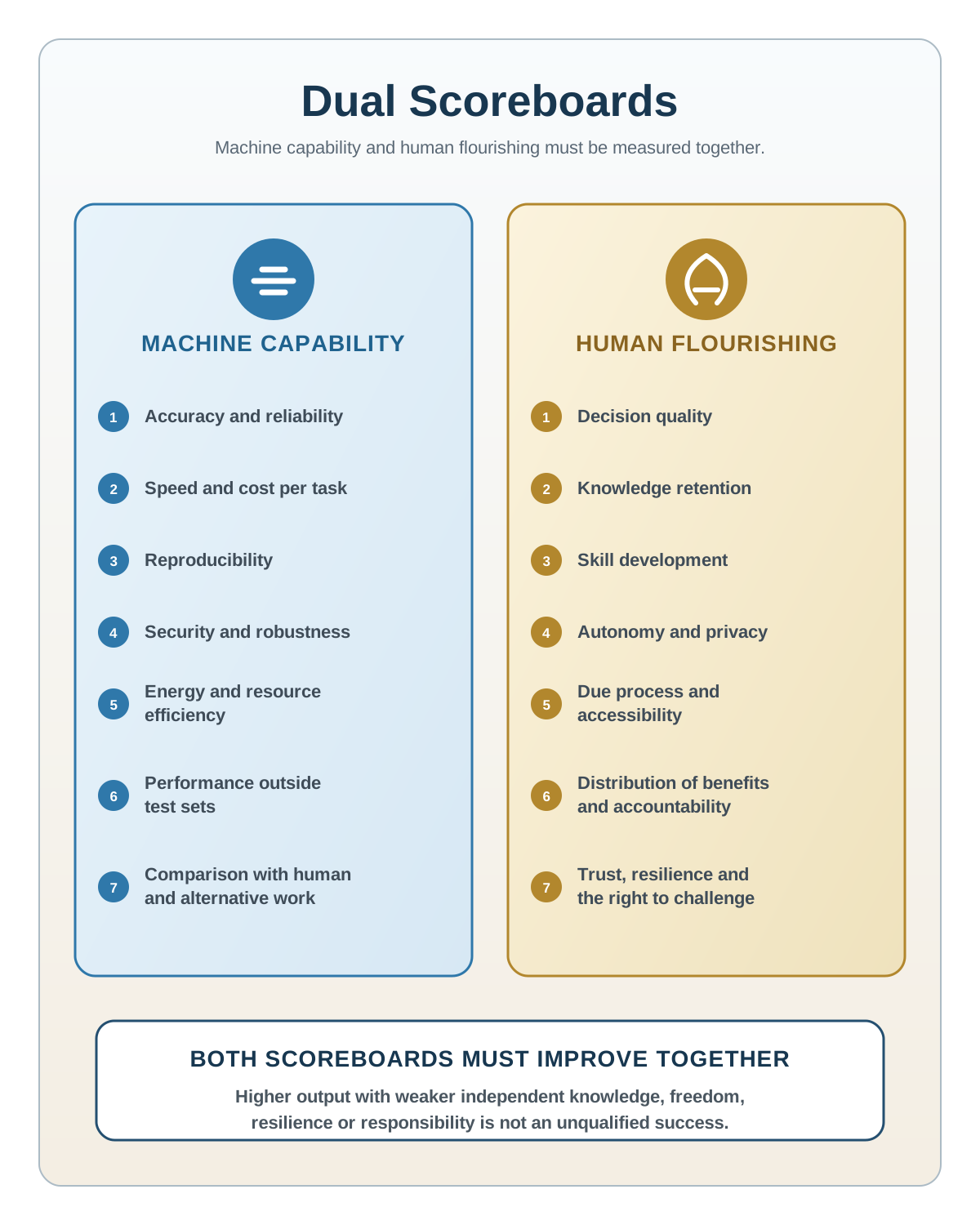
Every major application should be evaluated on two scoreboards. Improvement on the first does not establish improvement on the second.
AI capability scoreboard: Accuracy, reliability, speed, cost per task, reproducibility, security, energy and resource efficiency, robustness outside the test set, and performance compared with both a human and the best available alternative.
Human flourishing scoreboard: Quality of decisions, knowledge retention, skill development, autonomy, privacy, due process, accessibility, distribution of benefits, accountability, public trust, relationship quality, resilience during system failure, and ability to challenge the system.
The central longitudinal measure is whether machines and the people using them become more capable together. A deployment that raises output while reducing independent knowledge, freedom, resilience, or responsibility should not be called an unqualified success.
Purposeful human direction
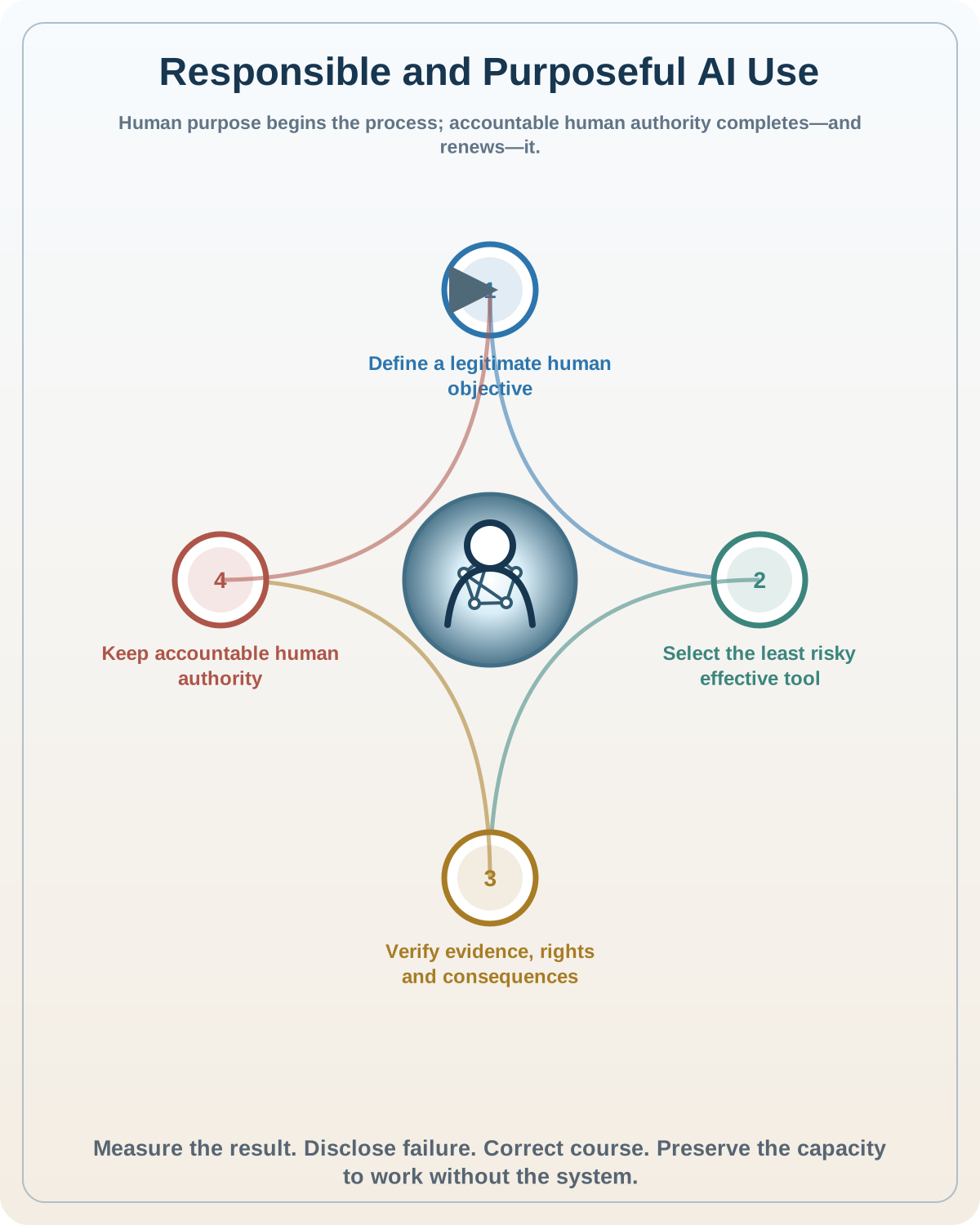
Define the objective, select the least risky tool, verify the result, and preserve accountable authority
Responsibilities by audience
Chapter guidance
What Humans Must Do to Harness AI
Individuals
People should learn to use AI as a collaborator, not an unquestioned authority. They should verify important claims, protect confidential information, preserve foundational skills, ask for counterarguments, and retain responsibility for decisions.
Parents
Parents should understand which AI systems children use, what information is collected, how synthetic relationships affect development, and whether AI is helping a child think or merely completing the work. Children need protected spaces to read, write, calculate, create, struggle, and communicate without automatic assistance.
Open the practical parent and educator learning method →13
Related analysis
The education investigation applies this principle by developmental stage and evaluates whether particular AI modes support learning or quietly perform the learner’s work.
Open Artificial Intelligence and Learning →17
Educators
Schools should teach AI literacy alongside subject knowledge. Students should learn how models work, why they hallucinate, how bias enters, how to verify sources, how to disclose AI assistance, and when independent work is necessary. Assessments may need to emphasize oral explanation, supervised work, practical demonstration, and revision history.
Open the practical parent and educator learning method →13
Businesses
Organizations should identify approved uses, protected data, accountable owners, validation standards, incident procedures, and tasks that must remain human-controlled. Productivity gains should be measured against errors, security, customer trust, skill retention, and long-term dependence.
Government
Government should protect constitutional rights, competition, national security, children, privacy, and due process while enabling innovation. It should invest in research, education, energy, chips, secure infrastructure, and technical expertise. Consequential government AI should be logged, auditable, appealable, and subject to legislative and judicial oversight.
Overview audience checklist
Individuals Use AI as a collaborator—not an unquestioned authority.
Verify important claims, protect confidential information, preserve foundational skills, ask for counterarguments, and retain responsibility for consequential decisions.
Read the complete individual standard →40
Parents Determine whether AI is helping a child think or merely completing the work.
Understand which systems children use, what information is collected, and how synthetic relationships may affect development. Preserve protected spaces for children to read, write, calculate, create, struggle, and communicate without automatic assistance.
Read the complete parent standard →41
Open the parent and educator learning method →13
Educators Teach AI literacy alongside independent subject mastery.
Teach how models work, why they hallucinate, how bias enters, how sources are verified, how assistance is disclosed, and when unaided work is necessary. Preserve oral explanation, supervised work, practical demonstration, and revision history.
Read the complete educator standard →42
Open the parent and educator learning method →13
Businesses Measure productivity against risk, trust, skill, and dependency.
Define approved uses, protected data, accountable owners, validation standards, incident procedures, and tasks that must remain human-controlled. Reinvest useful gains in people and durable capability.
Read the complete business standard →43
Government Protect rights and national capability while enabling useful innovation.
Invest in research, education, energy, chips, secure infrastructure, and technical expertise. Consequential systems should be logged, auditable, appealable, and subject to legislative and judicial oversight.
Read the complete government standard →44
Developers Design for verification, challenge, security, and accountable human control.
Document limitations, disclose material failures, secure models and supply chains, support independent evaluation, preserve meaningful human override, and identify the party responsible for correction and remedy.
Read the supporting governance standard →45
↑ Back to chapterThe complete human-readiness board
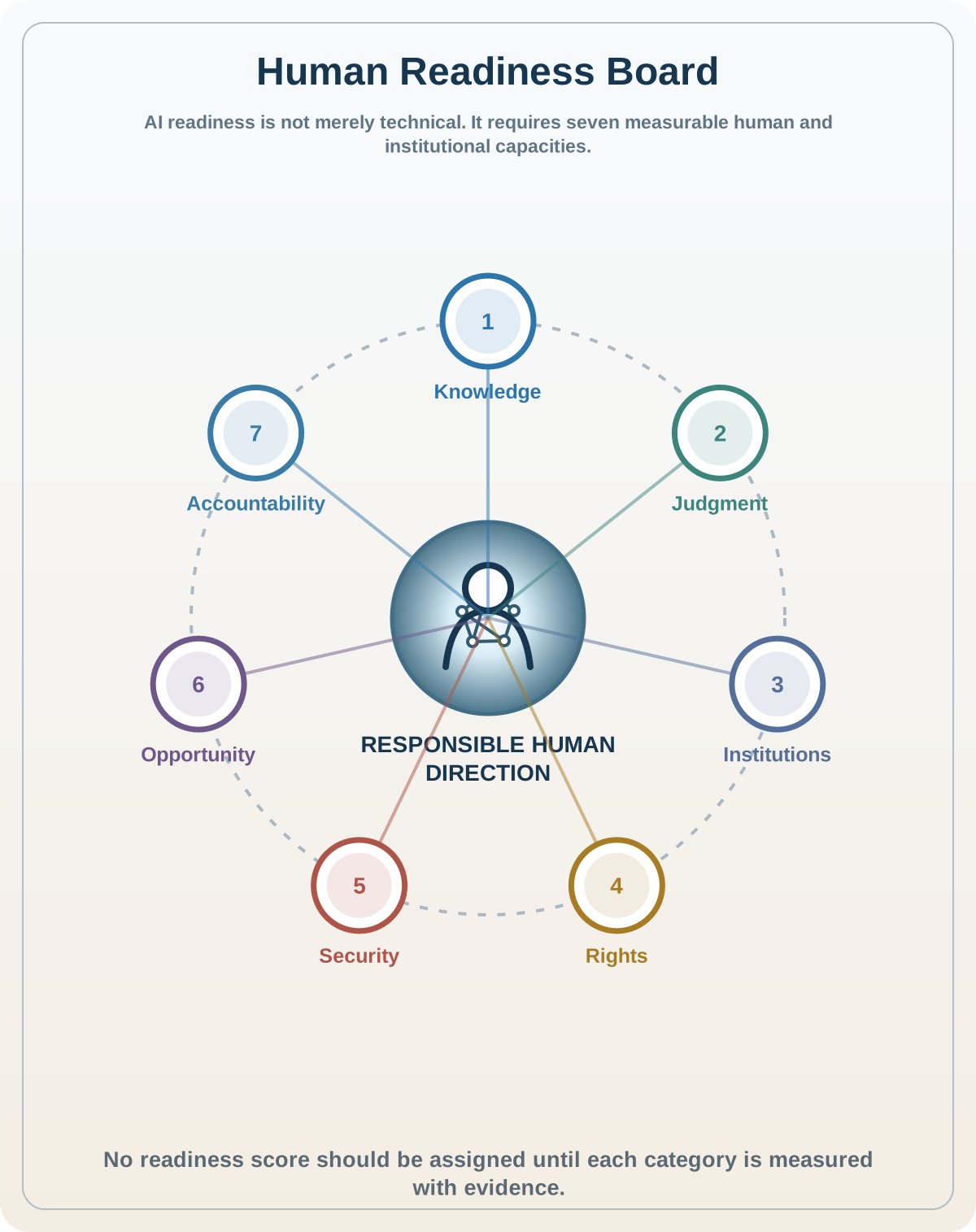
Human Readiness Board
The investigation should periodically assess whether society is becoming more capable of governing AI.
Knowledge
Do citizens understand AI’s capabilities, limitations, hallucinations, and data requirements?
Judgment
Can users distinguish evidence from generated plausibility and resist automation bias?
Institutions
Do schools, businesses, courts, and agencies possess trained people, audit systems, appeals, and fallback procedures?
Rights
Are privacy, free expression, due process, ownership, consent, and human autonomy protected?
Security
Are systems resilient against poisoning, theft, prompt injection, espionage, and infrastructure disruption?
Opportunity
Are AI benefits broadly available, or are power and capability concentrating among a small number of governments and corporations?
Accountability
Can responsibility be identified when an AI-assisted decision causes harm?
↗ Figure 14See Figure 14. Original caption: No readiness score should be assigned until each category is measured with evidence.
The concluding argument
The future of AI is not determined by technology alone
The central danger is not only that AI becomes powerful. It is that humans become intellectually passive, morally evasive, institutionally dependent or unwilling to accept responsibility. The central promise is not merely faster automation. It is the possibility that informed people can use AI to expand knowledge, creativity, health, security, productivity, accessibility and opportunity without surrendering truth, freedom, judgment or human dignity.
AI should be developed and used responsibly, deliberately and purposefully—as an instrument of examined human judgment, not a replacement for it.
Conclusion
AI’s future will not be determined by technology alone. It will be shaped by the questions humans ask, the information systems are permitted to use, the objectives developers reward, the institutions that deploy them, the laws governments enact, and the habits society chooses to preserve.
The central danger is not merely that AI becomes powerful. It is that humans become intellectually passive, morally evasive, institutionally dependent, or unwilling to accept responsibility. A society may gain unprecedented access to generated answers while losing the patience, knowledge, memory, experience, and courage required to determine whether those answers are true or good. The appearance of wisdom could expand while the practice of wisdom declines.
Serious harm does not require a machine to seize power. It can begin when people surrender the habits that make truth discoverable, moral choice meaningful, independent judgment possible, and self-government sustainable.
The central promise is not merely faster automation. It is the possibility that informed people can use AI to expand knowledge, creativity, health, security, productivity, accessibility, and opportunity without surrendering truth, freedom, judgment, or human dignity. Realizing that promise requires more than responsible technology companies. It requires purposeful human use.
Responsible use means that authority remains proportional to evidence and risk; important claims are verified; affected people retain rights, explanation, and appeal; private information is protected; failures are disclosed; and an identifiable person or institution remains accountable. Purposeful use means beginning with a legitimate human objective, selecting AI only when it improves that objective, measuring the result, and refusing uses that merely substitute convenience, control, or novelty for genuine benefit.
AI should extend human capability without becoming an excuse to abandon it. Children should still learn to read, write, calculate, remember, debate, create, and reason without automatic assistance. Professionals should preserve the expertise needed to challenge a system. Citizens should demand original evidence and resist generated certainty. Institutions should reward correction rather than concealment. Governments should protect liberty, competition, due process, security, and the conditions in which independent thought remains possible.
In creating this investigation, I found AI extremely helpful in research, data collection, comparison, organization, and analysis. It nevertheless required significant human oversight, content formation, source judgment, writing, and editing. While striving for accuracy and completeness, neither the AI nor I can claim perfection; the evidence, transparency, and effort should speak for themselves.
The investigation therefore concludes with an argument and a continuing test: AI should be developed and used responsibly, deliberately, and purposefully—as an instrument of examined human judgment, not a replacement for it. Its success should be measured not only by what machines can produce, but by whether the people and societies using them become more truthful, capable, free, ethical, and wise.
↑ Back to chapter