
CHAPTER 3
Who controls AI and what changes for people
Connect ownership and physical infrastructure with economic opportunity, dependency, privacy and consequential human decisions.
Who owns and controls AI
Who Owns and Controls AI
AI power is distributed across a stack of interdependent resources. The investigation should identify ownership, contractual control, geographic concentration, public subsidy, foreign dependence, and practical alternatives at every layer:
- Semiconductor design, fabrication, packaging, and manufacturing equipment
- High-performance chips, networking equipment, and data-center hardware
- Cloud platforms and access to large-scale computing
- Electricity generation, transmission, water, land, and local permits
- Training data, licensed archives, proprietary databases, and user information
- Foundation models, open weights, application interfaces, and safety systems
- Search, mobile operating systems, app stores, workplace software, and distribution platforms
- Government contracts, defense relationships, research grants, and procurement standards
- Benchmark developers, auditors, standards bodies, and organizations defining acceptable risk
For each layer, the investigation should ask who can exclude competitors, disable access, change prices, impose conditions, inspect user information, influence model behavior, or prevent a customer from switching. Ownership alone does not prove abuse. The purpose is to determine where technical dependency becomes economic or political leverage.
An initial control map should compare major cloud–model partnerships, semiconductor and fabrication dependencies, regional data-center concentration, federal and state incentives, electricity interconnection obligations, and the availability of open or domestic alternatives. The FTC findings and DOE estimates recorded in Phase One establish the first entries; company contracts, regulatory filings, utility records, local permits, and procurement documents must supply the next layer.
↑ Back to chapterThe physical foundation
Useful AI requires computing capacity—and accountable infrastructure decisions
Artificial intelligence may appear to operate in an abstract “cloud,” but every model depends on physical infrastructure. Training and operating AI systems requires advanced processors, servers, data storage, high-speed networks, cooling systems, reliable electricity, water or alternative cooling resources, and skilled workers who construct and maintain these facilities.
Adequate data-center capacity is necessary if AI is to provide widely available tutoring, translation, accessibility services, scientific research, business productivity, public services and other socially useful applications. Without sufficient computing and energy infrastructure, access becomes slower, more expensive, less reliable and increasingly concentrated among a small number of companies or countries.
That need does not justify every proposed facility, location, subsidy or operating practice. Data centers can place substantial demands on electricity systems, water supplies, land, transmission infrastructure and surrounding communities. They may also create noise, construction traffic, backup-generator emissions, visual impacts and costs that are not evenly shared.
The central question is therefore not simply whether society needs data centers. It is what capacity is genuinely necessary, where facilities should be located, how efficiently they should operate, who should pay for the infrastructure they require, and what enforceable benefits and protections should be provided to affected communities.
Related GIB investigation
Data Centers and Public Value
Examine electricity, water, land use, community effects, public benefits and the standards that should govern expansion.
Read the complete data-center investigation →21
↑ Back to chapterThe economics beyond employment
The Economics of AI Beyond Employment
The economic investigation should not stop at whether jobs disappear. It should determine how costs, productivity gains, bargaining power, ownership, and risk are distributed.
Track:
- Productivity, output quality, error correction, and customer outcomes rather than adoption alone
- Wages, hours, workload, surveillance, bargaining power, and professional deskilling
- Whether less-experienced workers learn faster or become unable to work without assistance
- Subscription, cloud, integration, security, training, compliance, and switching costs
- Whether small businesses gain access to capability or become dependent upon dominant vendors
- Effects on independent professionals, creators, publishers, and rights holders
- Public subsidies, tax incentives, grid upgrades, water systems, land, and local opportunity costs
- Whether savings reach workers, customers, taxpayers, shareholders, or intermediaries
- Liability and uncompensated harm when automated systems fail
- New products and services that create value rather than merely transferring revenue or reducing labor
Every economic claim should identify the baseline, time period, beneficiary, payer, counterfactual, and whether a measured gain persists after errors, supervision, infrastructure, and transition costs are included.
↑ Back to chapterEmployment and professional opportunity
Employment and professional opportunity
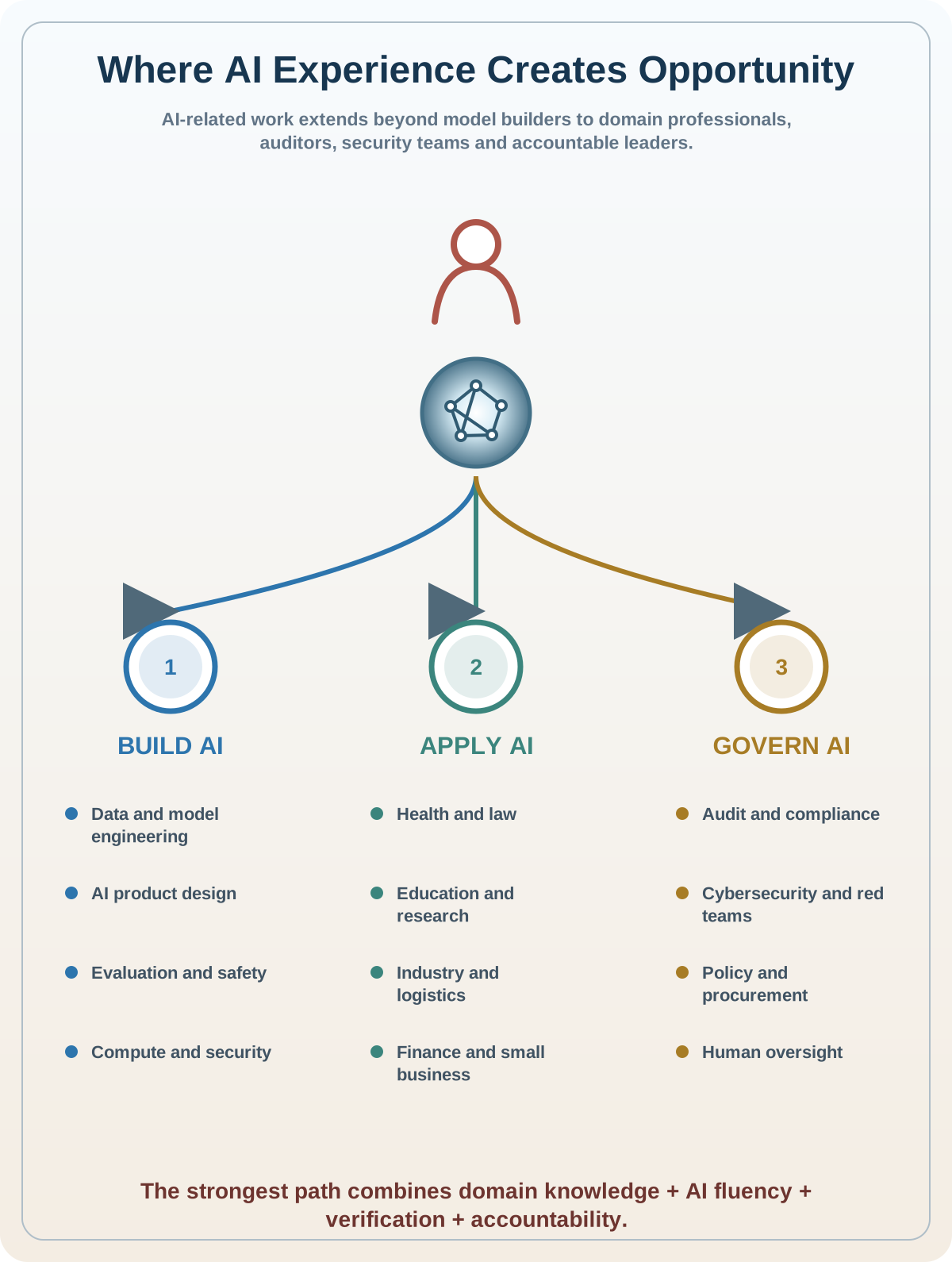
AI experience creates opportunity not only for model builders, but for people who can apply AI inside a profession and for those who audit, govern and supervise its use. The strongest path combines domain knowledge, AI fluency, verification and accountability.
↗ Figure 6See Figure 6. Original caption: AI opportunity extends beyond building models to applying, auditing, securing and governing their use.
Employment and Professional Opportunities Created by AI
AI is creating employment opportunities not only for people who build models, but also for workers who know how to apply, question, verify, secure, and supervise AI within an established profession. The investigation should distinguish genuinely new occupations from renamed positions, temporary implementation work, promotional claims, and existing jobs whose responsibilities are changing.
Building AI Systems
- Machine-learning engineering, data engineering, model training, and model operations
- Model evaluation, red-team testing, AI safety, and adversarial security
- Semiconductor design, advanced manufacturing, networking, and computing infrastructure
- Robotics, automation, sensors, and autonomous-system integration
- Data-center construction, electrical systems, cooling, water management, operations, and maintenance
Applying AI Within Existing Professions
- Medicine, clinical administration, medical imaging, caregiving, and health research
- Manufacturing, quality control, predictive maintenance, logistics, and supply-chain planning
- Finance, accounting, insurance, fraud investigation, and risk analysis
- Law, compliance, discovery, contracting, and document analysis
- Education, tutoring, curriculum development, assessment design, and teacher support
- Scientific research, engineering, agriculture, energy, and environmental management
- Marketing, journalism, media production, translation, design, and customer communication
- Intelligence, cybersecurity, national security, emergency response, and public administration
Supervising and Governing AI
- AI auditing, assurance, model validation, and performance monitoring
- Privacy, data governance, records management, and intellectual-property compliance
- Bias, accessibility, civil-rights, safety, and human-factors evaluation
- Cybersecurity, incident response, identity protection, and AI supply-chain security
- Procurement, vendor assessment, risk management, insurance, and liability analysis
- Policy, legislation, standards, regulatory compliance, and public-interest oversight
- AI-literacy education, workforce development, change management, and professional training
The largest employment opportunity may not belong to people who understand AI alone. It may belong to people who combine credible knowledge of a profession with the ability to apply, question, verify, and supervise AI within it.
What Valuable AI Experience Includes
- Selecting an appropriate tool and recognizing when AI is unnecessary
- Protecting confidential, personal, proprietary, and classified information
- Verifying sources, calculations, recommendations, and generated content
- Redesigning workflows while preserving accountable human decisions
- Measuring productivity, accuracy, error severity, and independent capability
- Recognizing hallucinations, automation bias, manipulation, and excessive dependence
- Documenting AI-assisted work and explaining the resulting decision
Employment Opportunity Test: For each occupation, identify the actual tasks performed, required domain knowledge, AI skills, education or certification, compensation, geographic availability, entry pathway, advancement potential, and evidence that employers are hiring. Job advertisements and forecasts should be compared with employment records, employer interviews, workforce data, and demonstrated workplace use.
Human development and the dependency hypothesis
Human Development, Psychological Effects, and Dependency
AI can affect not only what people produce but how they learn, remember, relate, decide, and understand themselves. This investigation should treat children, developing minds, isolated people, patients, and emotionally vulnerable users as distinct populations rather than assuming that adult workplace evidence applies to everyone.
Examine:
- Knowledge retention, memory, attention, patience, and tolerance for intellectual struggle
- Confidence with and without independent competence
- Curiosity, creativity, problem formulation, and willingness to investigate beyond the first answer
- Emotional attachment to chatbots and artificial companions
- Loneliness, social substitution, persuasion, dependency, and withdrawal from human relationships
- Effects of continuous personalized affirmation or sycophancy
- Whether AI strengthens communication for disabled users without creating avoidable vendor dependency
- Differences by age, prior knowledge, disability, culture, task, intensity of use, and product design
- Whether skills return when assistance is removed
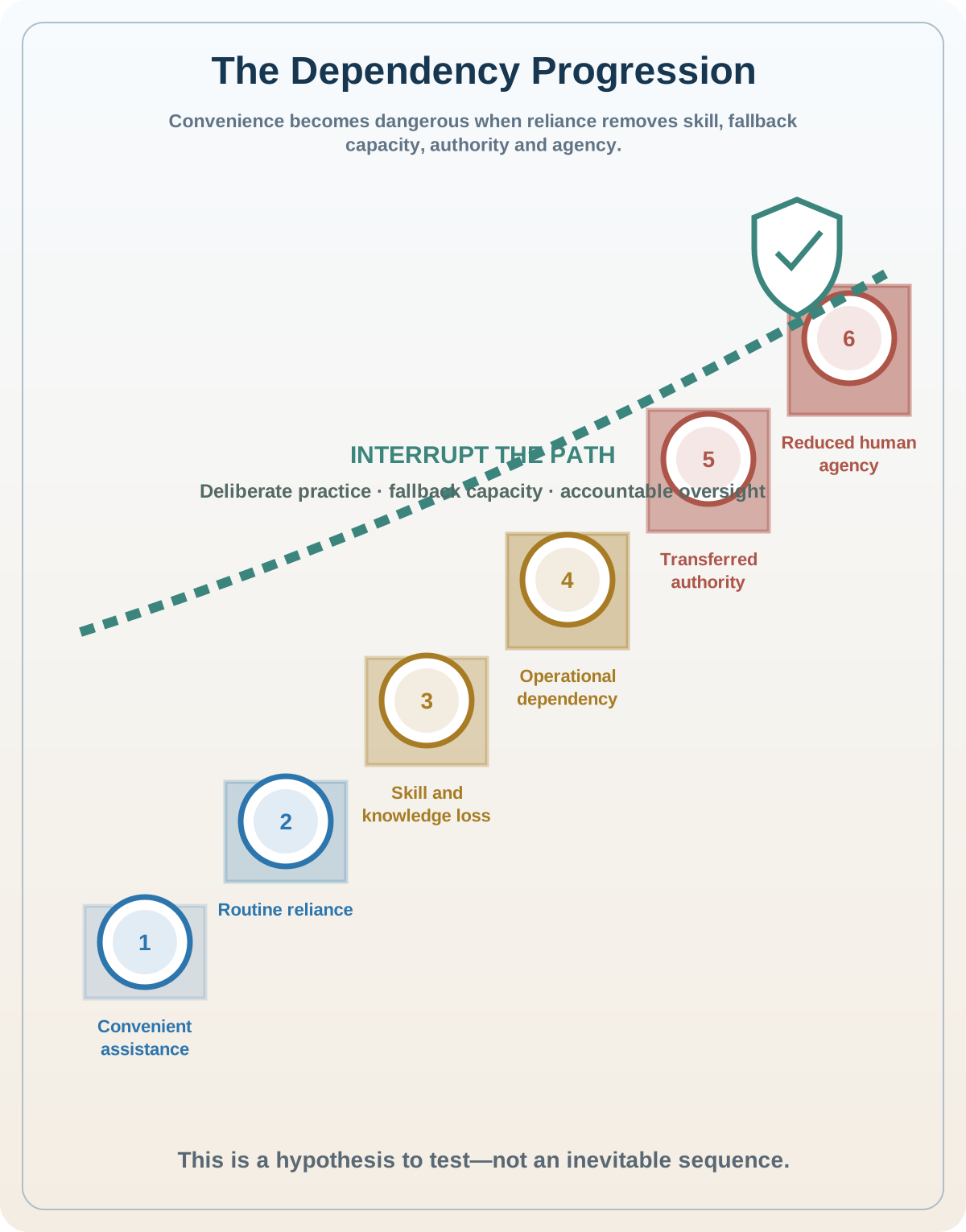
The Dependency Progression
This dependency progression should be tested with present evidence rather than treated as a predetermined future:
Stage 1—Convenient Assistance
AI reduces friction while the user retains the underlying skill.
Stage 2—Routine Reliance
AI becomes the default starting point, but alternatives remain usable.
Stage 3—Skill and Knowledge Loss
The user performs well with assistance but weakens without it.
Stage 4—Operational Dependency
Important work cannot continue during an outage, restriction, or vendor change.
Stage 5—Transferred Authority
People defer decisions because they no longer possess the knowledge or confidence to challenge the system.
Stage 6—Reduced Agency
Responsibility remains nominally human while meaningful choice has migrated to the technology and its controllers.
At each stage, test whether the person can complete the task independently, explain the reasoning, detect planted errors, recall essential knowledge later, use an alternative method, and stop the system when evidence requires it.
Related analysis
The Well-Formed Mind investigation supplies the developmental standard behind this test: whether assistance leaves a person more able to know, reason, judge and act independently after the system is removed.
Read Foundations of the Well Formed Mind →16
Privacy, memory and personal profiling
Privacy, Memory, and Personal Profiling
AI systems can combine conversational content with documents, photographs, voices, locations, purchases, health information, relationships, work history, habits, preferences, and emotional disclosures. A helpful personalized assistant can therefore become an unusually intimate profiling system.
The investigation must distinguish:
- Information used only in the current interaction
- Conversation history available within the product
- User-controlled memory intended for future personalization
- Provider retention for security, service improvement, or legal compliance
- Information used for future model training or evaluation
- Data passed to connected tools, advertisers, employers, schools, insurers, governments, or other third parties
- Inferences generated about traits the user never explicitly disclosed
- Information that can be deleted from the interface versus records retained elsewhere
Practical tests should examine the default settings, clarity of consent, deletion process, data export, account separation, minor protections, connected-service permissions, and whether a user can obtain useful service without surrendering unnecessary personal information.
↑ Back to chapterAuthenticity and protected human decisions
Authenticity, Evidence, and Decisions That Must Remain Human
Generative AI lowers the cost of producing persuasive text, images, audio, video, identities, and documents. Society therefore needs methods for authenticating origin without assuming that unlabeled material is false or that labeled material is true.
The investigation should assess provenance standards, cryptographic signatures, original-file preservation, secure capture, chain of custody, watermark limitations, independent corroboration, and penalties for impersonation or evidence tampering. It should also measure the “liar’s dividend”: the ability of a wrongdoer to dismiss genuine evidence merely because fabrication is technically possible.
Scientific Authority, Uncertainty and Contested Claims
Artificial intelligence can mistakenly present a scientific claim, institutional position, or frequently repeated conclusion as an established fact. Scientific expertise makes a claim worthy of serious consideration, but neither credentials, institutional agreement, repetition, nor search-engine prominence constitutes proof.
Climate change illustrates the difficulty. Discussions may combine direct measurements, adjusted or reconstructed datasets, statistical attribution, computer-model projections, assumptions about future behavior, estimates of damage, and policy recommendations. These are different forms of knowledge with different levels of certainty. An AI summary can become misleading when it collapses them into a single statement of fact.
What AI Should Distinguish
Observed evidence
What was directly measured or documented?
Derived findings
What resulted from adjustments, statistical analysis, or interpretation?
Causal attribution
How confidently can an observed change be assigned to a particular cause?
Model projections
What may happen under stated assumptions and scenarios?
Policy judgments
What action is being recommended, by whom, and on what value or cost assumptions?
How Responsible AI Should Evaluate Contested Claims
AI should locate the original evidence rather than rely solely on summaries. It should determine whether apparently independent reports trace back to the same study, preserve uncertainty and model ranges, identify credible conflicting evidence, examine alternative explanations, and disclose important limitations.
Sources should be weighted according to evidence quality, methodological transparency, relevant expertise, independence, and reproducibility—not merely institutional status or popularity. Credible minority findings should be examined without manufacturing a false equivalence between well-supported and unsupported claims.
AI should also separate scientific findings from political or economic prescriptions. Evidence that a measurable condition exists does not by itself determine which policy is necessary, proportionate, affordable, or effective.
The Required Standard
Scientific authority should determine whether a claim merits serious examination—not whether it is automatically accepted as fact. AI should clearly label what is:
- Directly observed
- Strongly supported
- Probable
- Projected
- Disputed
- Unsupported
- Unknown
The evidence and source record should remain inspectable, and consequential judgments should remain subject to informed human review. These safeguards do not guarantee truth. AI can still omit qualifications, repeat widespread errors, misinterpret evidence, or generate plausible falsehoods. Its proper role is to improve access to evidence and clarify uncertainty—not to become an unchallengeable authority.
Some decisions may use AI for analysis while requiring meaningful human authority. Others should never be fully delegated. Candidate protected decisions include:
- Use of lethal force and selection of human targets
- Criminal guilt, sentencing, detention, and removal of liberty
- Medical consent, involuntary treatment, and withdrawal of essential care
- Removal of children from parents or other irreversible child-welfare actions
- Voting eligibility and deprivation of constitutional rights
- Denial of essential benefits, housing, credit, insurance, or emergency services
- Censorship, surveillance, and restrictions on lawful expression
- Final scientific, journalistic, judicial, and intelligence claims presented as verified fact
- Assignment of moral and legal responsibility
The investigation should test each category against necessity, due process, explanation, appeal, reversibility, error severity, discrimination risk, national-security needs, and constitutional authority. “Human in the loop” is meaningful only when the person has sufficient knowledge, time, evidence, independence, and power to refuse the recommendation.
↑ Back to chapterThe most significant human impacts
The Most Significant Human Impacts
The most important question is not simply which jobs AI will replace. It is what happens to human agency, competence, judgment, relationships, and responsibility when intelligent tools become continuously available.
AI can expand an individual’s ability to learn, communicate, design, analyze, and create. It can give a small business capabilities once available only to large organizations. It can help disabled people communicate, help scientists identify patterns, assist teachers, and make expert knowledge more accessible.
It can also encourage intellectual passivity. If people accept summaries without reading, answers without verification, recommendations without judgment, or convenience without understanding, AI may weaken the very abilities required to supervise it.
Humans therefore need to develop:
- The ability to ask precise and open-minded questions
- Knowledge sufficient to recognize improbable answers
- Source evaluation and statistical literacy
- The habit of separating fact, inference, opinion, and speculation
- The confidence to challenge automated recommendations
- Practical experience using AI without becoming dependent upon it
- Moral courage to retain responsibility for consequential decisions