Permanent investigation / Energy, affordability and national capacity
Nuclear Got A Bad Wrap?
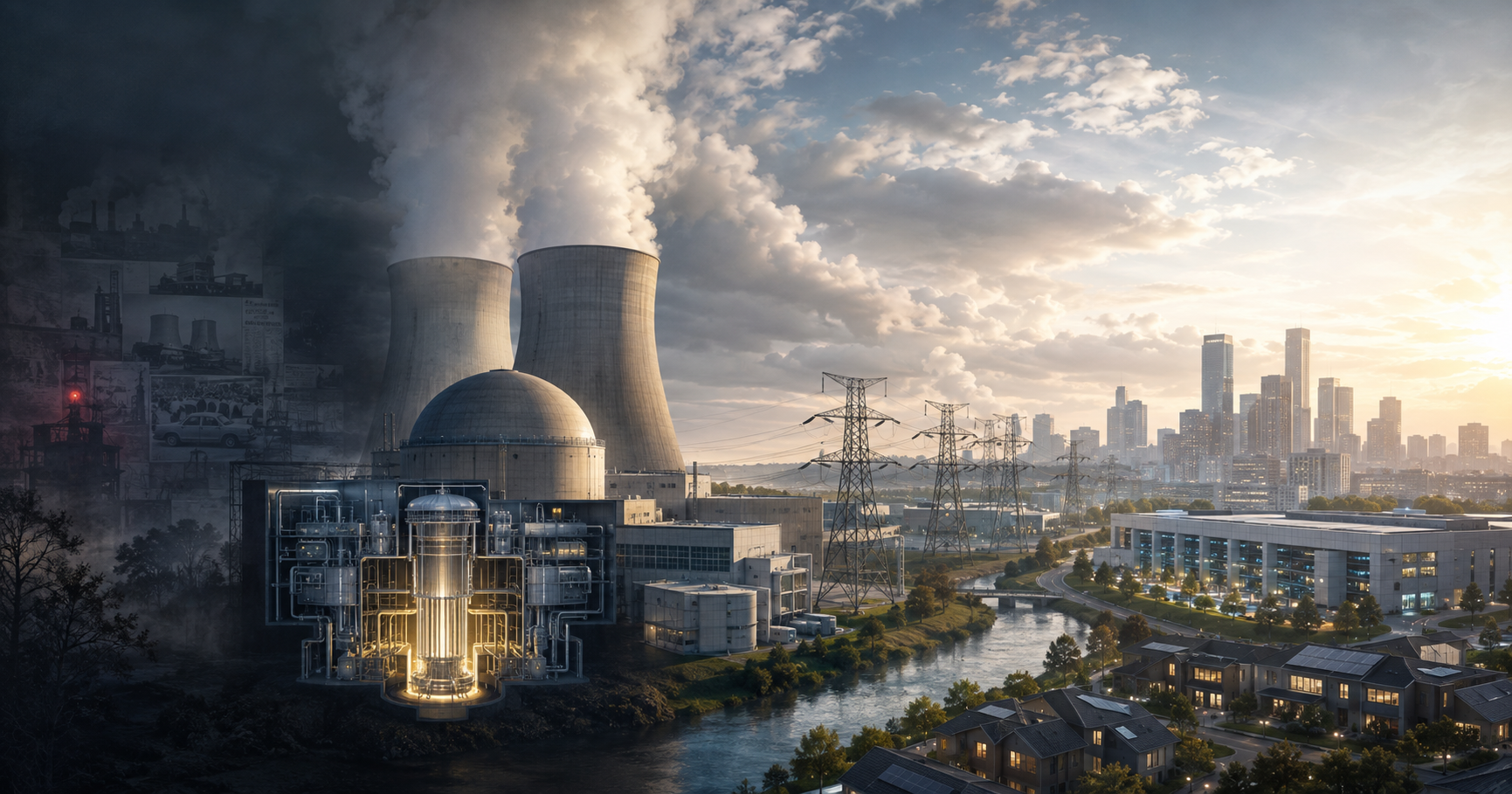
Project, Research, Analysis, Editorial by Patrick Russell; assisted by ChatGPT (OpenAI).
For decades, Americans were taught to see nuclear power primarily through catastrophe, radiation and waste. This investigation asks a harder consumer question: did the fear grow out of proportion to the demonstrated risk—and can a renewed nuclear industry finally deliver dependable electricity at a price people can afford?
· Original investigation evidence cutoff September 1, 2026 · Waste-policy update September 29, 2026
The question this investigation answers
How does nuclear power’s reputation compare with demonstrated risk, and can renewed deployment deliver reliable electricity at competitive total-system cost?
Distinct finding and connected evidence
- What this investigation adds
- A generation-specific comparison of safety, licensing, waste, financing, schedules, reliability and delivered consumer cost.
- Evidence assessed here
- Operating and licensing records, health research, lifecycle cost, utility proceedings and project delivery. A permit, prototype or proposed reactor is not operating generation.
- Next evidence test
- Compare preservation, uprates, restarts and new builds against feasible alternatives on consistent cost, reliability, schedule and risk assumptions.
- Data Centers
Assesses the load and local contract; this investigation establishes the generation option’s safety, delivery and economics.
- U.S. Economy
Assesses national economic effects; this investigation supplies delivered electricity and generation-cost evidence.
Executive verdict
Nuclear got a bad wrap—but nuclear does not get a free pass.
The evidence indicates that nuclear power acquired a public reputation for danger that, in important respects, became disproportionate to its demonstrated risks. Fear, sensational coverage, activism and political intervention contributed to America's retreat, although genuine construction failures, financing problems, utility decisions, regulatory complexity and changing electricity demand were also decisive.
Existing nuclear is unusually valuable
Preservation, safe uprates and economically justified restarts can retain firm output without repeating the full risk of a first-of-a-kind build.
Safety improved; risk did not disappear
Modern systems reduce the probability and consequences of severe accidents. They do not eliminate operational, security, waste or emergency-planning obligations.
SMRs are not yet a cost solution
Factory repetition may lower cost, but the United States has not yet demonstrated a commercial SMR fleet built repeatedly on schedule.
Consumers need delivered performance
Licenses, announcements and prototypes matter. The renaissance is proved only by reliable electricity at a competitive total-system cost.
01 / Why nuclear, why now?
America's electricity problem changed.
For years, flat electricity demand made large, slow power projects difficult to justify. That assumption no longer holds. Data centers, AI, advanced manufacturing, electrification, defense production and aging grid assets are creating a need for new generation that is not merely abundant, but available when demanded.
Nuclear's strongest case is not that every megawatt should be nuclear. It is that a system exposed to weather, fuel prices, transmission limits and rapidly growing round-the-clock loads gains value from a high-capacity-factor source with a small land footprint and low operating emissions. The competing question is whether that value exceeds nuclear's capital, schedule, water, waste and institutional costs.
Related GIB InvestigationData Centers: Infrastructure, Power, Water, and Public Value
Examine the AI and data-center demand behind the power question—including grid capacity, water, local effects, ratepayer exposure and the public-value test.
Read the data-centers investigation →Related GIB InvestigationAmerica Reloaded
Place civilian nuclear deployment beside deterrence, nuclear-enterprise modernization, industrial capacity and the broader test of American strategic endurance.
Read the nuclear-shield analysis →Related GIB InvestigationAI for Human Flourishing
Examine whether reliable energy and AI capacity translate into demonstrated human benefit.
Read the human-benefit investigation →02 / How America learned to fear nuclear
Three accidents became one public story.
Three Mile Island
A partial core melt, confusing official communication and intense television coverage fixed the image of an invisible domestic catastrophe. The plant failure was serious; the expected mass public-health toll did not appear.
Chernobyl
An unsafe Soviet reactor design, reckless test and inadequate containment produced an explosion, fire, acute radiation deaths, large contamination and lasting disease. The event was real evidence of catastrophic nuclear failure—but was often generalized to unlike reactor designs.
Fukushima Daiichi
An extreme earthquake and tsunami disabled power and cooling, producing meltdowns and releases. No acute radiation deaths occurred, but evacuation, displacement, cleanup and economic disruption were severe. The lesson is both technical and institutional: low-probability hazards still require credible defense in depth.
Cost of fear: Public reaction did not operate alone. But when orders stopped, specialized suppliers disappeared, experienced teams dispersed and every new project became an expensive first-of-a-kind undertaking. Fear and construction cost reinforced each other.
03 / Fear vs. evidence
Observed deaths, projected risk and non-radiological harm must not be mixed.
Radiation can injure and kill. The error is not taking it seriously; the error is treating every exposure, modeled projection, evacuation death, industrial injury and observed radiation fatality as the same measurement.
A reactor can explode like a nuclear bomb
FalseCommercial power-reactor fuel and geometry cannot produce a weapon-style detonation. Severe accidents can still cause steam, hydrogen or chemical explosions and radioactive releases.
Three Mile Island caused a public radiation death toll
Not supportedThe reactor was badly damaged, but the NRC's public-health assessment found very small off-site doses and no detectable health effects attributable to the accident.
Chernobyl proves every reactor has the same failure mode
False equivalenceChernobyl's RBMK design, positive void coefficient, disabled protections and lack of a Western-style containment were central. Its acute radiation deaths were real; its design and operating context are not interchangeable with U.S. light-water reactors.
Fukushima radiation killed thousands
False as statedThe earthquake and tsunami killed thousands. WHO reports no acute radiation injuries or deaths among workers or the public; evacuation and disruption produced serious non-radiological harms.
No radiation dose is ever safe
Needs contextHigh doses clearly cause harm. At low doses, risk is estimated with uncertainty; protection standards deliberately limit exposure, but a modeled statistical risk is not an observed casualty count.
Spent fuel is useless waste
FalseUsed fuel remains highly radioactive and requires isolation, but DOE says more than 90% of its potential energy remains. Recycling can recover material; it does not remove the need for safeguards and final disposal.
Evidence boundary: UNSCEAR reports 28 Chernobyl workers died within three months from acute radiation effects; longer-term thyroid cancers and modeled excess cancers require separate treatment. For Fukushima, WHO and UNSCEAR report no acute radiation deaths and no documented resident health effects directly attributable to radiation, while recognizing uncertainty and the need for continued monitoring.
04 / How nuclear actually works
A nuclear plant is a heat source connected to a steam plant.
Neutrons split certain heavy nuclei, releasing heat and more neutrons. Control rods, coolant, geometry and engineered safety systems regulate the chain reaction. Enrichment increases the share of uranium-235 in fuel; ordinary reactor fuel remains far below weapons enrichment. Most U.S. plants use water as coolant and moderator. Advanced designs change the coolant, pressure, temperature, fuel form or scale—but they still must remove decay heat after shutdown.
05 / Is today's nuclear different?
Some improvements are operating facts; others remain promises.
Operating fleet
94 U.S. reactors, mostly pressurized- and boiling-water designs. High capacity factor and extensive operating record; aging components, maintenance, security and economics remain plant-specific.
Large Gen III+
Passive-safety systems and standardized designs improve the safety case. Vogtle 3 and 4 proved the design can operate—but also exposed enormous U.S. construction, supply-chain and financing failures.
Light-water SMRs
Smaller modules seek factory repetition and lower single-project risk. NuScale has NRC design approval; no U.S. commercial SMR fleet yet demonstrates the promised schedule or cost.
Advanced reactors
Sodium, gas and salt-cooled systems may use lower pressure, passive heat removal or high-temperature output. TerraPower and Kairos have permits; commercial economics and repeatability remain unproved.
Microreactors
Potential uses include remote industry, military sites and resilient microgrids. The value proposition depends on fuel, security, staffing, transport and a customer willing to pay more for firm local power.
Fusion
Fusion progress is important but should not be counted as dependable generation for near-term grid planning.
06 / The fuel race
Reactors without a fuel supply chain are announcements, not infrastructure.
Today's fleet: LEU
Most U.S. light-water reactors use low-enriched uranium. Conversion, enrichment and fuel fabrication are strategic industrial capabilities; dependence on Russian-linked supply became a national-security vulnerability.
Advanced fleet: HALEU
Many advanced designs require high-assay low-enriched uranium. DOE allocations, pilot fuel lines and new enrichment contracts address the bottleneck, but commercial volume, price and transport remain unresolved.
Thorium
Thorium can breed fissile uranium-233 and offers technical advantages in some cycles. It is not a ready substitute for an established licensing, fuel-fabrication and operating ecosystem.
Recycling
Reprocessing can recover energy-bearing material and reduce some waste volumes. It adds cost, safeguards, chemical processing and proliferation considerations and still leaves material requiring disposal.
Fuel expansion must reach qualified reactor supply
Focused connection reviewed October 10, 2026 · Original evidence dates retained
Status: Development milestones documented; delivery and cost tests remain open
The Nolan interview highlights enrichment as a potential bottleneck, while public records establish existing U.S. enrichment, new milestone-based awards and fabrication work. Nuclear Got A Bad Wrap? tests whether fuel arrives in the required form, quantity, quality and time for each reactor. Robust TRISO fuel and an approved fabrication license are meaningful milestones; they do not alone prove a reactor’s safety, delivered output or promised electricity price.
Read the primary nuclear fuel and AI power review with references
07 / The waste problem
Technically contained; politically unfinished.
Used fuel first cools in pools and can then be stored in sealed dry casks. The physical volume is small relative to the energy produced, and DOE states that more than 90% of the fuel's potential energy remains. But “small” does not mean trivial: spent fuel remains hazardous for very long periods and deserves monitored storage, transport security and a permanent disposal pathway.
The United States' central failure is not proof that safe storage is impossible. It is that the federal government has not completed the permanent-disposal system promised under the Nuclear Waste Policy Act. Any renaissance that expands fuel use without a credible repository, consent process and financing plan carries an intergenerational liability forward.
September 2026 policy test: DOE is negotiating Nuclear Lifecycle Innovation Campuses that could combine fuel production, recycling and final disposition. Six states have signed memorandums to explore the concept; these are not final host agreements. Idaho Governor Brad Little says disposal over the Eastern Snake Plain Aquifer is unacceptable and wants firm safety and funding guarantees. West Virginia Governor Patrick Morrisey has also rejected making his state a nuclear-waste dumping ground. A DOE official says host states would need to accept spent fuel from other states. The unresolved questions are where waste would go, what forms and quantities would arrive, how safety and consent would be enforced, and who would fund management over generations. DOE · Idaho interview and DOE response · Senate hearing
08 / Nuclear and water
Withdrawal is not consumption—and cooling design matters.
Nuclear, coal, gas and solar-thermal plants may use water to reject heat. Once-through systems withdraw large volumes but return most of it warmer; recirculating towers withdraw less but consume more through evaporation. Dry and hybrid cooling reduce water use at a cost in capital or efficiency, especially during heat.
A nuclear plant paired with a data center does not make the data center's water demand disappear. The correct local test measures direct cooling, power-plant cooling, watershed scarcity, peak-day demand, thermal discharge and drought performance together.
09 / Why America stopped building
No single villain explains the retreat.
- Demand and finance: slower load growth, high interest rates and cheaper gas weakened the need for large baseload projects.
- Construction: bespoke designs, mid-build changes, poor quality control and weak project management drove delay and rework.
- Regulation and litigation: evolving rules, serial proceedings and uncertainty increased financing time and risk, even when safety improvements were justified.
- Politics and activism: organized opposition increased delay, cancellation pressure and perceived risk; supporters often understated cost and waste.
- Industrial atrophy: the loss of repeated orders hollowed out suppliers, workforce and utility owner-operator capability.
10 / What did the retreat cost?
Cancellation and closure costs differ by plant—but they do not vanish.
Shoreham
A completed Long Island plant never entered commercial service after evacuation-plan conflict and political opposition. Ratepayers absorbed construction debt without receiving sustained generation.
San Onofre
Failed replacement steam generators led to retirement. California had to procure replacement capacity and resolve years of litigation and ratepayer allocation; replacement included gas generation and preferred resources.
Indian Point
The last unit closed in 2021 after 59 years. EIA documented the loss of a major downstate source; attribution of later price or emission changes must account for gas prices, weather, imports and other resource additions.
Diablo Canyon
California reversed course and authorized a limited extension through 2029–2030 amid reliability concern. The extension preserves output but carries state financing, operating-cost and prudence questions.
11 / Why America is coming back
Demand, security and industrial competition changed the calculation.
AI and data-center loads made around-the-clock power commercially valuable to technology buyers. Russia's war and fuel leverage made domestic enrichment strategic. China and Russia's reactor export programs made nuclear industrial capacity a geopolitical asset. Meanwhile, operating U.S. plants demonstrated reliability that is difficult to replace quickly.
The sequence now favored by federal policy is preservation first, uprates and restarts second, demonstrations third, then repeat commercial construction. That sequence can produce power sooner—but only if safety review remains technically independent and consumer risk is not hidden inside subsidies or utility rates.
12 / Trump administration and DOE deployment strategy
The target is 400 GW by 2050. The evidence test begins long before then.
President Trump's May 2025 orders directed regulatory reform, DOE reactor testing, national-security deployment and rebuilding of the nuclear industrial base. DOE subsequently launched reactor and fuel-line pilot programs, expanded HALEU allocations, announced $2.7 billion for enrichment, supported restarts, created UPRISE for uprates, selected federal sites and backed SMR and large-reactor deployment.
DOE's proposed fuel-cycle campuses add a waste-management pathway to that strategy. Their progress now depends on negotiated host agreements, state consent, site-specific safety review, congressional authority and durable funding. See the September 2026 waste-policy update.
Existing fleet
License renewal, operating performance and economics; avoid preventable loss of proven output.
UPRISE
DOE aims for 2.5 GW of uprates by 2027 and 5 GW by 2029, using existing sites and infrastructure.
Closed plants
Palisades and Crane are the leading cases. Restart still requires plant-specific safety, equipment and licensing proof.
DOE pilots
Faster federal authorization can create operating data; commercial NRC deployment remains a separate threshold.
Domestic supply
LEU, HALEU, transport and fabrication programs address dependence and advanced-reactor bottlenecks.
10 large reactors
DOE announced supply-chain financing intended to support ten large reactors. Orders, sites, customers and risk allocation must become public and enforceable.
GIB assessment: The strategy is materially more complete than a research-only program because it addresses fleet, fuel, sites, financing and licensing together. It is not yet evidence that 400 GW is achievable, affordable or compatible with an independent safety regulator.
13 / Who is building the future?
Company and project scorecards
Tickers identify publicly traded exposure; they are not investment recommendations. Company schedules and economic claims remain claims until verified by licenses, contracts, construction records and delivered electricity.
ConstellationCEG · NasdaqCrane restart · 835 MWAdvanced execution
Company targets 2027; NRC approval remains required
Microsoft PPA; $1B DOE loan closed
TerraPowerPrivateNatrium · 345 MW plus storagePermitted, unproved commercially
NRC construction permit issued March 2026; operating license still required
Utility/customer structure and federal support; first power target remains a company schedule
X-energyPrivateLong Mott Xe-100 · four-module 320 MWActive licensing
NRC construction-permit review in progress
Dow industrial site; DOE demonstration support
TVA / GE HitachiFederal utility / GE private subsidiaryClinch River BWRX-300 · 300 MWActive licensing
NRC construction-permit review in progress
TVA applicant; DOE SMR support
Kairos PowerPrivateHermes 1 and Hermes 2 · up to 50 MW for Hermes 2Demonstration construction
Construction permits issued; Hermes 1 construction underway
TVA PPA for Google load; DOE ARDP support
OkloOKLO · NYSEAurora-INL · up to 75 MW classPre-commercial
DOE pilot milestones; NRC pre-application work continues after a 2022 denial without prejudice
INL site/fuel access; customer announcements are not operating revenue
NuScale PowerSMR · NYSE77-MW module / RoPower six-module conceptLicensed design, project risk
NRC standard design approval; no U.S. plant license or operating module
Romania FEED and supply-chain work
HoltecPrivatePalisades restart and SMR-300Restart ahead of new-build
Restart licensing in progress; SMR-300 remains pre-application
DOE financing and utility/offtake arrangements
Tap a company to view licensing, schedule, customer and financing details.
14 / Can America build it?
Vogtle's lesson is repetition—or failure.
Vogtle 3 and 4 are both a technical success and a project-delivery warning. The AP1000 units entered service, but years of delay, contractor collapse, incomplete designs, rework and supply-chain weakness helped raise total cost to roughly $30 billion according to GAO.
What must change
Complete design before nuclear construction; standardize; retain the same teams; order long-lead components; align contracts with controllable risk; build workforce and suppliers before the order wave.
What must be measured
Overnight cost, financing cost, labor hours, rework, schedule variance, module throughput, inspection findings, commissioning performance and the cost of the second through tenth unit—not a promotional first-unit target.
15 / Will nuclear lower my bill?
Maybe—but “cheap fuel” is not a retail-price guarantee.
A household bill includes generation, transmission, distribution, reserves, financing, taxes, utility returns and policy charges. Existing nuclear plants can provide high-value output at relatively stable fuel cost. A badly executed new reactor can burden customers for decades before—or even without—producing power.
Consumer protection test: Publish the contract price, escalation, capacity commitment, completion guarantee, cancellation liability, tax support, decommissioning and waste funding, transmission cost and who pays if the project is late or unused.
16 / Can America do it without nuclear?
Nuclear-Light vs. Nuclear-Heavy America
This is a system comparison, not a claim that only two grids are possible. Both pathways can combine many resources. The fair test requires identical electricity demand, reliability, weather years, reserve margin, fuel-security stress, transmission constraints and emissions limits.
Preserve less; build little
Requires more gas capacity and fuel infrastructure, renewable overbuilding, storage, transmission, demand flexibility or some combination. It may deploy faster in many regions but is more exposed to fuel price, weather correlation, land and network expansion.
- Lower nuclear construction exposure
- Higher dependence on substitute infrastructure
- Reliability depends on firming details
Preserve, uprate, restart and build
Reduces fuel-price and weather exposure and uses less land per unit of output, but requires large capital commitments, disciplined serial construction, fuel-cycle growth, cooling and long-term waste institutions.
- More firm, high-capacity-factor supply
- Higher project and financing concentration
- Success depends on repeat build performance
Finding: The evidence does not establish that America cannot meet demand without substantial nuclear power. It establishes that doing so requires substantially greater reliance on some combination of natural gas, renewable overbuilding, storage, transmission, demand response and supporting infrastructure.
17 / America vs. the world
The transferable lesson is a building system, not a flag.
China
Large state-backed program, serial orders, growing supply chain and multiple designs. Speed does not remove financing opacity or the need for independent safety evidence.
South Korea
Standardized designs, experienced teams and export discipline demonstrate the value of repetition and an integrated industrial program.
France
A standardized historical fleet produced low-carbon electricity; aging-fleet outages and Flamanville delays show that past scale does not guarantee current construction performance.
Canada
Refurbishments and Ontario's BWRX-300 program test whether experienced operators and sequenced orders can control risk.
Japan
Restarts after Fukushima show the importance of upgraded hazard protection, regulatory legitimacy and public consent.
Russia
Integrated state finance, fuel and reactor exports create geopolitical leverage—one reason U.S. fuel and export capacity now matter strategically.
18 / Promises vs. reality
Preserve the original promise. Record the delivered result.
Vogtle 3 & 4
Delivered power; failed original cost and schedule test- Original promise
- Two AP1000 units; Georgia Power share certified at $6.114B; expected service around 2016–2017
- Observed reality
- Units entered service in 2023 and 2024; GAO reports roughly $30B total project cost
V.C. Summer 2 & 3
Cancellation / no electricity- Original promise
- Two AP1000 units intended to supply South Carolina
- Observed reality
- Construction abandoned in 2017 after billions spent
NuScale UAMPS CFPP
Cancelled; design work retained- Original promise
- First U.S. multi-module SMR project, originally promoted for 2020s operation
- Observed reality
- Terminated in 2023 after projected costs rose and subscription was insufficient
Crane restart
Active—promise not yet delivered- Original promise
- 835 MW restart, originally announced for 2028 and later accelerated
- Observed reality
- Company currently targets 2027; regulatory work and construction continue
TerraPower Natrium
Major licensing milestone; cost/date unproved- Original promise
- Commercial advanced reactor in Wyoming with company schedule for early 2030s
- Observed reality
- Construction permit issued; nuclear-island construction and operating authorization remain
Kairos Hermes
Active demonstration- Original promise
- Low-power demonstration targeted for 2027
- Observed reality
- Nuclear construction began in 2025; no operating result yet
Grades: A = delivered, cancelled or otherwise established by definitive records. C = active and unresolved. A licensing milestone is not graded as first power; a corporate target is not graded as a completed schedule.
19 / Final verdict
Nuclear got a bad wrap—but nuclear does not get a free pass.
The evidence indicates that nuclear power acquired a public reputation for danger that, in important respects, became disproportionate to its demonstrated risks. Fear, sensational coverage, activism and political intervention contributed to America's retreat from nuclear power, although genuine construction failures, financing problems, utility decisions and changing electricity demand were also important.
America now faces the opposite problem: rapidly increasing demand for dependable electricity.
The evidence does not establish that the United States cannot meet that demand without substantial nuclear power. It establishes that doing so requires substantially greater reliance on some combination of natural gas, renewable overbuilding, storage, transmission and supporting infrastructure.
Existing nuclear generation therefore deserves particularly strong consideration for preservation, uprating and economically justified restart. New nuclear must meet a higher test: safe operation is not enough. America must demonstrate that reactors can be built repeatedly, on schedule and at predictable cost.
The nuclear renaissance will not be proven by announcements, permits or prototypes.
It will be proven by dependable electricity delivered to American consumers at a competitive total-system cost.
20 / Evidence and references
Primary records and clearly identified interested-party material
Government, regulator, UN and system-operator records establish facts and assessments. Company pages establish what a developer says, has contracted or has announced; they do not independently prove future cost, schedule or performance.
400-GW goal, licensing directives and stated administration policy.
Fuel, enrichment, pilot programs and deployment actions through May 2026.
UPRISE, restarts, large-reactor procurement, fuel-cycle and SMR actions.
Current schedules and completed reviews for TerraPower, Kairos, NuScale, X-energy and TVA.
Reactor-design and licensing-status background.
Accident sequence, releases and public-health assessment.
Observed acute-radiation cases and deaths, exposures and long-term evidence.
Radiation injuries, deaths and health-risk findings.
Updated evidence on observed and expected radiation-associated health effects.
Fuel, enrichment, spent fuel and recycling.
Fission, heat, steam, turbines and U.S. reactor count.
FOAK cost range, repetition and order-book requirements.
Vogtle cost, deployment barriers, licensing, fuel, workforce and supply-chain evidence.
LCOE/LACE framework and modeled economics.
Why a generator's cost is not the same as a household retail bill.
Withdrawals and consumption by cooling technology and plant.
Plant history, output and post-closure generation context.
Extension dates, proceedings and consumer-cost review.
Global construction, financing and SMR cost conditions.
International experience with standardized programs and learning.
March 2026 construction-permit issuance.
X-energy application and project status.
BWRX-300 application and review status.
Company capacity, schedule and claimed economic effects.
Power, customer and schedule claims.
DOE authorization milestone and fuel/site context.
Design output and current company-reported progress.
Proposed fuel-cycle campuses, six state memorandums and the distinction between exploration and host agreements.
Governors' written-consent position and September 2026 correspondence.
Congressional questions on state agreements, safety standards, disposal and funding.
Direct interview on aquifer protections and the state's negotiating status.
Original reporting syndicated by Conservative Daily News on Idaho and West Virginia objections.