
01 / The case for flourishing
Why human flourishing should guide AI
Human flourishing concerns the development of the whole person. It includes physical and mental health, understanding, character, meaningful relationships and the freedom to take responsibility for a life. Material security matters because hunger, untreated illness and constant insecurity can narrow a person's choices. Yet a comfortable life can still be aimless, lonely or dependent. A serious account of progress must make room for both material conditions and the qualities people develop through living.
This understanding has deep roots. Aristotle described flourishing as an active life shaped by reason and practiced virtue, with friendship and sound judgment among its essential goods. The modern capability approach asks what people are genuinely able to do and become, directing attention to the conditions that make meaningful choice possible. These traditions give the AI question a human focus: what abilities are being developed, and what opportunities can people actually exercise? Aristotle’s Ethics and The Capability Approach, Stanford Encyclopedia of Philosophy.
This is why productivity matters, and why it cannot carry the whole argument. Producing useful goods and services with fewer resources can make essentials more affordable and give people room to pursue other ends. Whether those possibilities become real depends on what happens to prices, earnings, working conditions and time. A faster process brings little relief to a family if its only consequence is a higher work quota.
Human dignity also reaches beyond productive capacity. A person's worth does not rise or fall with a wage, a test score or an ability to work independently. Children, people with disabilities and those who need care belong fully within the purpose of progress. Assistance can be an expression of dignity, even when independence is limited.
Ethics, agency and productivity belong together. Ethics concerns the ends we should pursue and the means we may use. Agency is the practical ability to understand, choose and act. Productivity expands what our efforts can accomplish. AI should support all three. The people who build and use it remain answerable for the purposes it serves. No institution needs authority to prescribe a single good life for everyone; it does need to respect the freedom and responsibility through which people pursue their own.
↑ Reading navigation02 / Obstacles and costs
What can hold human development back
Many obstacles are familiar: preventable suffering, poor education, insecure livelihoods and unreliable access to essential services. Others concern how we live together. Isolation can deprive a person of belonging. Manipulation can undermine informed choice. Work that offers no opportunity to learn can leave people with fewer options when circumstances change. AI deserves attention where it can help remove such barriers, with careful examination of any new dependence it creates.
Learning makes that danger concrete. In a randomized study involving nearly 1,000 high-school mathematics students in Turkey, a general GPT-4 interface improved performance during assisted practice. When the assistance was removed, those students scored 17 percent below the control group on subsequent exams. A teacher-designed version that supplied tutoring guidance avoided the detected harm, but did not establish an improvement in unaided exam performance. The study covered four sessions in one school, so its findings should not be turned into a verdict on every educational use of AI. It does show why a completed assignment can be a misleading measure of learning. Bastani and colleagues, PNAS, 2025
The same question belongs in workplaces and public services. Does assistance help people acquire competence, or leave them unable to judge the answer? Can they challenge a consequential decision, or must they accept what the system produces? Convenience can conceal a loss of skill or authority that becomes visible only when something fails.
Economic and institutional choices create further risks. An employer might use saved time to improve service and train staff, or intensify work while reducing opportunities to learn. A tool might help a small enterprise compete, or bind it to a supplier it cannot readily leave. These are different possible uses of the technology, not predetermined outcomes. Refusing a useful tool can also carry costs when it would reduce avoidable suffering or relieve a genuine burden. Prudence requires examining both choices.
↑ Reading navigation03 / Putting human purposes in charge
How to put human purposes in charge
The practical starting point is a human need that someone is responsible for meeting. A school should decide what students must learn before choosing its AI tools. A clinic should identify the barrier preventing people from receiving care. An employer should explain what improvement it seeks and how employees will be prepared for the change. Starting this way keeps the institution's purpose visible when a new capability becomes available.
For education, preserving effort is part of the design. Teachers can ask students to attempt a problem, explain their reasoning and then use assistance to identify a misunderstanding. Independent work remains necessary to establish what students can do themselves. Families also need space for conversation, reading and shared activities in which attention is given to another person. AI may help with preparation or routine administration; decisions about children's formation should remain with responsible adults who know them.
A randomized field trial of Tutor CoPilot tested another approach: giving AI suggestions to human tutors while they worked with students. The revised working paper reports a four-percentage-point increase in passing immediate lesson assessments, but no significant improvement on end-of-year standardized tests. Assistance supported the tutor's teaching, while the immediate assessments measured work students completed without the tutor's help. Wang and colleagues, Tutor CoPilot working paper, revised 2025

At work, adoption should include a plan for developing people. Employees need time to understand a tool's limitations, practise checking its work and learn tasks that become more valuable as routine work changes. Businesses should consider how gains can support better service, competitive prices and sustainable employment. Where displacement occurs, credible preparation and routes into new work matter more than a general assurance that other jobs will eventually appear. Enterprise and personal initiative need room to respond, including practical access for smaller firms.
The same practical attention should extend to farms, local utilities and rural communities. Useful advice needs to fit local circumstances, and adoption must include people who can maintain the system and act on its results. Strengthening productive capacity means building that ability in ordinary institutions, as well as developing more powerful technology.
Human oversight must involve real authority. The person responsible for a consequential decision needs enough knowledge and time to question the recommendation, access to relevant evidence and the ability to intervene. People affected by mistakes need a usable way to obtain correction. Privacy, freedom from arbitrary coercion and lawful treatment cannot simply be traded away because a system produces an attractive total return.
Public policy should support those responsibilities while leaving room for experimentation and competition. It should address concrete risks, protect legitimate choices and avoid making useful tools accessible only to institutions able to absorb heavy costs. Providers and purchasers should also account for the energy, water, infrastructure and security demands of the systems they deploy. Local communities should be able to understand costs placed on them. A durable improvement must be supportable by the people and resources on which it depends.
Conceptual pathways
How AI expands human potential
Conceptual pathways. Benefits depend on good design, appropriate use and human judgment. These are possible benefits, not measured study results.
Learning
From one question to a personalized path.
View the complete diagram here, or open it full size.

Read the pathway as text
Without AI: expertise within available time and attention.
Learning challenge → AI: support on demand.
- Personalized explanations
- Varied practice matched to gaps
- Rapid, targeted feedback
Can enable deeper mastery.
Human check: solve without AI; teacher verifies.
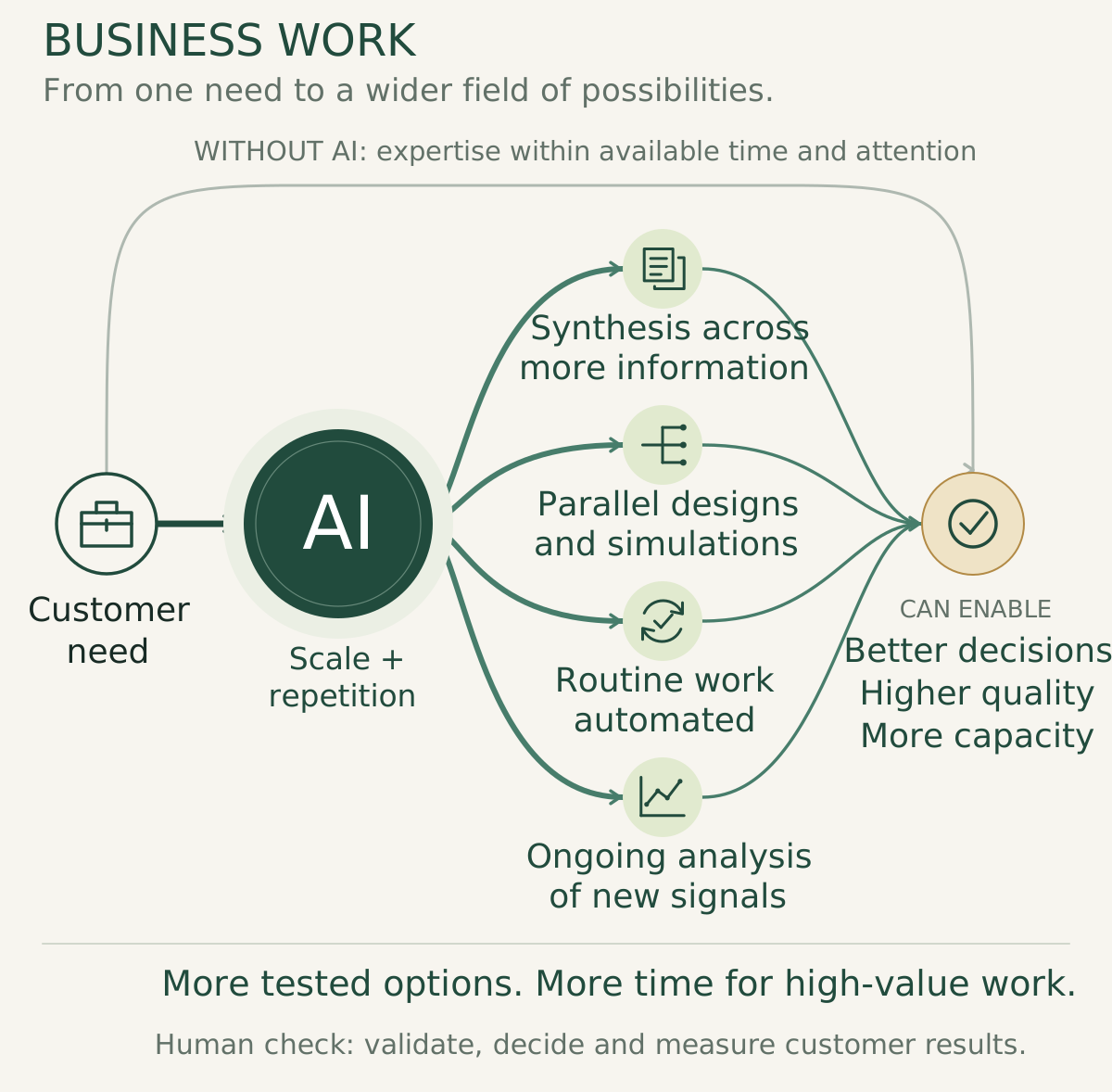
Business work
From one need to a wider field of possibilities.
View the complete diagram here, or open it full size.
Read the pathway as text
Without AI: expertise within available time and attention.
Customer need → AI: scale + repetition.
- Synthesis across more information
- Parallel designs and simulations
- Routine work automated
- Ongoing analysis of new signals
Can enable better decisions, higher quality and more capacity.
Human check: validate, decide and measure customer results.
04 / Benefits that reach people
The benefits that would make progress real
There is a practical basis for this ambition. A study of a staggered AI rollout to 5,172 customer-support agents found an average 15 percent increase in issues resolved per hour. Less experienced and initially less proficient workers gained most; the most skilled workers saw small declines in some quality measures. The study suggests a way that assistance can put useful expertise within reach of people still learning a job. It does not establish that workers received higher wages or that the gains became broadly shared prosperity. Those further outcomes depend on decisions the productivity figure cannot settle. Brynjolfsson, Li and Raymond, The Quarterly Journal of Economics, 2025
For an employer, this creates a concrete opportunity: connect assistance with training so that a beginner becomes a more capable worker. For the worker, the deeper benefit would be greater competence and better prospects, alongside useful help with today's task. Looking beyond the immediate output changes how a tool should be introduced and what its users should expect from it.

Healthcare offers another example of what becomes possible when technology fits a real need. In the ACCESS randomized trial of 164 young people with diabetes, offering AI retinal screening during an existing diabetes-clinic visit produced 100 percent screening completion in the intervention group. Completion was 22 percent in the group referred for a separate eye examination over six months. The intervention combined AI with convenient, on-site care, so the improvement cannot be assigned to the algorithm alone. This was an investigational use in that age group. It established greater screening access, not reduced vision loss; only 16 of the 25 participants referred after AI screening completed their eye-care follow-up. Completing the care pathway remained essential. Wolf and colleagues, Nature Communications, 2024

Other benefits should be described with the same care. A more accurate forecast matters to a family when a warning reaches them in time and they have somewhere safe to go. Better agricultural advice matters when it helps a farmer make a sound decision at an affordable cost. Scientific discoveries can open possibilities for treatment or more reliable energy, but practical development, delivery and access still stand between a discovery and a changed life. These are pathways to human benefit, not promises that every application will succeed.
Consider an emergency crew responding to a flood. A useful system might help the team interpret changing conditions and identify a route, while trained responders judge whether it is safe and decide whom to assist first. This is an illustrative pathway, not a reported result from a particular deployment. Its value would lie in timely help reaching people, with reliable communications and accountable command supporting the crew.

Some of the most valuable outcomes may be ordinary. A caregiver could spend less time on paperwork and more time with the person who needs care. A small business owner could have more time to serve customers and train an apprentice. Such possibilities deserve investigation alongside large scientific advances. Time saved becomes part of flourishing when people have genuine freedom to use it well.
↑ Reading navigationThe human measure of progress
The human measure of progress
AI can contribute to a society in which more people are healthy, capable and able to take responsibility for their lives. Achieving that requires deliberate choices about education, work, institutions and the uses to which power is put. Families and communities have purposes that technology should serve. Human beings still have to practise honesty, develop judgment, accept responsibility and care for one another.
The strongest case for AI is the opportunity to support that fuller life. We should pursue useful advances with confidence where the evidence warrants it, correct failures and preserve the freedom to choose a better approach. Success will be found in people who can do more of what matters and in communities better able to sustain them.
↑ Reading navigation