Permanent investigation / Military power, industrial capacity and national endurance
America Reloaded

Trump's Military Buildup and a New Era of American Strength
Project, Research, Analysis, Editorial by Patrick Russell; assisted by ChatGPT (OpenAI).
Can the United States generate, sustain, repair and replace military power faster than a major adversary can exhaust it? This investigation tests the rebuilding across people, readiness, industry, deterrence, innovation, allies, energy, economic power and national resolve.
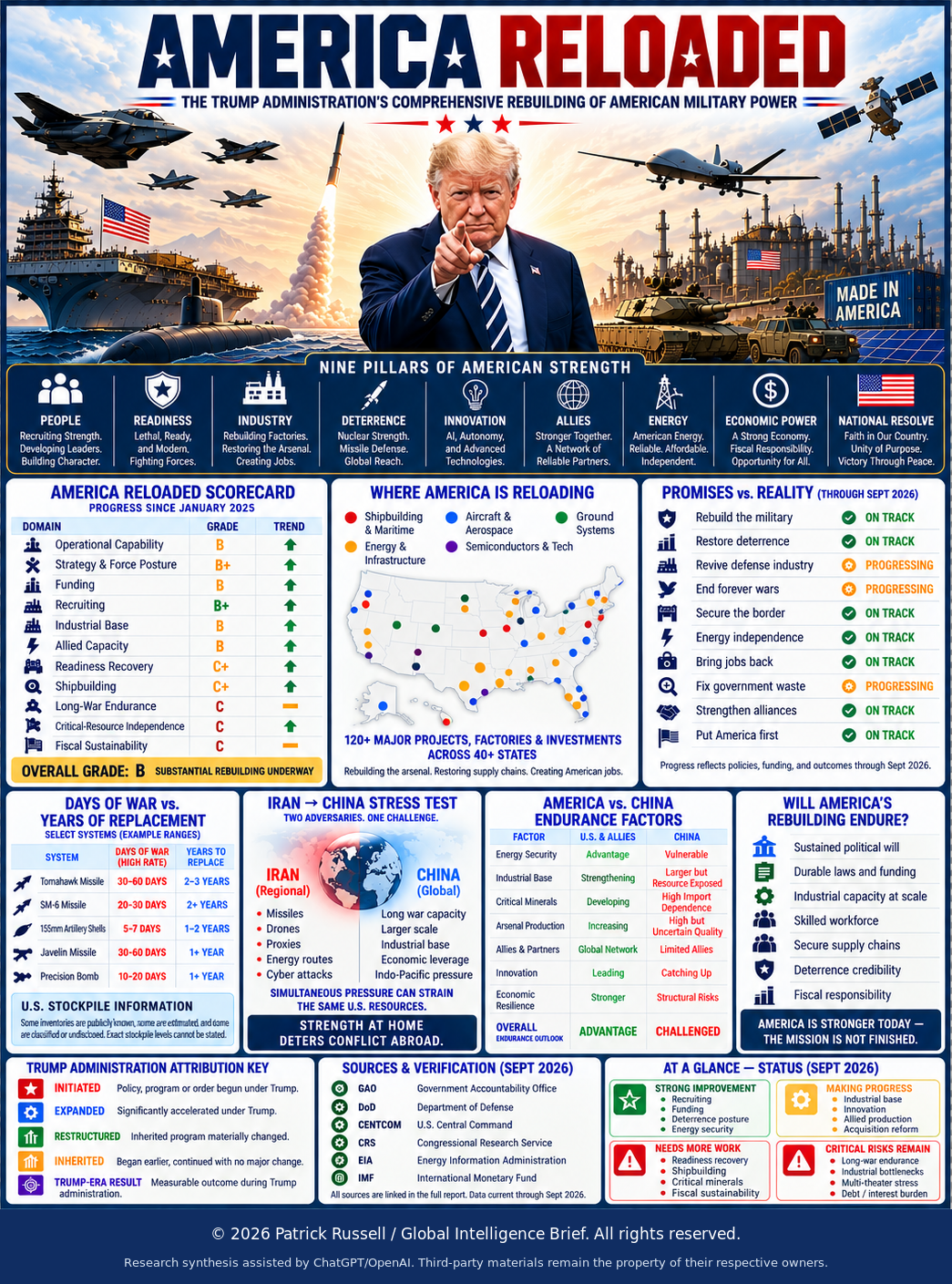
The question this investigation answers
Can the United States generate, sustain, repair and replace military power faster than a major adversary can exhaust it?
Distinct finding and connected evidence
- What this investigation adds
- An endurance assessment linking people, readiness, accepted deliveries, replenishment, industrial throughput, logistics and fiscal durability.
- Evidence assessed here
- Readiness and acquisition audits, production and delivery records, training and retention, funding execution and bounded operational evidence.
- Next evidence test
- Follow a funded program through realistic tests, operational acceptance, repeatable production, maintenance and replacement capacity.
- Defense Architecture
Owns layered-defense integration; this investigation measures the workforce, production and sustainment needed to build and maintain it.
- Iran/IRGC
Owns conflict and regime findings; this investigation uses documented operations as a bounded test of readiness, expenditure and replenishment.
- Defense projects ledger
Supplies project-level records; this investigation assesses their combined contribution to delivered capacity and endurance.
Editorial Standard
This publication master consolidates the investigation into 32 chapters. It separates policy success, implementation success, strategic success and durability; distinguishes presidential credit from inherited programs; and avoids treating announcements, rated factory capacity or projected jobs as completed outcomes.
Evidence grades: A — Demonstrated; B — Substantiated; C — Developing; D — Promise. Attribution labels: Created; Expanded/Accelerated; Restructured; Inherited/Continued; Trump-era Result.
Stockpile methodology: Where public data are incomplete for national-security reasons, the article distinguishes publicly known quantities and production rates from estimates and classified/undisclosed inventory information. Unknown does not mean zero, and classified does not mean sufficient; the evidence grade reflects what can be demonstrated from the public record.
Open Research Source Priority LadderHow legal authority, transactions, official review and independent analysis are weighted
Source priority is determined by what a record can prove, not merely by the reputation of its publisher. The investigation moves from controlling legal authority and actual transactions through implementation, independent verification and specialized data before relying on outside analysis or news reporting.
Priority order for America Reloaded researchTap to expandTap to collapse
Public laws, National Defense Authorization Acts, appropriations, executive orders and binding regulations establish legal authority, enacted funding and presidential direction. They prove what government authorized—not what industry ultimately delivered.
USAspending obligations, Department of Defense (DoD) contract notices, System for Award Management (SAM.gov) procurement records, exercised options and government acceptance or fielding records establish that money and hardware moved beyond announcement. Contract ceilings and solicitations are identified separately from obligated funds and completed deliveries.
DoD Comptroller procurement, research and development, modification, operations and construction exhibits; production schedules; fiscal-year (FY) service justification books; acquisition-program offices; and Navy shipbuilding plans establish requested quantities, schedules, technical milestones and official production assumptions. Requests and projections remain plans until funded and performed.
The Government Accountability Office (GAO), DoD Inspector General and Congressional Budget Office (CBO) independently test cost, schedule, management, readiness and affordability. The Congressional Research Service (CRS) provides nonpartisan congressional synthesis. These are official analytical or oversight sources rather than transaction-level primary records, but they carry exceptional weight when judging performance.
Defense Logistics Agency (DLA) Strategic Materials, United States Geological Survey (USGS), National Nuclear Security Administration (NNSA), Defense Security Cooperation Agency (DSCA) and specialized Navy, Army, Air Force, Space Force and Missile Defense Agency records establish mineral exposure, stockpile actions, nuclear-enterprise requirements, foreign demand and program-specific industrial needs.
Securities and Exchange Commission (SEC) Forms 10-K, 10-Q and 8-K; audited financial statements; and specific facility or production disclosures help identify backlog, capital investment, workforce risk and announced capacity. Company claims are checked against government obligations, schedules and deliveries.
The Center for Strategic and International Studies (CSIS), RAND Corporation (RAND), Center for Naval Analyses (CNA) and Institute for Defense Analyses (IDA) provide modeling, scenario analysis and synthesis. Credible news reporting identifies developments and attributed claims. These sources guide questions and interpretation; Global Intelligence Brief (GIB) follows their citations back to primary records wherever possible.
GIB proof sequence: Law → Appropriation → Budget → Obligation → Construction → Production → Government Acceptance → Fielding → Readiness → Strategic Effect. A program receives credit only for the highest stage supported by evidence.
Sources and underlying recordsTap to expandTap to collapse
Sources and underlying recordsTap to expandTap to collapse
Sources and underlying recordsTap to expandTap to collapse
Open the Requirement-to-Readiness Evidence LedgerWhat is proved—and what remains unproved—across six strategic capability areas
This first research tranche follows each capability from stated military need through authority, funding, contracts, production, government acceptance and fielded readiness. The grade stops at the highest stage supported by public evidence.
Six priority capability chainsTap to expandTap to collapse
Proved: In January 2026, the Defense Department and Lockheed Martin signed a framework targeting an increase in annual capacity from approximately 600 to 2,000 interceptors.
Not yet proved: The release says the framework is the basis for negotiating a seven-year supply contract and remains subject to congressional authorization and appropriations. The supply contract, supplier subcontracts, annual delivered output and fielded readiness therefore remain pending.
Proved: The Army set a 100,000-rounds-per-month objective for 2026, opened additional production capacity, and reported that a new Parsons, Kansas, load-assemble-pack facility could produce 12,000 M795 projectiles per month at full operating capacity. An August 2025 metal-parts modification brought the cited contract's cumulative face value to approximately $749.8 million.
Not yet proved: Nameplate capacity is not aggregate finished-round output. The contract notice says work locations and funding are determined with each order; order-level obligations, accepted deliveries and sustained network output still require reconciliation.
Proved: Public budget records and independent modeling support a multiyear requirement to replenish and expand inventories including Tomahawk, SM-6 and the Long Range Anti-Ship Missile (LRASM).
Not yet proved: Complete inventories are classified or undisclosed. Current program-specific appropriations, obligations, P-21 production schedules, accepted deliveries and theater-ready quantities must be extracted before assigning a higher readiness grade.
Proved: The May 2026 Navy shipbuilding plan identifies $124.9 billion for submarine construction across FY2027–FY2031, including $62.0 billion for Columbia and $62.9 billion for Virginia, plus $6.2 billion for the submarine industrial base. The stated goal is at least one Columbia and two Virginia submarines per year by FY2031.
Not yet proved: A plan and multiyear demand signal do not establish the achieved one-plus-two annual cadence, supplier throughput, workforce sufficiency or on-time delivery.
Proved: The January 2025 executive order established policy direction. Defense officials subsequently described a draft architecture, phased implementation, a program office and an initial $25 billion FY2026 investment request spanning sensors, command-and-control and interceptors.
Not yet proved: An integrated, tested and fielded national system, trained operating force, recurring sustainment base and demonstrated readiness do not yet appear in the cited public record.
Proved: GAO reported in 2026 that the United States was 100 percent net-import-reliant for 12 critical minerals and at least 50 percent reliant for 34. It found that substitution or recycling for several semiconductor-related minerals generally remains years away.
Not yet proved: Announced mines, processing plants, recycling projects and semiconductor facilities must still be traced to qualified domestic output, defense-component integration and stockpile sufficiency.
Evidence boundary: A target or rated factory capacity is not production; a contract ceiling is not an obligation; an accepted delivery is not necessarily fielded readiness. Classified or undisclosed data are recorded as unknown—not assumed sufficient or deficient.
Sources and underlying recordsTap to expandTap to collapse
Sources and underlying recordsTap to expandTap to collapse
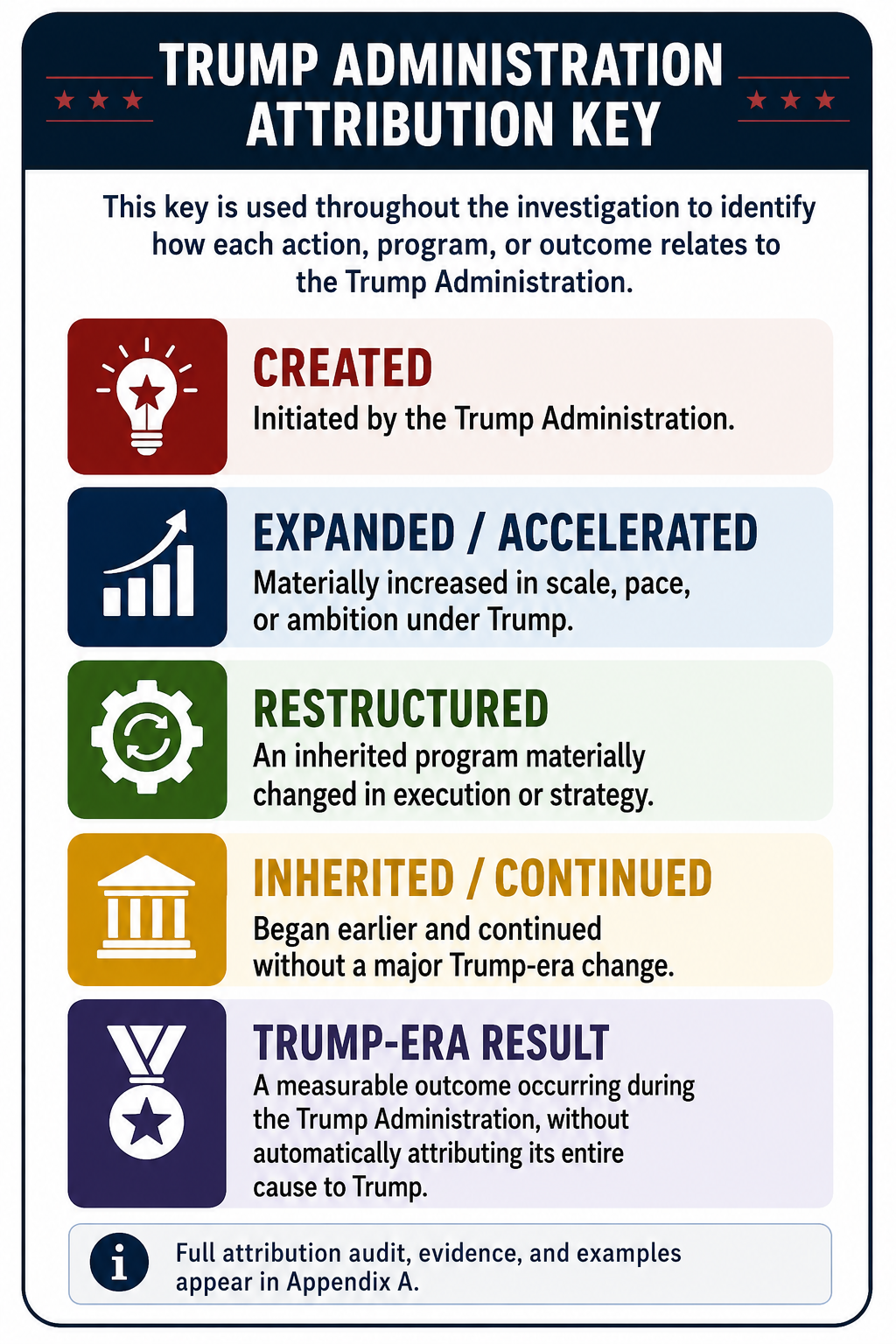
Attribution key used throughout the investigation.
Open attribution methodologyHow presidential credit is assigned without erasing inherited programs
The policy, program or order began during Trump’s second administration. Creation does not by itself establish successful implementation or a durable result.
An inherited effort received demonstrably greater scale, funding, speed or priority. The earlier origin remains part of the record.
An inherited program was materially reorganized. The result is graded separately from the decision to restructure it.
The program began before January 2025 and continued without enough evidence of a major current-administration change.
A measurable outcome occurred during the current term, while causation and prior investment are still disclosed.
PART I — WHY AMERICA HAD TO RELOAD
1. America at an Inflection Point
The United States enters this period with the world’s most capable military, but battlefield superiority rests on a larger national system. Weapons require factories; factories require workers, energy, materials, electronics and transportation; prolonged combat requires repair and replacement. The central question is therefore not whether America possesses advanced weapons, but whether it can generate, sustain, repair and replace military power faster than a major adversary can exhaust it.
A complete buildup must be judged across military capability, industrial capacity, economic capacity, resources, infrastructure, people, alliances and national resolve. The battlefield is the end of the production chain—not the beginning of national defense.
2. The Cost of Complacency
After the Cold War, force structure contracted, defense firms consolidated, inventories narrowed and global supply chains deepened. Many choices were understandable in a period when leaders expected a smaller number of technologically superior forces to handle regional conflicts. The strategic cost emerged later: fewer suppliers, slower surge capacity, aging infrastructure and long replacement times.
The peace dividend was not irrational. The question is whether America allowed too much mobilization reserve to disappear.
3. How the Arsenal Hollowed Out
The industrial chain became concentrated. Prime contractors fell dramatically from Cold War-era levels, while specialized suppliers disappeared or merged. Modern weapons became more capable, but production systems often became less able to surge.
The result is industrial latency: America can decide to buy more weapons long before factories, machine tools, skilled labor and upstream suppliers can deliver them.
CSIS reaches a compatible but independently developed conclusion: post–Cold War consolidation and peacetime production economics reduced the number of prime and lower-tier suppliers and left little spare capacity for a sudden surge. GIB treats that as secondary analysis and checks its factual inputs against government budgets, acquisition records, contract announcements and company disclosures.
CSIS — Six Reasons Why the United States Is Low on Munitions · CSIS — Deterrence by Capacity
4. The World America Faces
China combines military modernization with extraordinary manufacturing and shipbuilding scale. Russia remains a nuclear and military power capable of imposing costs in Europe. North Korea can pressure Korea and Japan, while Iran has demonstrated the ability to threaten regional bases, shipping and energy routes.
These states do not need to operate as a fully integrated alliance to create a multi-theater problem. Simultaneous pressure can draw on the same finite American pools of missiles, interceptors, tankers, submarines, bombers, airlift, sealift and maintenance capacity.
PART II — TRUMP’S BLUEPRINT
5. A Comprehensive Rebuilding Strategy
Trump’s second-term buildup is best understood as a national-capacity strategy rather than a claim that the administration invented every weapon system. Several important programs began under earlier administrations. The relevant attribution question is: who originated it, who financed it, who accelerated it, and when did it begin producing useful capacity?
The administration’s distinctive approach connects readiness, munitions, factories, acquisition reform, energy, critical materials, semiconductors, infrastructure, commercial technology, economic leverage, allies and national confidence.
6. The Nine Pillars of American Strength
The investigation evaluates nine mutually dependent pillars: people, readiness, industry, deterrence, innovation, allies, energy and resources, economic power, and national resolve. Weakness in one pillar can constrain several others.
This systems approach is the organizing logic for the rest of the article.
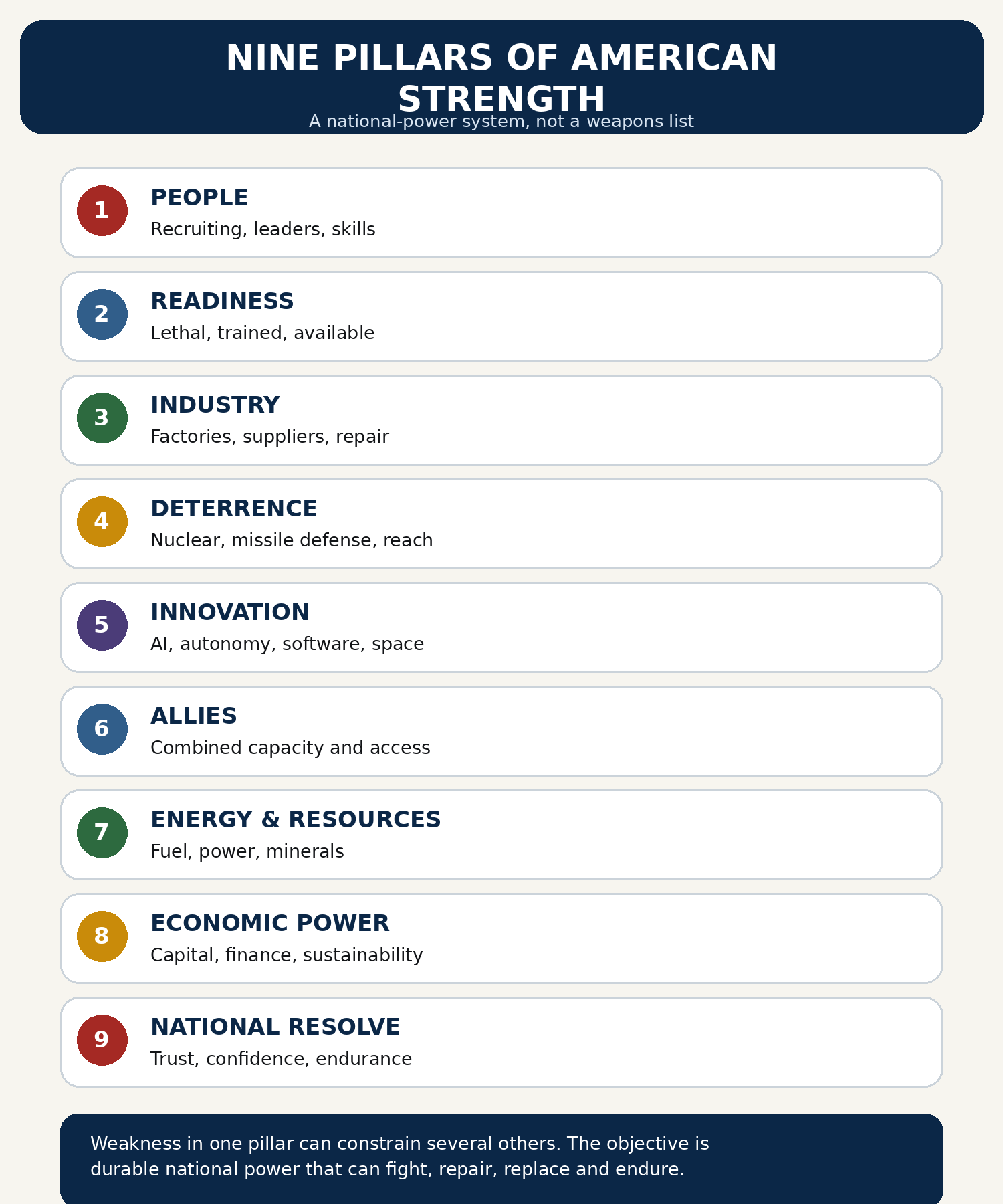
Nine Pillars of American Strength — the national-power system used throughout this investigation.
7. Can Washington Move as Fast as Technology?
GAO reported in June 2026 that expected delivery time for major programs now exceeds 12 years. Executive Order 14265, issued April 9, 2025, directed commercial-first acquisition where appropriate, greater use of Other Transaction authorities and rapid pathways, fewer duplicative approvals, workforce reform and review of major programs that are more than 15 percent late or over cost.
The reform is real policy change. It is too early to claim that average acquisition time has materially fallen. Speed also cannot become an excuse to remove testing, safety or accountability that demonstrably protects warfighters and taxpayers.
Expanded evidence — acquisition speedTap to expandTap to collapse
GAO’s 2026 portfolio review found that expected time to initial capability for major programs now exceeds 12 years. This is the inherited performance baseline against which the administration’s reforms must be judged.
In a separate review, about half of the acquisition programs surveyed by GAO reported schedule effects from continuing resolutions, including delayed contracts, fielding and program activity.
Executive Order 14265 directs commercial-first acquisition where appropriate, wider use of rapid authorities and review of programs more than 15 percent late or over cost.
The success metric is shorter time from validated requirement to useful fielded capability without shifting failure into testing, sustainment, cybersecurity or unit readiness.
Sources and underlying recordsTap to expandTap to collapse
8. Promises vs. Reality
Every major initiative is graded through Promise → Authority → Funding → Implementation → Delivery → Result. Policy success is separated from implementation success, strategic success and durability.
This prevents a contract from being counted as production, a factory announcement from being counted as capacity, or an administration objective from being counted as a strategic outcome before the evidence exists.
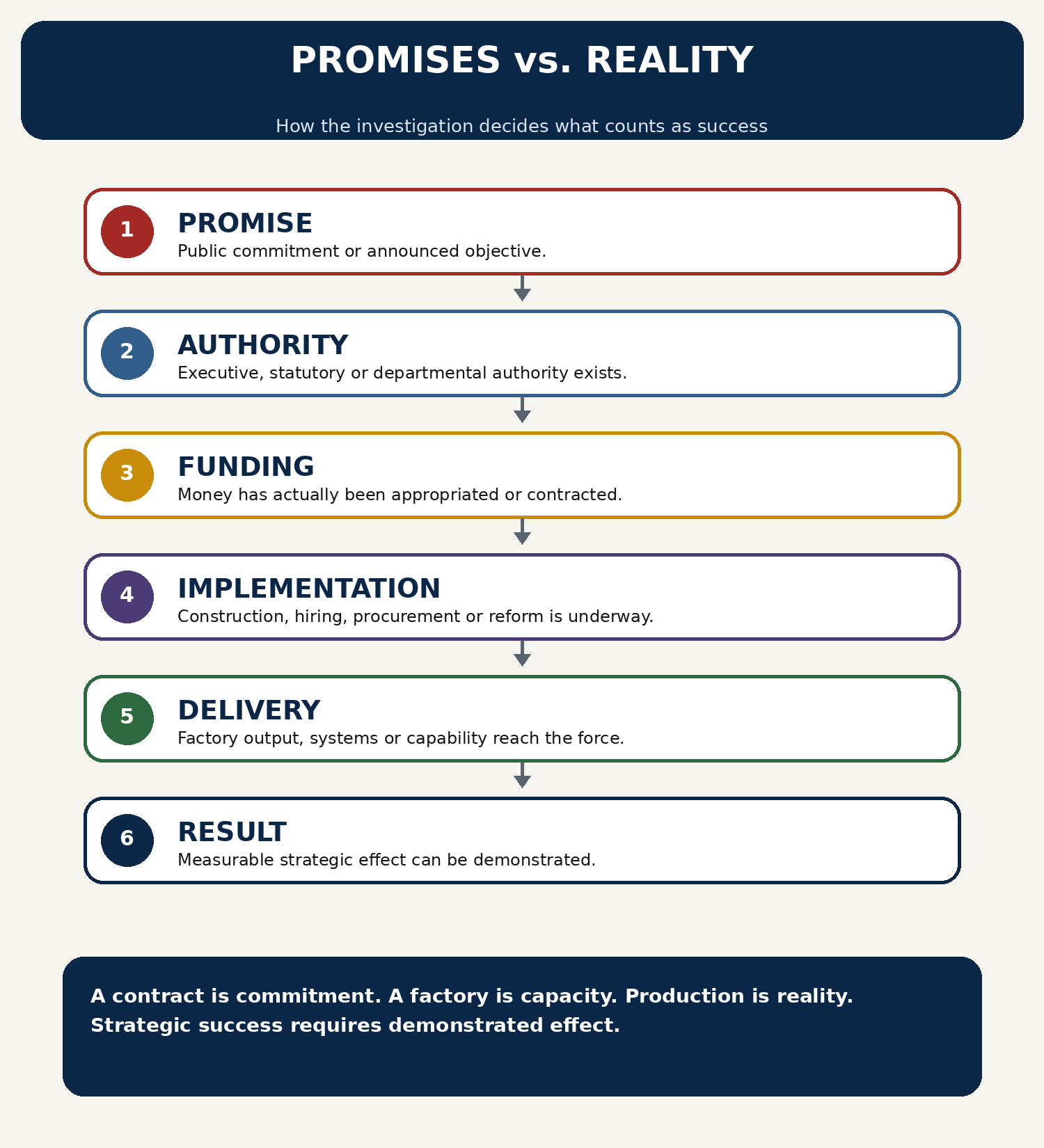
Promises vs. Reality — the evidence ladder used to distinguish announcements from demonstrated results.
Open the complete promises-to-results trackerTen objectives from the infographic, translated into evidence-bounded status assessments
Funding, acquisition reforms, recruiting recovery and production expansion are documented. Full long-war sufficiency is not yet demonstrated.
Force posture and operational capability are strong; deterrence remains partly inferential because prevented adversary decisions cannot be observed directly.
Contracts and plant investment are expanding, while shipbuilding, energetics, skilled labor and lower-tier suppliers remain constraints.
The objective is established, but continuing operations and new contingencies mean the durable outcome remains unresolved.
Administration action and enforcement outcomes belong to the wider GIB record; this investigation treats border security as one component of national capacity, not a defense-production result.
Domestic resource strength is an advantage. Military endurance still depends on refining, storage, transport, grid resilience and delivery under disruption.
Construction, hiring and manufacturing commitments are documented. Announced or projected jobs are not counted as completed employment.
Efficiency actions and verified recoveries matter, but the Defense Department has not achieved a clean audit and structural fiscal pressure persists.
Industrial cooperation is expanding. Allied capacity becomes operational only when it is contracted, interoperable, politically available and logistically connected.
The policy direction is clear; success is judged by delivered U.S. capacity, deterrence, household prosperity and fiscal durability rather than rhetoric alone.
Evidence boundary: These labels summarize direction of travel. They do not convert a policy objective into a demonstrated strategic result.
PART III — PEOPLE AND NATIONAL RESOLVE
9. Recruiting Comes Back
The Army reported more than 61,500 active-duty contracts four months before the end of FY2026. The Navy reported 45,000 future Sailors contracted by July 2, and the Air Force and Space Force reported 32,000 active-duty recruits five months early. These are demonstrated recruiting-goal achievements.
They do not prove that every critical specialty is filled or that the force can replace losses during a prolonged peer war. Recruiting receives an A for current goal achievement; long-war manpower remains developing.
Expanded evidence — recruiting is only the first gateTap to expandTap to collapse
DoD reported 62,050 Army, 44,096 Navy, 30,166 Air Force, 819 Space Force and 26,600 Marine Corps accessions—an important reversal after the services collectively missed recruiting goals by about 41,000 in FY2023.
The master records early goal achievement by the Army, Navy, Air Force and Space Force. The evidence supports recruiting recovery, not a conclusion that every cyber, nuclear, medical, maintenance or intelligence specialty is adequately staffed.
The Navy previously told Congress that recruits sometimes waited because boot-camp capacity could not immediately absorb them. Accession, training completion, qualification and unit arrival should therefore be measured separately.
GAO describes child care as essential to readiness and retention; DoD programs served about 171,000 children in FY2024. Housing, medical access, spouse employment and operational tempo also affect whether trained personnel remain.
Sources and underlying recordsTap to expandTap to collapse
10. One Military, Hundreds of Careers
Modern military manpower includes intelligence, cyber, nuclear power, aviation maintenance, logistics, engineering, medicine, space and many other technical specialties. Service can therefore function as both national defense and human-capital development.
The strongest pipeline is Recruit → Train → Serve → Credential → Transition → Build America. Programs such as SkillBridge and the GI Bill can move military training back into the civilian industrial base.
11. The Skilled-Worker Army
Uniformed personnel are only one of three defense workforces. The others are government civilians and the private defense-industrial workforce. Shipyards, depots, missile plants and nuclear facilities all compete for welders, machinists, engineers, technicians and cyber specialists.
This creates a retention paradox: a skilled worker leaving uniformed service may weaken one unit while strengthening the broader defense ecosystem if that worker enters a shipyard or factory.
Related GIB standing coverageJobs & Workforce
Compare employment, projected openings, technical occupations, training pathways and regional opportunities across the strategic sectors tracked by GIB.
Open the workforce dashboard →12. Patriotism, Trust and the American Story
Recruiting recovery coexists with weaker measures of intense national pride and fragmented institutional trust. That is not a contradiction. Patriotism is not identical to approval of a president, government or war.
The investigation therefore measures national resolve through behavior as well as sentiment: enlistment, volunteering, civic knowledge, willingness to serve, institutional confidence and belief that the country can improve.
13. Media, Information and Trust
The evidence does not establish a single centralized domestic conspiracy controlling American information. It does establish repeated cases of partisan framing, premature certainty, correction asymmetry, gatekeeping and fragmented trust networks across the political spectrum.
The proper standard is case-by-case: accurate; accurate but selective; misleading framing; materially false; or unresolved. The strategic concern is whether Americans retain enough shared confidence in evidence and institutions to act collectively during a crisis.
Defense, space and AI: evidence update · October 4–6, 2026
Targeted public-record review · October 4–6, 2026. Earlier chapters retain their original evidence dates.
SDA transport satellites: launch delayed; delivery and operational acceptance remain ahead
Confirmed milestone status: SpaceX automatically aborted the October 5 Falcon 9 launch attempt for 21 Northrop Grumman-built Space Development Agency Tranche 1 Transport Layer satellites. Air & Space Forces reported that the launch vehicle and satellites were in good health; Spaceflight Now later reported that SpaceX also waived the October 6 opportunity. SpaceX listed the next attempt for October 8 at 12:54 a.m. Pacific. A scheduled retry is not a completed launch. Air & Space Forces · updated October 5; Spaceflight Now · updated October 5; SpaceX mission page · accessed October 6.
Program boundary: the mission would raise the Tranche 1 on-orbit total from 63 to 84 satellites. Launch, separation, checkout, transfer to an operations center and operational service are separate gates. SDA has moved York satellites into operations with limited experimentation, while Air & Space Forces reported unresolved engineering work transferring most Lockheed Martin satellites. SDA targets operational capability beginning in 2027; no October 6 evidence establishes that capability as accepted service.
Launch-capacity planning: Vandenberg Space Force Base requested industry feedback on a proposed Mission Development Zone for payload processing, testing, assembly and possible manufacturing. Air & Space Forces reported a planning objective of up to roughly 200 launches per year by decade's end, compared with 66 in 2025. The request is planning evidence, not an appropriation, award, built facility or demonstrated launch rate. Air & Space Forces · October 5.
Counter-UAS testing: an operational learning step, not a Golden Dome intercept milestone
Confirmed exercise: the Army reported October 1 that Falcon Peak 26.2 established permanent counter-small-UAS test lanes at Yuma Proving Ground and used Anduril’s Lattice as the baseline command-and-control platform for commercial sensor-to-shooter evaluations. The exercise supported U.S. Northern Command and Joint Task Force Southern Border. It establishes test infrastructure and an operating experiment, not procurement of every demonstrated system or performance against peer military threats. Army · October 1.
Attributed operational figures: Reuters reported October 5 that Brig. Gen. Brian Filler said the military detected 378 border drone incursions during the prior 30 days, mostly commercial systems used for surveillance around smuggling activity. Reuters also reported the military’s statement that lasers had downed 11 cartel-linked drones since August. The Defense Department’s August 28 release independently confirms the first three laser defeats; the larger cumulative figure remains an attributed October 5 operational total rather than a separately published incident ledger. Reuters · October 5; Defense Department · August 28.
Assessment: permanent test lanes, a common software baseline and reported operational use are evidence of implementation and learning. They do not establish that all incursions were hostile, that every engagement was successful, or that a national layered missile-defense architecture is operational. Next evidence should include adjudicated detection and false-positive data, system reliability, civilian-airspace safeguards, cost per engagement, contract awards and transition into accepted service.
TITAN: an awarded move from prototypes to production
Confirmed acquisition action: the Army’s September 1 release reports August 31 delivery orders totaling $192 million: $127 million to Palantir and $65 million to Anduril. Eight initial production systems—four Advanced and four Basic—are scheduled over 18 months, alongside nine prototypes retained for operational use. Palantir leads production with L3Harris, Sierra Nevada Corporation, Strategic Technology Consulting and World Wide Technology; Anduril supplies hardware and shelter integration. Army · September 1.
TITAN is an AI-enabled intelligence ground station that fuses sensor information and supports target recognition, geolocation and automated target nominations. The Army attributes the transition to soldier feedback. The release supplies no quantitative accuracy benchmark or independently measured sensor-to-shooter improvement.
What this changes: production is now a documented execution step rather than a future ambition. Count accepted deliveries, reliability and qualified support staff before converting it into a whole-force readiness judgment. A further FY2027 order is anticipated, not already awarded in this record.
NGC2: a confirmed Palantir–Anduril software relationship
The Army’s June 22 record confirms Anduril leading a common data baseline using Lattice and Palantir Foundry for an edge-to-cloud data mesh, with Raft supplying registries, transformation and federation. Anduril leads implementation at 4th Infantry Division; Lockheed Martin leads at 25th Infantry Division. Ten months of exercise feedback informed the baseline, including cyber and electromagnetic attack conditions. This deepens the existing joint-command record with named interfaces and team roles. Army · June 22.
Remaining test: sustained delivery, access to interfaces, comparable error and latency measures, and recovery under network loss. Exercise validation is useful evidence; the public release does not disclose comprehensive failure rates or establish Golden Dome integration.
Ship OS: a faster planning task is not a delivered submarine
The Navy’s December 9, 2025 announcement establishes a $448 million investment using Palantir software to join enterprise, legacy and operational data. It reports pilot schedule planning at Electric Boat falling from 160 manual hours to under 10 minutes, and Portsmouth material review from weeks to under an hour. These are Navy-reported workflow results, not independently isolated increases in ship deliveries. Navy · December 9, 2025.
Industrial implication: faster information handling can expose bottlenecks, but skilled labor, suppliers, facilities and maintenance capacity still govern throughput. GAO’s September 25, 2026 review estimates the separate Shipyard Infrastructure Optimization Program exceeds $200 billion and 50 additional years, and calls for consolidated cost, risk and performance reporting. That audit addresses physical infrastructure, not the effectiveness of Ship OS. GAO · September 25.
Unmanned vessels: production follows bounded at-sea testing
On September 29 the Navy announced production agreements for 30 medium unmanned surface vessels, ten each from Galliano Marine Services, HII and Saronic, with first deliveries scheduled before end-FY2027. Phase I tested environmental awareness, autonomous collision-rule navigation and long-duration missions. Follow-on payload integration, operational acceptance, maintenance and fleet training remain distinct gates; this record does not establish autonomous combat engagement. Navy · September 29.
PART IV — CAN AMERICA FIGHT AND REPLACE?
14. Can America Fight Tonight?
Yes. The United States retains extraordinary global operational capability. But readiness is not identical to possession of advanced platforms. GAO found F-35 mission-capable rates fell from 67 percent in FY2021 to 44 percent in FY2025, while full-mission-capable rates fell from 38 percent to 25 percent.
The rebuilding is real; the recovery is incomplete. Immediate operational strength receives an A, while systemic readiness recovery remains B/C.
Aviation terminology used in this assessment: Collaborative Combat Aircraft (CCA); engineering and manufacturing development (EMD); Advanced Medium-Range Air-to-Air Missile (AMRAAM); Joint Air-to-Surface Standoff Missile (JASSM); Joint Direct Attack Munition (JDAM); and Small Diameter Bomb (SDB).
Expanded evidence — readiness by functionTap to expandTap to collapse
F-35 mission-capable rates declined from 67 percent to 44 percent between FY2021 and FY2025; full-mission-capable rates fell from 38 percent to 25 percent.
Attack-submarine maintenance delays and idle time removed more than 15,000 operational days over a decade and cost approximately $3.4 billion without providing operational capability.
The services now have designated authorities for predictive maintenance, but GAO previously found limited implementation across a maintenance enterprise costing nearly $90 billion annually.
Recent joint operations demonstrate global reach, sortie generation, command integration and precision-strike capacity. Those achievements do not measure the duration for which the force can sustain peak operations.
Sources and underlying recordsTap to expandTap to collapse
Combat Air Power and Aviation Industrial BaseTap to expandTap to collapse
Combat aviation is a system of systems, not a fighter inventory. The operational chain is aircraft, trained crew, protected base, fuel and tanker support, sensing and command, integrated weapons, spare engines and components, software and test equipment, and depot capacity. A shortfall at any link can ground an otherwise advanced fleet.
CBO projects the Defense Department fighter inventory will fall to about 3,000 in 2029 before rising later. It also projects that stealth aircraft will exceed half the force beginning in 2033. These are projections, not delivery commitments.
GAO reported a 25-percent full-mission-capable rate in FY2025. Possession, delivery and mission-ready availability must therefore be reported separately.
The aircraft-procurement request includes 38 F-35s, 24 F-15EXs, 23 T-7As and 15 KC-46As. Requested funding and quantities are not enacted appropriations, accepted aircraft or operational capacity.
The Navy describes a request covering aircraft, spares and support, including increased F-35 buying, P-8 line restart, E-2D extension, CH-53K, KC-130J and MQ-25. Execution and deliveries remain to be measured.
Mission portfolio — what must exist and work togetherTap to expandTap to collapse
F-22, F-35A/B/C, F-15EX, F-16 and Navy/Marine F/A-18 fleets carry current missions while F-47, the Navy's F/A-XX and Collaborative Combat Aircraft build the next force. The F-47 Boeing award establishes engineering and manufacturing development—not operational fielding. General Atomics FQ-42 and Anduril FQ-44 received development and production contracts in 2026; the Air Force states an objective of more than 150 combat-capable CCA by decade's end. Accepted quantities, autonomy performance and unit integration remain future tests.
B-21, B-2, B-1 and B-52 together provide penetrating and stand-off strike while modernization proceeds. A February 2026 B-21 agreement applies $4.5 billion already authorized and appropriated to increase annual production capacity 25 percent. GAO estimates the B-52 modernization portfolio at about $21 billion. Delivered aircraft, engines, radar modifications and mission-capable rates—not nominal capacity—will determine success.
KC-46A replaces part of the aging KC-135 force and enables fighter, bomber and mobility reach. The FY2027 request seeks 15 KC-46As, but GAO reported critical parts shortages across both tanker fleets and identified parts failures as a major contributor to low availability. Tanker capacity is therefore a first-order combat-air-power metric.
C-17, C-5M, C-130J and the Civil Reserve Air Fleet move forces, ammunition, repair teams and medical support. The public assessment must track aircraft availability, crews, spare parts, airfield throughput, fuel, loading equipment and commercial activation—not airframe count alone.
E-2D, E-3 replacement efforts, RC-135, P-8, EA-37B and space-enabled targeting create the information layer that turns aircraft into a joint force. The Navy request would extend E-2D production and restart P-8 production; the Air Force requests three EA-37Bs. Fleet transitions, software, sensors, data links and trained mission crews require separate verification.
F-35B/C, F/A-18E/F, EA-18G, E-2D, MQ-25, CH-53K, V-22 and KC-130J link sea control, expeditionary operations, refueling, warning and lift. This portfolio belongs inside the aviation assessment even though ship construction is evaluated separately. F/A-XX is a development program intended to augment and eventually replace Super Hornets and Growlers beginning in the 2030s; it is not current fleet capacity.
The T-7A is intended to replace the T-38C. Boeing's 2018 fixed-price award covers development and 350 planned operational aircraft; five test aircraft had been delivered by December 2024, and FY2027 requests 23 aircraft. The complete personnel chain also includes pilots, weapon-system officers, remotely piloted and autonomy operators, boom operators, loadmasters, intelligence crews and instructors.
Dispersed operating locations, hardened shelters, runway repair, fuel storage and distribution, ground equipment, communications, air and missile defense, and rapid logistics determine whether aircraft can keep flying after an attack. Aircraft procurement without resilient basing produces fragile capacity.
Industrial base — primes, enabling companies and public capacityTap to expandTap to collapse
F-35 prime contractor and a central participant in tactical-aircraft modernization. Its output depends on Pratt & Whitney F135 engines, radar and electronic systems, software, depot activation and a multinational supplier and sustainment network.
B-21 prime contractor and participant in aviation sensors, mission systems and autonomy. The B-21 capacity agreement is stronger evidence than a proposal, but actual annual deliveries and supplier throughput are not fully public.
Prime contractor for F-15EX, KC-46A, T-7A, F-47, F/A-XX and MQ-25, and original manufacturer/integrator for major legacy fleets including B-52 and C-17. Concentration creates scale and engineering depth while making program execution, skilled labor and supplier performance cross-portfolio risks.
Pratt & Whitney/RTX, GE Aerospace and Rolls-Royce North America are central to current and future fighter, bomber, tanker, mobility and training propulsion; RTX and other suppliers provide radar, avionics and autonomy. Engines, modules, castings, forgings and repair capacity must be counted independently from final assembly.
General Atomics and Anduril hold FQ-42 and FQ-44 aircraft contracts. The Air Force also selected Anduril, General Atomics, Lockheed Martin, Northrop Grumman, RTX Collins Aerospace and Shield AI for a competitive mission-autonomy software pool. Open architecture may reduce vendor lock, but fielded reliability and upgrade speed remain unproved.
Ogden, Oklahoma City and Warner Robins Air Logistics Complexes maintain aircraft including F-35, KC-135 and C-130 fleets. GAO found depot delays increased considerably after FY2019 and warned that revised completion targets can obscure unplanned work. Organic technical data, tooling and artisans are industrial capacity, not overhead.
September 29, 2026 — fighter development and supply-chain securityTap to expandTap to collapse
The Navy selected Boeing for a contract valued at more than $20 billion for full-scale development of its sixth-generation carrier fighter. The award covers multiple test aircraft for ground, airworthiness, systems and weapons-integration work. The intended fighter would extend carrier-air-wing reach, team with uncrewed aircraft and operate alongside the F-35C as it begins to augment older F/A-18E/F and EA-18G fleets in the 2030s. This is a major procurement milestone, not a delivered or operational aircraft. Boeing must now execute F/A-XX and the Air Force's F-47 in parallel; test progress, supplier and engineering capacity, appropriations and accepted aircraft are the next evidence points.
Components shipped from Australia to the United States were diverted to Hong Kong. The F-35 Joint Program Office says it is investigating the shipment, seeking recovery and working on safeguards. Reports say the parts included a canopy and weapons-bay door and were taken into Chinese custody; the office has not publicly established how the diversion happened or what technology, if any, was exposed. Australian defense officials disputed that the parts were sensitive. Senator Tom Cotton requested a review of contractor-managed military shipping. Track chain of custody, route-change approval, recovery, findings and corrective action before drawing conclusions about compromise or intent.
The shipment case gives a concrete test of the broader F-35 parts-accountability problem identified by GAO in 2023. That audit concerned the global spares pool and does not establish the cause of this particular diversion.
People, supply chain and material requirementsTap to expandTap to collapse
-
Personnel
Pilots and mission crews; maintainers; avionics, propulsion and low-observable technicians; weapons loaders; software and cyber specialists; logisticians; depot artisans; engineers; test personnel; contracting officers; and instructors. The Department of the Air Force proposes adding 12,700 Airmen and Guardians in FY2027, but the public topline does not prove adequate staffing in every aviation specialty.
-
Propulsion and structures
Hot-section superalloys, titanium, aluminum, carbon composites, castings, forgings, bearings, actuators, landing gear, ejection systems and qualified repair parts. Capacity must be measured at the bottleneck component and repair tier, not just at the airframe plant.
-
Electronics and mission systems
Trusted microelectronics, radar and electronic-warfare components, sensors, secure communications, data links, batteries, processors, test equipment, software integration laboratories and cyber-secure update pipelines.
-
Stealth, weapons and support
Low-observable materials and repair facilities; AMRAAM, AIM-9, JASSM, LRASM, JDAM, SDB and other integrated weapons; fuel, tankers, simulators, ranges, shelters and ground equipment. Aircraft and weapons production schedules must be reconciled rather than audited separately.
-
Acceptance, sustainment and regeneration
The proof sequence is funded contract → qualified suppliers → production → government acceptance → trained unit → mission-capable sortie rate → combat use → repair and replacement. Public data remain incomplete for lower-tier dependencies, wartime spares, classified readiness and exact surge capacity.
Assessment: The United States retains formidable combat-air reach and is funding several consequential transitions. The most important unresolved risks are mission-capable availability, tanker and depot performance, aging bridge fleets, engine and component capacity, trained specialty personnel, software integration, resilient basing and the conversion of development programs into affordable operational mass. Budget authority, contract award, factory capacity, delivered aircraft and sustained combat-ready output are reported as separate milestones.
Sources and underlying recordsTap to expandTap to collapse
CBO fighter-force structure and projections · GAO F-35 sustainment · Air Force FY2027 budget request · Air Force aircraft procurement justification · Navy FY2027 aviation request · Air Force F-47 EMD award · Air Force CCA contracts · Air Force B-21 capacity agreement · GAO B-52 modernization · GAO tanker sustainment · Air Force T-7A acquisition status · GAO Air Force depots · Boeing F/A-XX award statement · F/A-XX award reporting · F-35 Joint Program Office response via AP · Cotton review request reporting · GAO F-35 global spare-parts accountability
Ground Combat Power and Land-Warfare Industrial BaseTap to expandTap to collapse
Ground combat power is a combined-arms production system: trained formations, armored and tactical vehicles, artillery and missiles, air defense, drones and electronic warfare, engineering equipment, secure command networks, ammunition, fuel, repair parts and depot capacity. Platform counts alone do not establish how many brigades can deploy, fight, recover and be regenerated after sustained loss.
The procurement request includes $12.1 billion for missiles, $5.5 billion for ammunition, $3.7 billion for weapons and tracked combat vehicles, and $12.71 billion for other procurement. These are requested amounts—not enacted appropriations, obligations, deliveries or fielded readiness.
The Fiscal Year 2027 (FY2027) request seeks $1.151 billion for 196 Armored Multi-Purpose Vehicles (AMPVs). The justification supports full-rate production, integration and testing; government acceptance and unit fielding remain later milestones.
The same budget book requests 2,795 M250 automatic rifles, 14,944 XM8 carbines and 20,402 advanced fire-control systems. Funding, qualification, production, soldier training and fielding must be audited separately.
The Army describes its Organic Industrial Base (OIB) as 23 depots, arsenals and ammunition plants. It reported more than $1 billion in modernization projects executed during FY2025, but site investment is not proof of sufficient wartime throughput.
Mission portfolio — what land forces must be able to doTap to expandTap to collapse
Abrams tanks, Bradley fighting vehicles, AMPVs and Stryker formations must combine protection, mobility, firepower and networked sensing. General Dynamics Land Systems and BAE Systems are central prime contractors, while engines, transmissions, armor, gun systems, optics and tracks expose the force to lower-tier bottlenecks.
Rifles, automatic rifles, fire-control optics, night vision, body armor, radios and small-unit drones must arrive as an integrated kit. The Army's FY2027 request signals scale, but accepted weapons, trained users, spare parts and ammunition stocks determine usable capacity.
High Mobility Artillery Rocket System (HIMARS), Guided Multiple Launch Rocket System (GMLRS), Precision Strike Missile (PrSM), Paladin and towed artillery link launchers and guns to targeting, propellant, explosives, rocket motors and reloads. Lockheed Martin, BAE Systems and the Army's ammunition enterprise are prominent participants; the governing metric is sustained accepted rounds and missiles, not launcher inventory alone.
Patriot, Terminal High Altitude Area Defense (THAAD), the Integrated Air and Missile Defense Battle Command System (IBCS), short-range air defense and counter-unmanned aircraft systems (counter-UAS) protect forces, logistics hubs and infrastructure. Lockheed Martin, RTX and Northrop Grumman are major contractors; interceptor inventory, sensors, launchers, trained crews and reload time all constrain coverage.
Small unmanned aircraft systems (UAS), counter-UAS, ground sensors, electronic support and electronic attack increasingly shape detection and survivability. The supplier field includes established and nontraditional firms; contract ceilings and demonstrations must not be counted as deployable fleets before acceptance and formation-level integration.
Bridging, breaching, route clearance, recovery vehicles, trucks, fuelers, water systems and material-handling equipment determine whether combat units can move and remain supplied. Oshkosh Defense, AM General and specialized equipment suppliers participate across this layer, but fleet age, availability and repair-cycle data are fragmented.
Forward maintenance, battle-damage repair, evacuation, depot overhaul and replacement production turn losses back into combat power. Anniston, Red River, Letterkenny, Tobyhanna, Watervliet and Rock Island are among the public facilities whose artisans, tooling, technical data and supplier flow must be assessed alongside private factories.
People, companies, supply chains and material requirementsTap to expandTap to collapse
-
Personnel and formations
Infantry, armor, cavalry, artillery, air-defense, engineer, signal, intelligence, electronic-warfare and logistics personnel; maintainers, medics, depot artisans, welders, machinists, engineers, software specialists, testers, contracting officers and instructors. Recruiting is only the first gate; qualification, collective training, leadership and retention create a ready formation.
-
Prime and subsystem network
General Dynamics Land Systems, BAE Systems, Lockheed Martin, RTX, Northrop Grumman, Oshkosh Defense and AM General anchor major vehicle, fires, air-defense and command portfolios. Industrial concentration below them—in engines, transmissions, castings, forgings, gun tubes, bearings, seekers, rocket motors and energetic materials—can set the actual production rate.
-
Structures and mobility materials
Armor-grade steel and aluminum, titanium, ceramics and composites; engines, transmissions, tracks, tires, suspension, hydraulic components, gun tubes, castings, forgings and qualified weldments. Nameplate assembly capacity is not usable if one qualified component controls the line.
-
Electronics, weapons and energetics
Trusted microelectronics, thermal sights, radar, radios, navigation, batteries, actuators and software; plus explosives, propellants, fuzes, warheads, rocket motors and cartridge cases. Shelf life, testing, explosive safety and defense qualification make these different from ordinary commercial supply chains.
-
Proof of combat-ready output
The evidence chain is appropriation → obligation → qualified suppliers → completed facility → production → government acceptance → trained formation → mission-capable equipment → sustained use, repair and replacement. Public reporting remains incomplete for wartime stocks, consumption assumptions, lower-tier dependencies and surge capacity.
Assessment: The United States is funding consequential renewal across armored vehicles, fires, air defense, soldier systems and the Army's public industrial base. The unresolved test is whether these programs produce enough ready combined-arms formations—and enough ammunition, repair and replacement capacity—to sustain distributed high-intensity combat. The most important public gaps are unit-level readiness, wartime stock sufficiency, counter-UAS scale, lower-tier component capacity, trained maintainers and the throughput of public depots and ammunition plants.
Sources and underlying recordsTap to expandTap to collapse
Army FY2027 budget overview · Army weapons and tracked-vehicle justification · Army FY2027 budget highlights · Army missile-procurement justification · Army OIB transformation strategy · Army OIB sites and workforce · Army OIB modernization execution · Government Accountability Office weapon-systems assessment · Government Accountability Office military-readiness assessment
NASA and the shared space industrial baseTap to expandTap to collapse
NASA’s civilian crew, cargo and exploration purchases connect to the suppliers and skills supporting the wider American space economy. The new NASA review covers SpaceX agreements, commercial stations, lander development, Ai and workforce programs. Civil awards remain separate from the defense ledger; shared contractors do not establish a shared military mission.
Space, Cyber and Command, Control, Communications, Computers, Intelligence, Surveillance and Reconnaissance (C4ISR)Tap to expandTap to collapse
Space, cyber and C4ISR form the nervous system of the joint force. The mission chain is persistent sensing → trusted communications → fused data → commander decision → weapon assignment → battle-damage assessment, all while adversaries jam, deceive, penetrate or destroy parts of the network. A satellite count or a software contract does not prove that this chain will survive combat.
The Department of the Air Force describes a request that includes $6.7 billion for satellite communications, $6.8 billion for missile warning and tracking, $21.6 billion for space-control systems and $500 million for cyber warfare operations. These are proposed resources, not fielded capability.
The FY2027 justification includes $7.06 billion for space-based air and moving-target indication radar and $2.38 billion for a proliferated low-Earth-orbit (pLEO) mesh-data-network backbone. Operational coverage, latency, interoperability and survivability remain separate tests.
The Space Development Agency awarded prototype agreements to L3Harris Technologies and Sierra Space for 36 Tracking Layer Tranche 3 vehicles, expected to be available for launch by the end of 2028. Potential award value and planned launch availability are not on-orbit operational service.
The Army says Next Generation Command and Control (NGC2) will modernize applications, data, transport and infrastructure. Division exercises informed a common data-layer baseline; fleetwide scaling and combat resilience remain to be demonstrated.
Mission portfolio — the joint information and space architectureTap to expandTap to collapse
Overhead Persistent Infrared sensors, ground radars and proliferated tracking satellites must detect, classify and maintain custody of ballistic, hypersonic and cruise-missile threats. L3Harris, Sierra Space, Northrop Grumman and RTX participate across sensing and processing; the proof is global coverage, timely tracks and weapon-quality data under attack.
Strategic protected communications, tactical satellite links, commercial capacity and the Proliferated Warfighter Space Architecture (PWSA) move orders and targeting data. Lockheed Martin, Boeing, Northrop Grumman, L3Harris, Viasat and commercial constellation operators occupy different layers; terminals, spectrum access, encryption and ground stations can be as limiting as spacecraft.
The Global Positioning System (GPS) supports navigation, precision weapons, communications timing and logistics. Resilient receivers, alternate timing, anti-jam antennas and training for denied environments are necessary because orbiting satellites alone do not eliminate jamming or spoofing risk.
Sensors, intelligence, maneuver, defensive operations and counterspace capabilities must find and protect friendly assets while attributing hostile activity. Much of the operational record is classified; public budgets show priority but cannot establish combat effectiveness or escalation control.
SpaceX, United Launch Alliance and other providers supply national-security launch, while smaller launch and spacecraft companies broaden options. Responsive reconstitution also requires available payloads, qualified launch sites, integration crews, range capacity, licenses and ground networks—not launch vehicles alone.
NGC2 and wider joint command efforts seek to connect sensors, commanders and weapons across services. Anduril leads the Army common-data baseline with Palantir and Raft, while Lockheed Martin leads implementation for the 25th Infantry Division. Exercise success is useful evidence; enterprise delivery, interoperability and operation in degraded conditions are the next gates.
Government and commercial imagery, signals intelligence, airborne sensors and ground collection must be processed into timely, attributable decisions. Collection volume can overwhelm analysts and networks; data provenance, classification barriers, automation quality and dissemination speed determine whether information becomes usable intelligence.
Mission-defense teams, secure software pipelines, identity and access controls, zero-trust architecture, supply-chain security and recovery protect weapons and infrastructure. Cyber readiness cannot be inferred from spending: vulnerabilities, access, training and operational results are often sensitive or classified.
People, industrial base and material requirementsTap to expandTap to collapse
-
Personnel
Guardians, space and cyber operators, intelligence analysts, signals and electromagnetic-spectrum specialists, software and data engineers, mission-defense teams, satellite controllers, ground-system maintainers, acquisition professionals, testers and security-cleared industrial workers. The FY2027 proposal would grow the Guardian force by 2,800, but specialty fill rates, experience and retention require separate measurement.
-
Spacecraft, payload and ground-system companies
Lockheed Martin, Northrop Grumman, Boeing, L3Harris, RTX, Sierra Space, General Dynamics, Viasat and a widening commercial-space ecosystem build satellites, sensors, terminals, processing and control systems. Palantir, Anduril, Raft and service integrators contribute data and battle-management software. Exact roles, contract values and delivery states vary by program and are recorded only where an official award or budget source supports them.
-
Microelectronics and radio-frequency chain
Radiation-tolerant processors, field-programmable gate arrays, memory, secure chips, radio-frequency components, gallium nitride, gallium arsenide, rare-earth magnets, photonics, antennas and precision clocks. Trusted fabrication, packaging, testing and long component lead times can control schedule and replenishment.
-
Power, optics, structures and launch
Solar cells, batteries, thermal-control materials, optical sensors, reaction wheels, propulsion, composite structures, engines, solid and liquid propellants, ground stations, secure cloud and edge-computing facilities, fiber and resilient electric power. Commercial availability does not by itself prove military qualification or assured access in war.
-
Proof of resilient operational service
The evidence chain is funded award → qualified hardware and software → test → accepted delivery → launch or deployment → operational checkout → trained crew → interoperable mission service → performance during jamming, cyberattack and physical loss → restoration or reconstitution. Classified performance limits how far a public assessment can proceed.
Assessment: The United States is committing substantial resources to proliferated sensing, protected communications, space control and command modernization, and it is using both traditional primes and commercial providers. The major unresolved risks are integration across services and classification boundaries, cyber and supply-chain compromise, spectrum denial, ground-segment fragility, workforce depth, spacecraft replenishment and whether decision-quality data reaches weapons quickly enough under attack. The public record supports acceleration; it does not yet prove an end-to-end resilient combat network.
Sources and underlying recordsTap to expandTap to collapse
United States Space Force FY2027 budget summary · Space Force FY2027 procurement justification · Space Development Agency Tranche 3 awards · Space Force Objective Force Design · Space Systems Command sensing portfolio · Army NGC2 common-data baseline · Army NGC2 prototype award · Government Accountability Office weapon-systems and cybersecurity review · Government Accountability Office technology supply-chain risk review
Strategic Logistics, Mobility and Mobilization BaseTap to expandTap to collapse
Strategic logistics converts industrial and military capacity into usable power at distance. The chain is mobilization → ports and airfields → sealift, airlift and surface movement → theater distribution → fuel and ammunition delivery → maintenance, medical support and replacement. The relevant measure is cargo and personnel delivered on time through a contested network—not vehicles owned or warehouse space listed on paper.
The Maritime Administration's July 2026 fleet page lists 37 roll-on/roll-off vessels, four auxiliary crane ships and two aviation-maintenance vessels. Ships are assigned five- or ten-day readiness standards; age, activation, crewing and successful sailing must be measured separately.
The March 2026 U.S.-flag dashboard lists 60 ships in the Maritime Security Program (MSP), nine in the Tanker Security Program (TSP) and 101 in the Voluntary Intermodal Sealift Agreement. Program enrollment creates access; it does not by itself prove wartime availability or safe passage.
The Navy's FY2027–FY2031 plan proposes seven fleet oilers, seven strategic sealift ships, two hospital ships, five surveillance ships and one next-generation logistics ship. Planned procurement is not delivered tonnage or operational availability.
The Government Accountability Office reported classified 2025 reviews of contested fuel delivery and pre-positioned assets. The public record confirms material risk and mitigation work, but withholds the data needed to judge sufficiency by scenario.
Mission portfolio — moving, sustaining and regenerating the forceTap to expandTap to collapse
United States Transportation Command (USTRANSCOM) schedules joint movement, but bases, overflight rights, ports, railheads, commercial contracts and allied political approval determine available routes. Access promised in peacetime must be distinguished from access exercised under crisis conditions.
The Ready Reserve Force (RRF), Military Sealift Command ships and commercial U.S.-flag vessels move most heavy unit equipment and initial sustainment. Vessel age, drydock availability, spare parts, activation reliability, loading berths, escorts and merchant-marine crews determine usable surge capacity.
C-17 and C-5M aircraft provide outsized and rapid lift; C-130 fleets support theater movement. The Civil Reserve Air Fleet (CRAF) adds commercial passenger and cargo aircraft with their crews and facilities. Military aircraft availability, commercial participation, airfield access, loaders and fuel jointly control throughput.
KC-135 and KC-46A tankers extend fighters, bombers, surveillance aircraft and transports. Government Accountability Office reporting says both fleets fell short of availability and capability standards from FY2019 through FY2025. Tankers therefore belong in both aviation and strategic-logistics assessments.
Military Ocean Terminals, strategic seaports, commercial terminals, railcars, trucking, cranes and staging areas connect installations to ships and aircraft. Physical attack, cyber compromise, foreign-linked equipment, congestion and single-point failures can reduce nominal national capacity sharply.
Refineries, pipelines, storage, tankers, fuel farms, bladders, trucks and protected distribution are required from the continental United States to the tactical edge. Domestic energy abundance does not guarantee the right fuel at the right theater, in the right quantity, after ports and networks are attacked.
Afloat and ashore stocks reduce deployment time, but equipment condition, inventory accuracy, host-nation access and compatibility with arriving units determine utility. Distribution then depends on trucks, watercraft, aircraft, autonomous systems, warehouses and protected command networks.
Forward repair, evacuation, depot overhaul, spare-part distribution, casualty movement and hospital capacity restore people and equipment. A logistics plan that delivers the opening force but cannot replace losses does not establish endurance.
People, companies, infrastructure and material requirementsTap to expandTap to collapse
-
Personnel
Merchant mariners, pilots and aircrew, port operators, longshore workers, logisticians, movement controllers, maintainers, railroad and truck crews, fuel specialists, contracting and customs personnel, cyber defenders, security forces and medical-evacuation teams. Mobilization requires trained reserve and commercial personnel who are available at the same time as their equipment.
-
Government and commercial operating base
USTRANSCOM, Military Sealift Command, the Maritime Administration (MARAD), Air Mobility Command, the Defense Logistics Agency and the services coordinate with contracted ship managers, U.S.-flag carriers, airlines, ports, railroads, trucking firms, fuel suppliers and maintenance providers. Company rosters and committed assets change, so current program enrollment and task orders must control company-level claims.
-
Vehicles, handling equipment and repair chain
Ship propulsion and generators, aircraft engines, trucks, trailers, railcars, containers, 463L pallets, cranes, forklifts, loaders, expeditionary bridging, tires, bearings, batteries and repair parts. Drydocks, depots and qualified technicians determine whether these assets can return to service.
-
Consumables and resilient infrastructure
Aviation and marine fuel, lubricants and additives; food, water and medical supplies; ammunition-compatible storage; pipelines, electric power, port and runway repair materials; secure logistics software, communications and positioning. Inventory must be usable, dispersed and deliverable—not merely recorded in a national total.
-
Proof of wartime throughput
The evidence chain is funded access or asset → maintained readiness → trained crew → successful activation → loading → departure → protected transit → theater reception → onward distribution → sustained delivery rate → repair and replacement after loss. Exercises and activations provide stronger evidence than plans, but classified war plans prevent a complete public sufficiency test.
Assessment: America retains a uniquely global logistics system and deep commercial partnerships, but its advantages depend on aging sealift, concentrated ports and airfields, tanker availability, merchant mariners, assured access, contested fuel distribution and cyber-secure intermodal networks. Current budgets and recapitalization plans address important gaps; they do not yet prove that the force can deliver, sustain and replace combat power at the required rate while routes and nodes are under attack. Public reporting should track activation success, crew fill, cargo throughput, delivered fuel, repair time and losses—not only fleet size and planned investment.
Sources and underlying recordsTap to expandTap to collapse
MARAD Ready Reserve Force inventory and readiness · MARAD March 2026 U.S.-flag fleet dashboard · MARAD Maritime Security Program · Navy May 2026 shipbuilding and auxiliary-fleet plan · Air Force Civil Reserve Air Fleet description · Government Accountability Office military-readiness and contested-logistics review · Government Accountability Office aerial-refueling readiness review · USTRANSCOM commander's mobility-posture testimony
15. The Munitions Revolution
The critical measure is not how many weapons are purchased in a budget year. It is inventory, usable stock, wartime consumption, production rate, lead time and replacement time.
Multiyear procurement and factory expansion can give industry predictable demand. But the final measure is Days of War vs. Years of Replacement. Iran demonstrated how quickly sophisticated munitions can be consumed.
Strategic-significance test: A weapon matters not only for its lethality, but for the mission it enables, the forces and infrastructure it protects, the quantity likely required in sustained combat, production and replacement speed, supply bottlenecks and allied interoperability. This test connects the readiness, munitions, naval, homeland missile-defense, nuclear and theater-stress sections.
National-Security Limitation: The Department of Defense does not publicly disclose complete inventories, readiness levels, locations, consumption assumptions or wartime reserve requirements for many weapons and munitions. Public production figures, procurement records, congressional documents and independent estimates can reveal trends and potential shortages, but they cannot establish the exact classified stockpile available for a specific contingency. Any “Days of War” estimate in this investigation is therefore an analytical estimate, not a confirmed inventory figure, and should not be interpreted as revealing U.S. war plans or classified reserve levels.
Public munitions production trackerTap to expandTap to collapse
A January 2026 Defense Department framework calls for annual capacity to rise from approximately 600 to 2,000 interceptors. The release says it establishes the basis for negotiating a seven-year supply contract and is subject to congressional authorization and appropriations; delivered annual output must still be verified.
Strategic significance: Patriot provides mobile lower-tier air and missile defense for forces and critical assets. PAC-3 MSE availability therefore affects force protection, air-base and logistics continuity, allied defense and the endurance of a layered missile-defense network.
The publicly stated objective was 100,000 rounds per month. A July 2026 inspector-general review evaluated management of the expansion. An August 2025 metal-parts modification brought the cited contract's cumulative face value to approximately $749.8 million through 2027; work locations and funding are determined with each order.
Multiyear buying and expanded production can improve supplier confidence, but complete inventories, ready-to-fire quantities and theater allocations are not public. Procurement totals must not be converted into a definitive “days of war” claim.
Commercial technology can add affordable mass, but the relevant evidence is systems accepted, fielded, supported and integrated—not prototypes, demonstrations or announced contract ceilings.
Sources and underlying recordsTap to expandTap to collapse
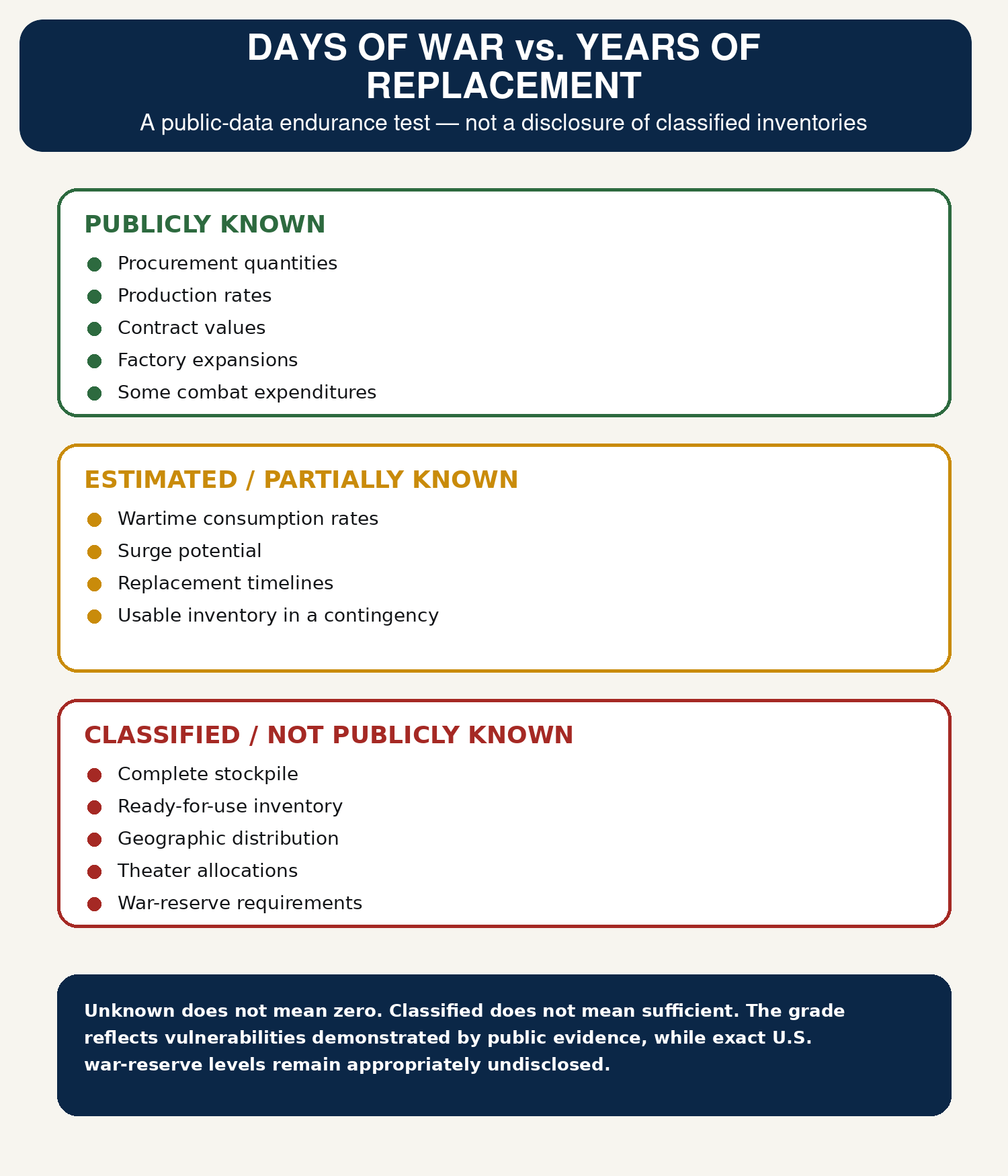
Days of War vs. Years of Replacement — public-data methodology; exact war-reserve inventories remain classified or undisclosed.
16. Rebuilding the Navy
Naval power exposes the hardest replacement problem. GAO reported that the 11 most recent Navy lead ships cost at least $8 billion more than planned, while shipyards face workforce and delivery problems. In August 2026 GAO reported more than 15,000 lost operational days from attack-submarine maintenance delays over a decade and about $3.4 billion in associated costs.
Investment in shipyards, distributed manufacturing and allied expertise is meaningful, but the United States has not yet demonstrated a systemic shipbuilding turnaround.
Expanded evidence — the naval replacement testTap to expandTap to collapse
GAO found the 11 most recent Navy lead ships collectively exceeded planned cost by at least $8 billion. First-of-class complexity is therefore both an innovation problem and a production-discipline problem.
Maintenance backlogs directly reduce deployed capacity even when authorized fleet size is unchanged.
The Navy must build new ships while repairing and modernizing the fleet it already owns. New-construction yards, public yards, private repair yards and lower-tier suppliers are separate bottlenecks.
Australia, Britain, Japan, South Korea and European partners add capital, skilled labor and technical capacity. Their contribution becomes operational only when contracting, security rules, qualification and logistics permit it.
Sources and underlying recordsTap to expandTap to collapse
17. The New American Arsenal
Artificial intelligence (AI), autonomy, drones, software, commercial space, cyber systems, electronic warfare and lower-cost weapons offer a way to create military effects faster than traditional acquisition alone. America’s innovation base remains a major advantage.
The recurring weakness is conversion: promising technology must become contracts, tested systems, production lines, fielded quantities and battlefield effects. Technology leadership without scale is not sufficient.
18. Golden Dome and Homeland Defense
Golden Dome represents an attempt to integrate existing and emerging sensors, command systems and interceptors into a broader homeland missile-defense architecture. Funding and policy direction are real; a nationwide operational shield is not yet demonstrated.
The correct grade is high for policy and funding, developing for integrated architecture and deployment.
19. The Nuclear Shield
The United States is modernizing virtually the entire nuclear enterprise: bombers, ballistic-missile submarines, land-based missiles, warheads and production infrastructure. B-21 production is expanding, while Sentinel remains a cautionary case because of severe cost and schedule problems.
Nuclear modernization is among the most durable parts of the buildup because it spans administrations, congressional appropriations, long-term facilities and enduring military requirements.
Related GIB investigationNuclear Got A Bad Wrap?
Examine reactor safety, fuel, waste, cost and deployment alongside the Trump/DOE strategy behind nuclear power as strategic infrastructure and dependable generation.
Read the nuclear investigation →Project Meridian: the future of warfare · September 30, 2026
Status: commissioned study. Recommendations due January 28, 2027.
The September 30 memorandum directs Chief Technology Officer Emil Michael to commission Project Meridian through a partner organization. It will examine future battlefields, identify capability gaps and recommend practical steps to develop, test and field the weapons and technologies needed to maintain U.S. military superiority. The Joint Staff and all military services are directed to prepare to connect their future-warfare research to the project.
The memorandum names Ai, autonomy, directed energy, robotics and biotechnology among the advances changing warfare. Outside technologists, innovators, business leaders, policymakers and national security experts will contribute perspectives. The Department's accompanying release identifies Elon Musk, Palmer Luckey and Newt Gingrich as co-directors. Findings must support the goals of the 2026 National Security Science and Technology Strategy and reach the Secretary's office within 120 days of announcement, on January 28, 2027.
Connected implementation announcements: the same Department release announced an Autonomous Warfare Command intended to accelerate testing, procurement and fielding of drones and robotic systems, and the FORTRESS program for resilient power, cyber defense, supply chains and installation survivability. These are announced organizational initiatives. Their budgets, final authorities, staffing, acquisition records, tests and operational outcomes remain to be verified.
Assessment: The Trump Administration is establishing a coordinated process to identify what America needs for future warfare. Its industrial significance will depend on whether recommendations become funded development, realistic tests, accepted systems and sustained production. The memorandum establishes the study and deadline; the release names three co-directors, but neither record identifies the partner organization, a Project Meridian budget, contract awards or a specific fielding schedule.
Milestones to watch: identification of the partner and full participant roster; findings and recommendations by January 28; AutoWarCom's formal authority and planned October 2027 operating milestone; FORTRESS implementation; subsequent funding and acquisition decisions; development and testing results; operational acceptance; and evidence of repeatable production and sustainment. Jobs and output should be credited only when documented.
Golden Dome and Space Force are not explicitly named in this memorandum. Connections to those programs should be assessed when the recommendations or implementing decisions establish them.
Connected coverage: The Industrial Machine · National Defense · U.S. Leadership in Ai
Primary sources: Commissioning of Project Meridian: The Future of Warfare · September 30, 2026 (PDF) · Department release on six initiatives · September 30, 2026
PART V — THE INDUSTRIAL MACHINE
Project Meridian: turning future-war requirements into industrial capacityTap to expandTap to collapse
On September 30, 2026, the Secretary commissioned a study of future battlefields, capability gaps and steps to develop, test and field emerging technologies. Recommendations are due January 28, 2027. GIB’s industrial assessment: potential demand for Ai, autonomy, directed energy, robotics and biotechnology must be followed through funding, acquisition, accepted systems and sustained output; the study announcement does not establish factories, production or jobs.
Read the Project Meridian assessment and milestones. Primary source: September 30 commissioning memorandum (PDF).
20. America Starts Making Things Again
Factories convert policy into physical capacity. The investigation uses a five-stage scale: Announced; Funded/Contracted; Construction; Operational; Output Demonstrated.
Projects in Alabama, Mississippi, Ohio, Texas, the Mountain West and other regions show substantial rebuilding, but attribution varies. Some were created under Trump, some accelerated, and some were inherited projects reaching completion during his term.
Related GIB standing coverageU.S. Industrial & Economic Revival
Follow manufacturing, investment, energy, infrastructure, productivity, jobs and completed output as the daily GIB tests industrial announcements against measurable results.
Open Business & Industry intelligence → Related GIB investigationU.S. Economy: Policy, Prosperity & the Evidence
Test whether industrial rebuilding translates into completed output, durable work and household prosperity after fiscal costs.
Open the economic assessment →
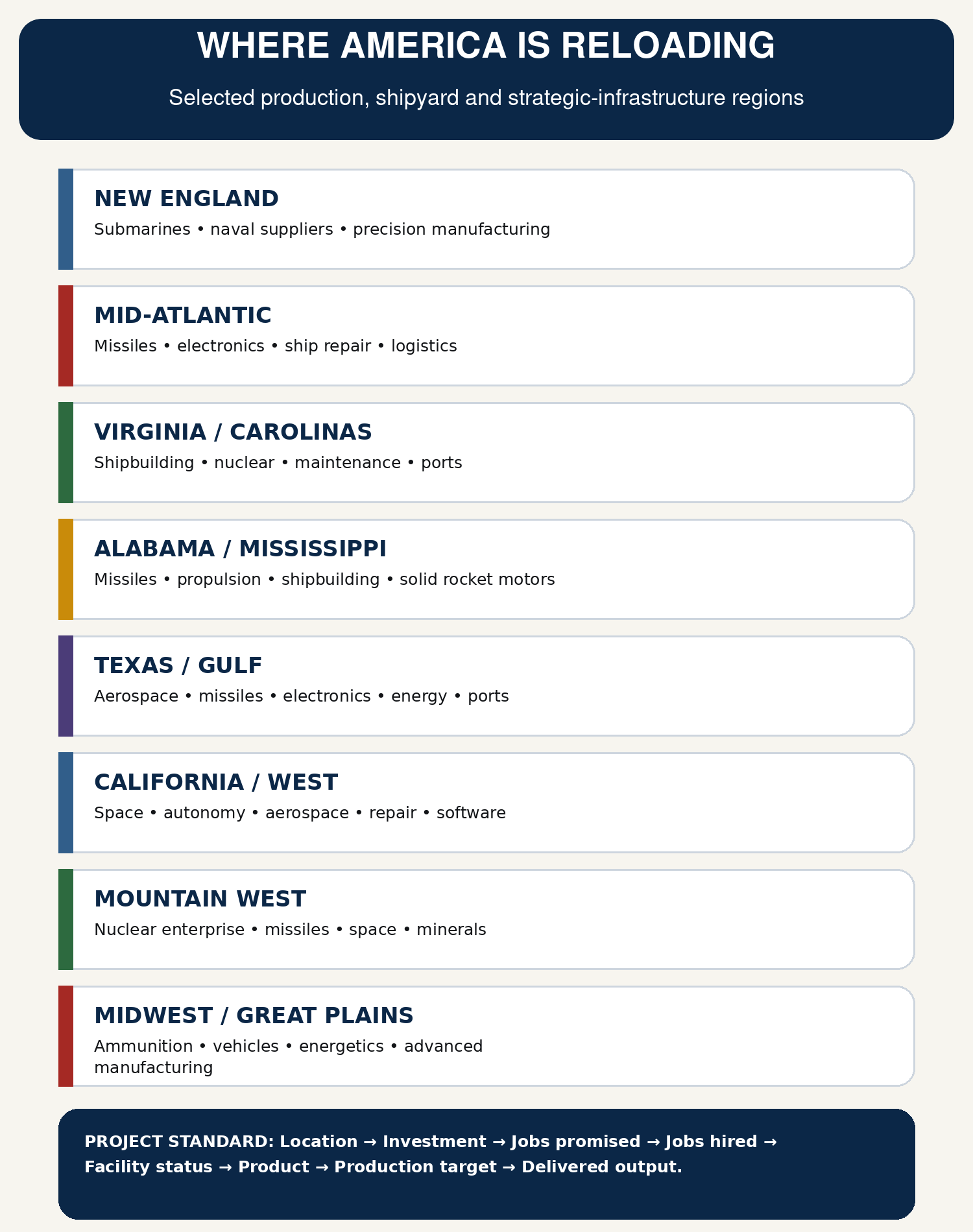
Where America Is Reloading — selected regional centers of defense production and infrastructure.
21. The Supplier Problem
More factories do not guarantee resilience if every factory depends on the same upstream supplier. DoD’s supplier network extends through hundreds of thousands of firms, while visibility into lower tiers remains incomplete.
The key metric is Bottleneck-Adjusted Capacity: the maximum output of a weapons system is constrained by its scarcest critical input, not the headline capacity of final assembly.
CSIS’s 2026 industrial-base work reinforces this system-level test by emphasizing production rate, repair speed, supplier shock absorption and allied mobilization rather than spending totals alone.
Factory and supplier ledger — what must be countedTap to expandTap to collapse
Large plants, shipyards and prime-contract awards are usually identifiable. They are the easiest portion of the rebuilding to document.
Explosives, propellants, rocket motors, forgings and specialty metals can cap output across several weapon families even when final-assembly space expands.
Defense output depends on trusted microelectronics, specialized equipment, software and technicians that may serve several programs simultaneously.
GAO reports that more than 200,000 suppliers support DoD, while existing databases provide little insight into the vast majority or the foreign origin of lower-tier inputs.
Sources and underlying recordsTap to expandTap to collapse
22. Semiconductors and the Electronics Base
Domestic semiconductor manufacturing investment is substantial, but strategic independence requires more than fabs. Equipment, gases, substrates, packaging, testing, software and specialized workers all matter.
Manufacturing expansion is real; the broader research and supply-chain picture is mixed. The article therefore grades manufacturing more strongly than complete semiconductor sovereignty.
Related GIB investigationWhere Society Meets AI Super-intelligence
Connect semiconductor capacity and autonomous systems to the wider evidence on computing infrastructure, national capability, human control and accountability.
Read the AI investigation → Related GIB investigationGlobal AI Power & Governance
Compare American semiconductor and AI capacity with China, allied nations and the laws, infrastructure and strategic choices shaping the global race.
Read the global AI comparison → Strategic DirectiveU.S. Leadership in Artificial Intelligence
Connect semiconductor capacity, autonomous systems and industrial endurance to the national AI objective, implementation record and measurable results.
Open the U.S. leadership hub →Expanded evidence — semiconductor milestonesTap to expandTap to collapse
As of July 2025, Commerce had awarded $30.9 billion in direct incentives and $5.5 billion in loans across projects spanning wafer fabrication, packaging, materials and equipment.
GAO found that milestone dates extended through 2033. One new leading-edge logic facility in Arizona had been certified complete by June 2025.
Commerce projects the investments could move the U.S. share of global leading-edge logic manufacturing from zero in 2022 to 20 percent by 2030. That is a government projection, not a demonstrated outcome.
Advanced packaging, substrates, equipment, specialty chemicals, design software, workforce and secure defense qualification remain necessary parts of sovereignty.
Sources and underlying recordsTap to expandTap to collapse
23. The Critical-Materials War
China retains powerful positions in the processing of several critical minerals. The U.S. response includes mining, separation, refining, recycling and alternative-material projects, but many remain at research, pilot or demonstration scale.
The maturity ladder is Research → Bench → Pilot → Demonstration → Commercial Facility → Commercial Production → Defense-Qualified Production. Money moving into a project is not the same as strategic dependence disappearing.
Expanded evidence — the mineral chainTap to expandTap to collapse
GAO reported that the United States imported more than 95 percent of the rare earths it consumed from 2019 through 2022, with almost three-quarters of those imports coming from China.
DoD’s China report identified major Chinese positions in gallium, germanium, graphite and rare-earth processing. Export licensing and restrictions demonstrate that concentration can become coercive leverage.
By January 2025, DoD said it had awarded more than $439 million to establish domestic rare-earth supply chains. Later mining, recycling and substitution actions expand the response but do not prove defense-qualified volume.
A mine announcement does not solve separation; a separation plant does not solve magnet or component manufacturing. The relevant endpoint is reliable, price-competitive and defense-qualified material at usable scale.
Sources and underlying recordsTap to expandTap to collapse
PART VI — ENERGY AND INFRASTRUCTURE
24. Fueling American Strength
Energy is one of America’s clearest strategic advantages. The country possesses abundant oil, natural gas, coal, nuclear, renewable and hydro resources. The defense problem is ensuring that energy can still reach factories, bases, ports and logistics networks under disruption.
Resource abundance must therefore be distinguished from usable wartime capacity: production, refining, storage, pipelines, terminals, grid resilience and protected delivery all matter.
25. Infrastructure Behind the Military
Military power must move. Ports, railroads, highways, bridges, airports, fuel terminals, warehouses, dry docks and the electric grid are therefore components of national defense.
The Pacific creates the hardest logistics problem because distance magnifies sealift, airlift, tanker, forward-base, fuel and repair requirements. Production + Transportation + Repair + Replenishment = Endurance.
Related GIB investigationData Centers & Public Value
Examine how digital infrastructure draws on the same electric grid, water, land, skilled labor and public investment that support broader industrial and national capacity.
Read the data-centers investigation →Energy and infrastructure endurance testTap to expandTap to collapse
Domestic oil and gas production reduce exposure, but military usefulness depends on refining, storage, protected pipelines, terminals, tankers and distribution at the point of need.
Grid connections, backup generation, microgrids, fuel security and restoration plans determine whether bases, depots and factories continue operating during a regional outage or cyberattack.
Ports, sealift, airlift, tankers, rail access, warehouses and overseas handling capacity must move production across ocean-scale distances. A factory’s output is not combat power until it reaches and can be sustained in theater.
Dry docks, depots, spare parts, technical data and qualified workers determine whether damaged or heavily used systems return to service instead of accumulating in maintenance queues.
Evidence boundary: No single public database measures the complete wartime throughput of this network. GIB therefore grades individual facilities and routes by funded capacity, demonstrated throughput, redundancy and restoration performance—not resource abundance alone.
PART VII — THE ECONOMIC ENGINE
26. Defense Spending as Industrial Policy
The investigation distinguishes defense consumption from defense capital formation. Factories, tooling, shipyards, infrastructure, intellectual property and workforce training can create productive capacity that remains after an individual weapon is expended.
The objective is not maximum defense spending. It is maximum sustainable American strength per taxpayer dollar.
27. Debt, Waste and Fiscal Capacity
Debt is a strategic constraint because interest consumes resources without directly creating military capability. Defense did not create the national debt by itself, but defense strategy cannot ignore the fiscal foundation supporting it.
Waste is also weakness. Slow acquisition, uncontrolled sustainment, duplicative processes and poorly performing programs consume resources that could otherwise buy readiness and industrial capacity. Fiscal capacity is a form of national reserve ammunition.
Fiscal terminology: Gross domestic product (GDP) measures the value of goods and services produced in the economy.
Related GIB investigationGovernment Waste, Fraud & the National Debt
Test debt, interest, improper payments, auditability and industrial strategy against the question of whether borrowed money creates durable national value.
Read the national-debt investigation →Expanded evidence — fiscal capacityTap to expandTap to collapse
GAO reported this April 2026 level at roughly the size of the economy and projected debt held by the public to reach 123 percent of GDP by 2036.
Net interest spending in FY2025 exceeded federal national-defense spending. Interest therefore competes directly with the capacity to finance readiness, infrastructure and other national priorities.
DoD spends more than $1 trillion annually and controls most federal physical assets, yet its financial management remains on GAO’s High-Risk List. A larger buildup increases the importance of reliable asset and cost data.
GAO says congressional and agency action on its duplication and efficiency recommendations has produced about $774.3 billion in financial benefits across government. Verified savings matter, but they do not eliminate structural deficits.
Sources and underlying recordsTap to expandTap to collapse
PART VIII — IRAN: THE REAL-WORLD TEST
28. Iran Tests America’s Ability to Fight
United States Central Command (CENTCOM) describes Operation Epic Fury as 38 days of major combat operations involving more than 10,200 sorties and more than 13,500 strikes. CENTCOM assesses that over 85 percent of Iran’s ballistic-missile, drone and naval defense-industrial base was damaged or destroyed and that 82 percent of its air-defense missile systems were knocked out.
Those percentages are CENTCOM assessments, not independent measurements. Operationally, the campaign demonstrates extraordinary joint-force integration while also revealing replenishment pressure.
Iran operational scorecardTap to expandTap to collapse
CENTCOM reported more than 10,200 sorties and more than 13,500 strikes during 38 days of major combat operations. Those are official operational totals.
The 85-percent and 82-percent damage figures remain CENTCOM assessments. They should not be converted into independently verified destruction percentages without imagery, site-level records or other corroboration.
Interceptors, aircraft hours, maintenance, tanker support, intelligence and protected logistics all create replenishment requirements even when operational objectives are achieved.
Degrading launchers, air defenses and production capacity reduces capability. It does not by itself prove that Iran cannot disperse, repair, import or rebuild portions of the system.
Sources and underlying recordsTap to expandTap to collapse
September 2026: AI-assisted reconnaissance against U.S. naval forcesTap to expandTap to collapse
Anthropic reports that an Iran-nexus actor used Claude to gather public information on U.S. naval movements and personnel, research known shipboard-system vulnerabilities, and produce targeting recommendations. It says it banned the account and shared intelligence with authorities. This is evidence of an adversary's reported reconnaissance workflow, not evidence that a U.S. ship was struck using it or that the Iranian government directed the actor.
The force-protection question is how quickly public movement data, photographs, transponder information, and commercial imagery can be combined into a usable targeting picture. Review information exposure, operational security, and the effectiveness of defensive measures against that specific risk. CSIS notes that AI may accelerate familiar methods and give less experienced actors technical capacity, while downstream combat effects still require separate proof.
Sources and underlying recordsTap to expandTap to collapse
29. Destroying Capability and Restricting Rebuilding
The Iran strategy combines physical attack on command, air defenses, missiles, drones, naval capability, manufacturing and logistics with financial pressure on oil, shipping, banking, offshore assets and sanctions evasion.
The strategic model is simple: destroy capability while restricting the money required to rebuild it. The physical and financial pressure is substantial; permanent dismantlement remains unproven.
Two-track pressure — what would prove durable success?Tap to expandTap to collapse
-
Physical degradation
Named sites, systems and production nodes are damaged and remain unavailable.
-
Financial restriction
Oil, shipping, banking and procurement networks lose usable revenue and transaction channels—not merely receive new designations.
-
Replacement denial
Iran cannot obtain machine tools, electronics, propellants, components or outside technical support at the required rate.
-
Sustained verification
Reconstruction, dispersed production, proxy resupply and restored operational tempo remain below pre-campaign levels over time.
What remains unproved: The public record does not establish permanent dismantlement, full interruption of every sanctions-evasion route or the precise time required for Iran to restore each capability.
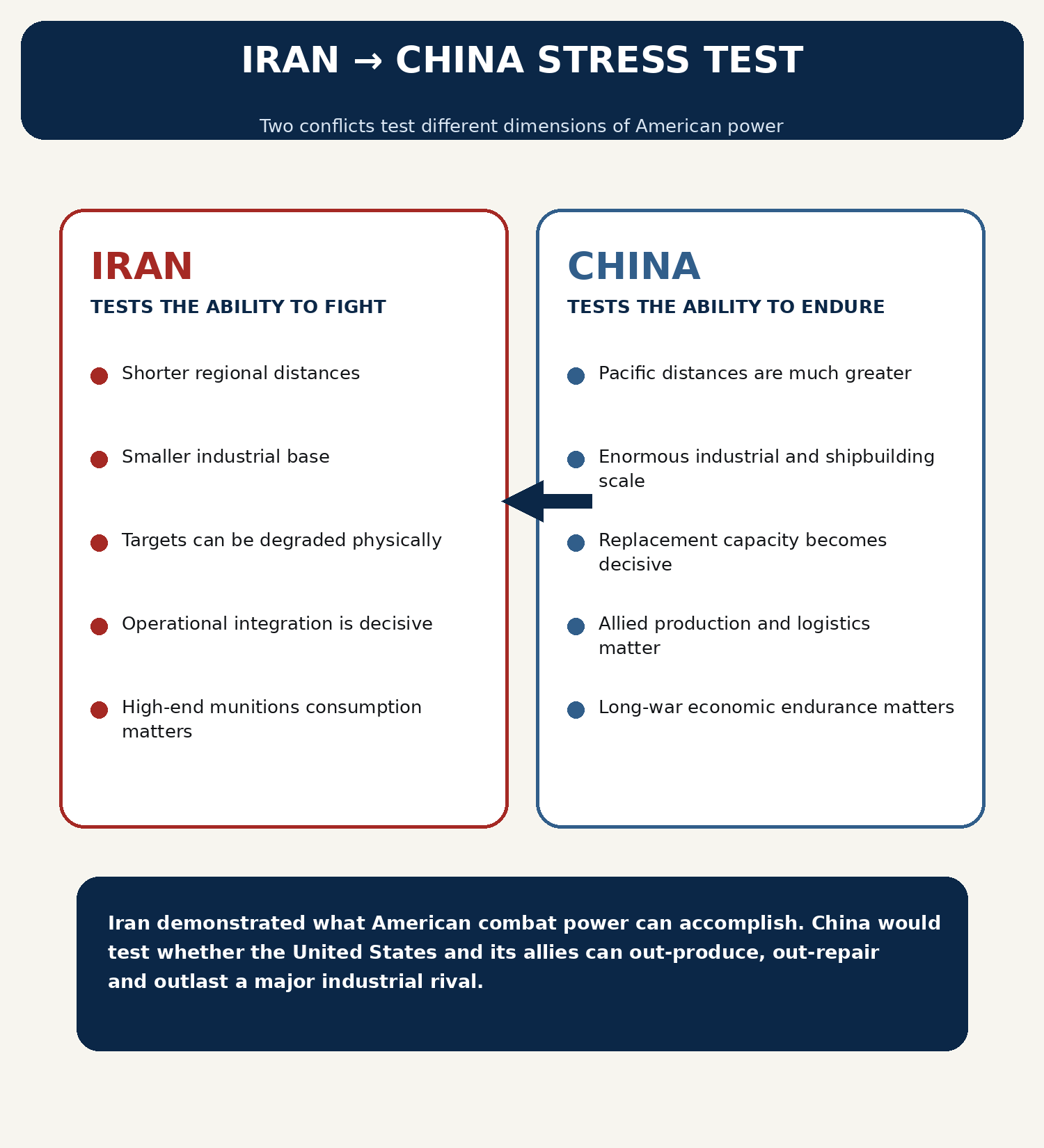
Iran → China Stress Test — Iran tests combat power; China would test national endurance.
Open the two-adversary stress-test dataWhy regional combat success does not prove endurance against an industrial peer
Iran — regional test
Pressure instruments: missiles, drones, proxies, energy routes and cyberattack capacity.
What the operation demonstrated: U.S. sortie generation, precision strike, command integration and regional force projection.
What remains unresolved: replenishment cost, reconstruction denial and durable suppression of Iranian capability.
China — global endurance test
Pressure instruments: industrial scale, shipbuilding, economic leverage, critical-material processing and Indo-Pacific geography.
What America would need: sustained production, repair, protected logistics, allied capacity and fiscal endurance.
What remains unresolved: the usable wartime balance across multiple theaters and the duration each side could replace losses.
PART IX — CHINA: THE ENDURANCE TEST
30. Iran Tests Fighting. China Tests Endurance.
China is not simply a larger Iran. It is an industrial superpower with enormous shipbuilding, manufacturing and mineral-processing capacity. A conflict would therefore test the entire American national system rather than battlefield performance alone.
China also has vulnerabilities. The United States Energy Information Administration (EIA) reported that China, the world’s largest crude importer, imported 8.1 million barrels per day in the second quarter (Q2) of 2026—32 percent below the first quarter (Q1) amid Hormuz disruption. Energy, iron ore, maritime commerce, agricultural inputs and selected advanced technologies create exposure, but not an easy or immediate shutdown mechanism.
China endurance balanceTap to expandTap to collapse
China’s concentrated industrial system can produce and repair at scale. The comparison must measure usable military output, quality, workforce, yard access and wartime survivability—not commercial tonnage alone.
The Q2 2026 crude-import decline shows sensitivity to Hormuz disruption. It does not prove that China lacks reserves, alternative suppliers, pipelines, rationing options or the ability to prioritize military demand.
China’s processing position strengthens its industrial endurance and creates dependencies for the United States and its allies.
The United States retains important advantages in advanced computing, aerospace, software, undersea operations, finance and alliances. The strategic question is whether those advantages can be converted into sustained production and repair.
Sources and underlying recordsTap to expandTap to collapse
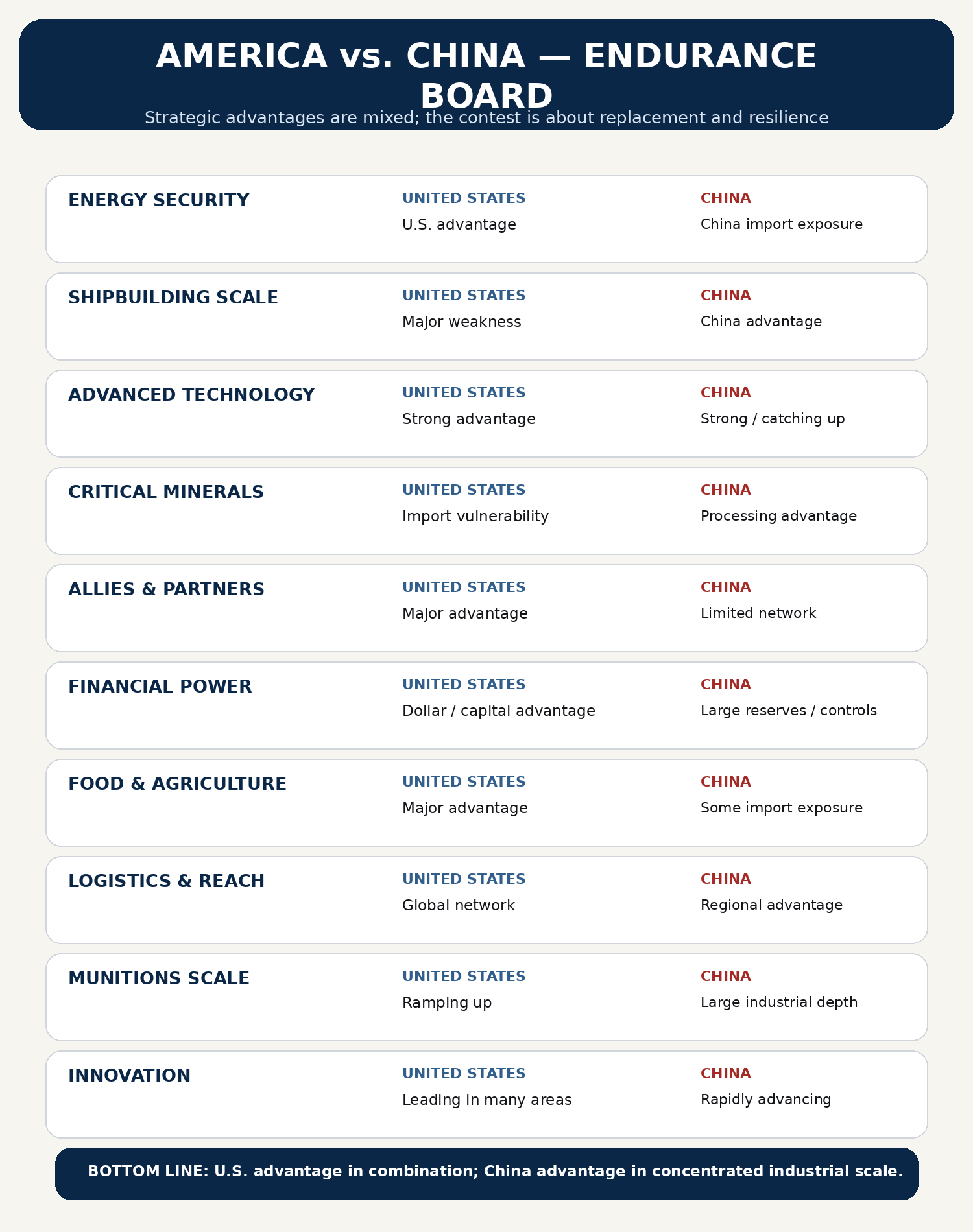
America vs. China Endurance Board — strategic strengths and vulnerabilities relevant to prolonged competition or conflict.
Open the factor-by-factor endurance comparisonThe underlying judgments and limits behind the board
America has a larger domestic resource base; China remains exposed to maritime imports but retains reserves, alternative suppliers and prioritization options.
U.S. capacity is strengthening, while China’s concentrated manufacturing and shipbuilding system remains larger in several relevant sectors.
Domestic and allied projects are developing, but Chinese processing leverage remains a material vulnerability.
American missile and ammunition capacity is expanding; the decisive measure is delivered, qualified output and replacement speed.
The United States has the stronger global network, provided partner capacity is interoperable and politically available.
Advanced computing, aerospace, undersea systems and software are strengths; China is narrowing gaps in several fields.
America has financial and alliance advantages, but debt and supply-chain exposure matter. China faces structural risks while retaining large industrial capacity.
31. America’s Alliance Advantage and the Multi-Theater Test
China’s industrial advantage is concentration. America’s greatest potential advantage is combination. Japan, South Korea, Australia, Canada, Britain and European allies add shipbuilding, aerospace, missiles, minerals, nuclear expertise, repair capacity and industrial depth.
Potential capacity is not automatically usable wartime capacity. It must be interoperable, contracted, politically available and logistically connected. Simultaneous pressure in the Pacific, Europe, Middle East and Korea would still stress finite American assets.
Alliance terminology: The Australia–United Kingdom–United States security partnership (AUKUS) and Guided Multiple Launch Rocket System (GMLRS) production are evaluated below.
Alliance capacity — from diplomatic asset to production systemTap to expandTap to collapse
Submarine-industrial cooperation and advanced-capability development can add capital, training and technical depth. AUKUS was established before Trump’s second term and is appropriately graded Inherited/Continued + Expanded.
DoD has identified Australian production work involving GMLRS and technical-data sharing for M795 artillery ammunition.
Allied initiatives include planned German production of Patriot GEM-T missiles and increased European artillery and energetics capacity.
Japan, South Korea, the Philippines and other partners can contribute repair, basing, shipbuilding, logistics and production. Political approval, contracting and interoperable standards determine whether that capacity is available in a crisis.
Sources and underlying recordsTap to expandTap to collapse
PART X — MAKING THE REBUILDING LAST
32. Will America’s Rebuilding Endure?
The final durability test is whether reforms move from presidential direction into law, appropriations, multiyear contracts, factories, delivered capability and institutional habit. Concrete is more durable than policy language. Production is more durable than concrete.
The investigation’s final judgment is B — Substantial Rebuilding Underway. America is materially stronger in several dimensions but is not yet fully reloaded for a prolonged peer conflict. The hopeful outcome is not permanent mobilization or war. It is deterrence: a United States so capable of fighting, repairing, replacing, financing and enduring that adversaries conclude aggression cannot succeed.
The purpose of America Reloaded is therefore not war. Its highest measure of success is the wars American strength prevents—and the safer, more prosperous country that strength leaves to the generations that follow.
Durability tracker — how much survives one administration?Tap to expandTap to collapse
Executive direction exists; sustained cycle-time improvement remains to be demonstrated and institutionalized.
Goals were achieved, but retention, specialty balance, training capacity and future recruiting conditions determine durability.
Multiyear demand and plant investment improve staying power; delivered output and replenished inventories remain the final test.
Long-lived yards and submarines make investment durable, but schedule, maintenance and workforce performance remain weak.
Statutory funding and facilities span administrations; milestones and domestic supply-chain completion extend into the 2030s.
Mines, processing and recycling facilities can outlast policy, but dependency falls only when qualified commercial production is sustained.
Facilities and platforms have broad institutional durability, while Sentinel’s cost and schedule problems remain a warning.
The initiative becomes durable only through architecture, testing, fielded layers, trained operators and recurring sustainment.
Defense capacity cannot remain durable if interest, deficits, waste and unstable appropriations erode the resources required to sustain it.
Bottom line: Presidential direction can start the rebuilding. Law, appropriations, multiyear contracts, factories, workers, delivered output and institutional habit determine whether it lasts.
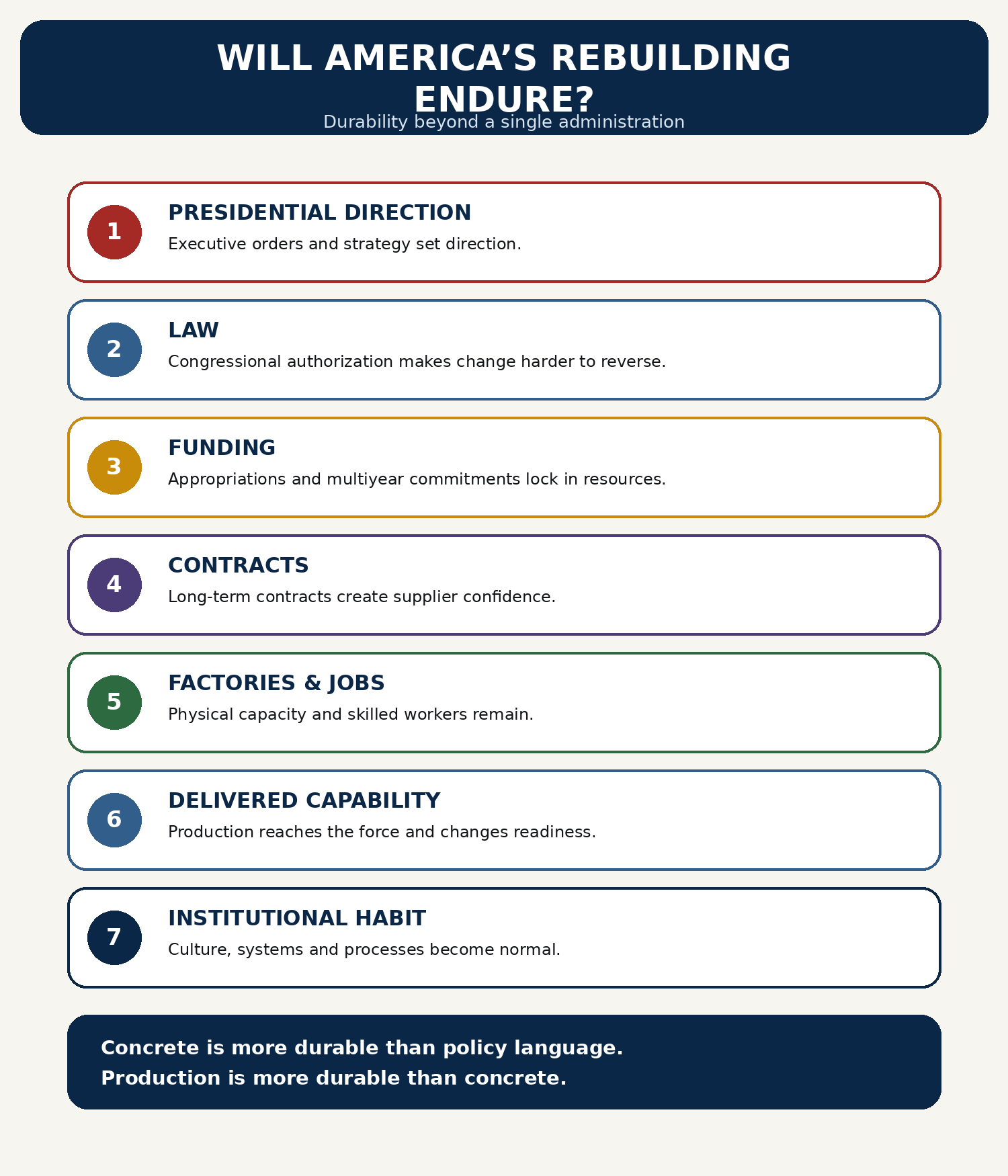
Will America’s Rebuilding Endure? — the durability ladder from presidential direction to institutional habit.
Final America Reloaded Scorecard
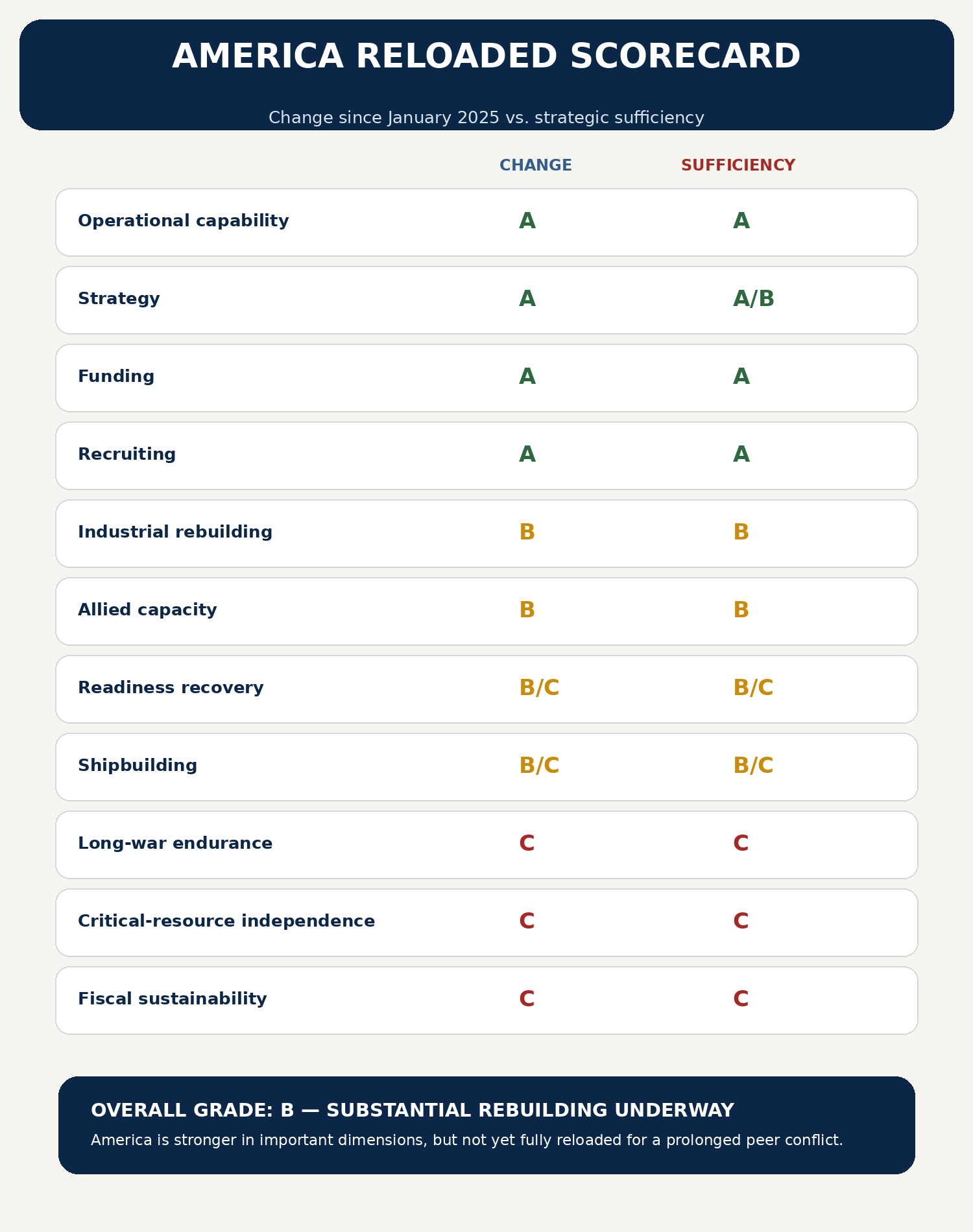
America Reloaded Scorecard — change since January 2025 compared with strategic sufficiency.
Overall grade: B — Substantial Rebuilding Underway. Operational capability remains the strongest pillar; long-war endurance, critical-resource independence, shipbuilding, Pacific logistics and fiscal sustainability remain the principal constraints.
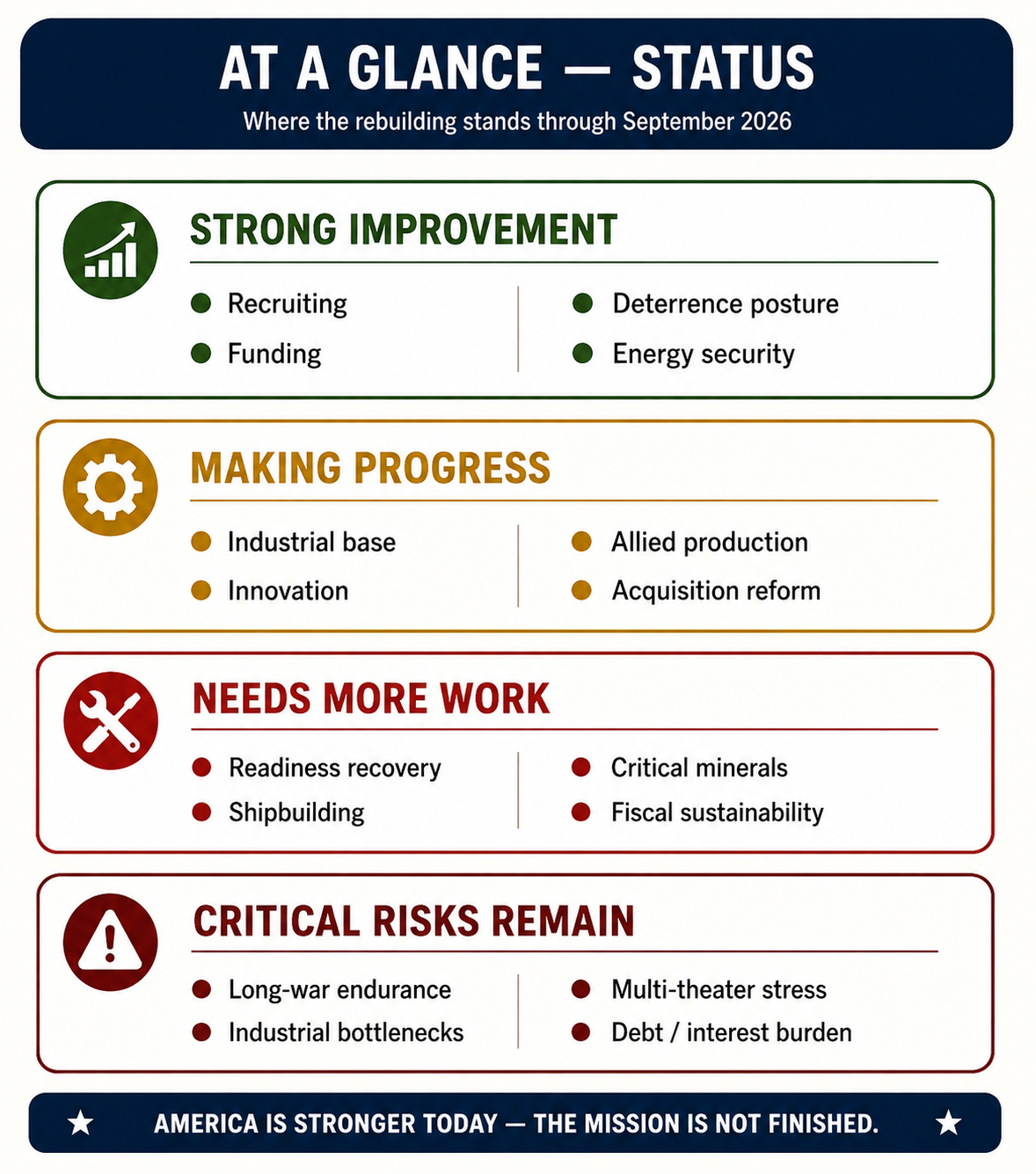
At a Glance — approved two-column status layout, with balanced spacing for iPhone readability.
Open the evidence behind the four status groupsWhy each item is classified as improvement, progress, unfinished work or critical risk
Recruiting, funding, deterrence posture and energy security show the clearest positive movement, while each still has narrower unresolved constraints.
The industrial base, innovation, allied production and acquisition reform have policy, funding or construction evidence but incomplete delivered outcomes.
Readiness recovery, shipbuilding, critical minerals and fiscal sustainability remain below the level required for a prolonged peer conflict.
Long-war endurance, industrial bottlenecks, multi-theater stress and debt/interest burden could constrain otherwise strong operational capability.
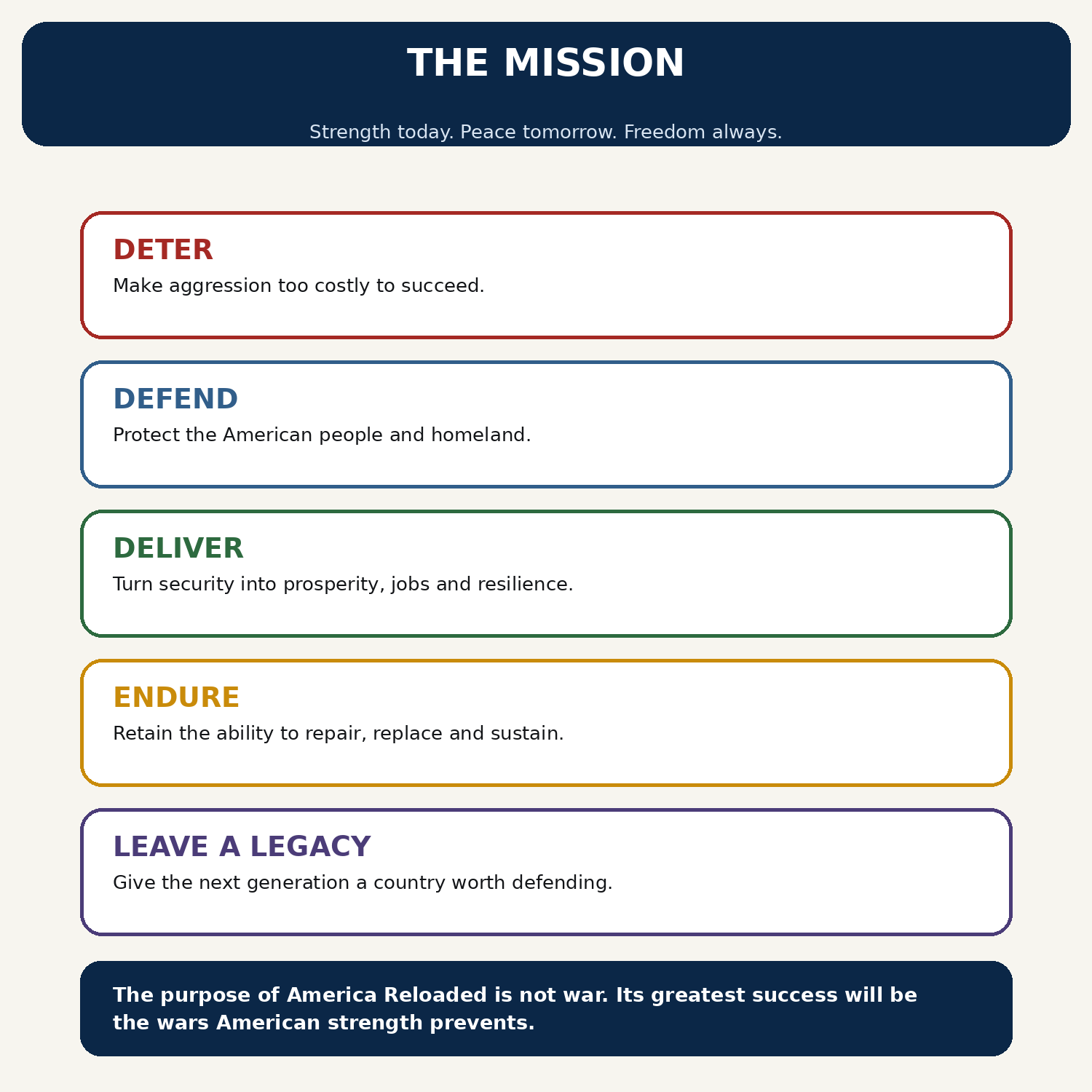
The Mission — deterrence, defense, prosperity, endurance and a durable national legacy.
Final Attribution Audit
Acquisition reform / EO 14265 — Created
Policy framework originated in Trump II; outcome speed still developing.
Golden Dome — Created
Trump II architecture and funding initiative; components include inherited technologies.
Recruiting recovery — Trump-era Result
Goals achieved during Trump II; causation is multi-factor and began before the final result.
155mm expansion — Inherited/Continued + Accelerated
Major expansion began during Biden/Ukraine period; continued and incorporated into Trump buildup.
Munitions multiyear expansion — Expanded/Accelerated
Existing missile families; procurement scale and long-term contracts expanded.
AUKUS — Inherited/Continued + Expanded
Established under Biden; continued as allied industrial strategy.
Submarine industrial-base investment — Inherited/Continued + Accelerated
Large investments predate Trump II; new actions add capacity and distributed production.
B-21 Raider — Inherited/Continued + Accelerated
Program predates Trump II; production expansion funded during current term.
Sentinel ICBM — Inherited + Restructured
Inherited troubled program; restructuring is current-era action.
Pantex HESE — Inherited/Continued; Trump-era Result
Construction began in 2020; facility reached completion in 2026.
Y-12 processing milestones — Inherited/Continued; Trump-era Result
Long-running nuclear modernization produced measurable 2026 milestones.
CHIPS manufacturing projects — Inherited/Continued + Modified
Statutory program predates Trump II; implementation and R&D direction changed.
Critical-mineral acceleration — Expanded/Accelerated
Longstanding problem; 2026 funding and DPA actions materially expanded response.
Energy DPA / national-defense energy strategy — Created
2026 Trump actions explicitly tied large-scale energy and petroleum infrastructure to national defense.
AI national-security framework — Created/Restructured
Trump II memorandum replaced prior framework and redirected adoption.
Drone dominance / airspace actions — Created/Expanded
Trump II executive actions accelerated domestic drone and counter-drone policy.
Iran Operation Epic Fury — Created; Trump-era Result
Current administration military campaign; CENTCOM operational assessments clearly attributed.
Iran financial pressure — Expanded/Accelerated
Sanctions architecture predates Trump; current administration intensified and combined it with military pressure.
Freedom250 / patriotic education initiatives — Created/Expanded
Current administration initiatives; national-confidence outcome remains developing.
DoD civilian workforce reductions — Restructured
Current administration action; strategic net effect remains unresolved.
Allied co-production / Finland-model approach — Expanded/Accelerated
Alliance and co-production foundations predate Trump; current policy pushes allied capital and technology into U.S. capacity.
Verified Source Ledger — Publication Audit
1. GAO-26-109135 — Weapon Systems Acquisition
Major programs now exceed 12 years to initial capability; systemic acquisition waste and leading-practice comparison.
https://www.gao.gov/products/gao-26-109135
2. Executive Order 14265 — Modernizing Defense Acquisitions
Commercial-first preference, rapid authorities, workforce reform and 15% schedule/cost review threshold.
3. GAO-26-108113 — F-35 Sustainment
Mission-capable rate 67% to 44%; full-mission-capable 38% to 25%, FY2021–FY2025.
https://www.gao.gov/products/gao-26-108113
4. GAO-26-109068 — Navy and Coast Guard Shipbuilding
Shipbuilding cost/schedule problems; last 11 lead ships at least $8B over planned cost.
https://www.gao.gov/products/gao-26-109068
5. GAO-26-109256 — Attack Submarine Maintenance
More than 15,000 lost operational days and about $3.4B in costs over 10 years.
https://www.gao.gov/products/gao-26-109256
6. Army FY26 Recruiting
More than 61,500 active-duty contracts; goal met four months early.
https://www.army.mil/article/292740/us_army_meets_fy26_recruiting_goals
7. Navy FY26 Recruiting
45,000 future Sailors contracted by July 2, 2026.
8. Air Force / Space Force FY26 Recruiting
32,000 active-duty Airmen and Guardians; goal met five months early.
9. CENTCOM — Operation Epic Fury assessment
CENTCOM assessment: 10,200+ sorties, 13,500+ strikes, 85%+ specified Iranian DIB damage, 82% air-defense missile systems knocked out.
10. EIA — China crude imports Q2 2026
China imported 8.1 million b/d in Q2 2026, 32% below Q1; contextualizes energy vulnerability.
https://www.eia.gov/todayinenergy/detail.php?id=67905
11. GAO-26-108100 — DoD Civilian Workforce
DoD civilian workforce fell about 10% / 78,000 in 2025; impact analysis inconsistent.
https://www.gao.gov/products/gao-26-108100
12. GAO-26-107065 — Continuing Resolutions and Defense
Program delays, increased costs, operational effects and administrative burdens reported across a selected group of defense activities and acquisition programs.
https://www.gao.gov/products/gao-26-107065
13. DoD — FY2025 Recruiting Results
Service-by-service accession goals and achieved totals; establishes the recruiting-recovery benchmark without resolving specialty or retention gaps.
14. GAO-26-107827 — Military Child Care
Readiness and retention significance; approximately 171,000 children served by DoD programs in FY2024.
https://www.gao.gov/products/gao-26-107827
15. GAO-25-107604 — Predictive Maintenance Follow-Up
Maintenance spending, implementation weaknesses and the services’ designation of accountable predictive-maintenance authorities.
https://www.gao.gov/products/gao-25-107604
16. DoD — PAC-3 MSE Production Framework
Official plan to increase annual interceptor production capacity from approximately 600 to 2,000.
17. DoD Inspector General DOWIG-2026-095 — 155mm Ammunition
Management and production-capacity review for the Army’s 155mm high-explosive ammunition expansion.
https://media.defense.gov/2026/Jul/10/2003960034/-1/-1/1/DOWIG-2026-095_REDACTED_FINAL%20SECURE.PDF
18. GAO-25-107283 — Defense Foreign-Supplier Risk
More than 200,000 defense suppliers and limited visibility into lower-tier manufacturing origin and dependency.
https://www.gao.gov/products/gao-25-107283
19. GAO-26-107882 — Semiconductor Projects
Awards to 19 companies for 40 projects, funding and loan totals, milestone completion, locations and projected leading-edge capacity.
https://www.gao.gov/products/gao-26-107882
20. GAO-24-107176 and GAO-26-108687 — Critical Materials
Rare-earth import exposure, Chinese supply-chain leverage and near-term substitution and recycling options.
https://www.gao.gov/products/gao-24-107176
https://www.gao.gov/products/gao-26-108687
21. GAO-26-108610 and GAO-26-109115 — Fiscal Health and DoD Auditability
Public debt, interest burden, fiscal trajectory and the Defense Department’s continuing financial-management limitations.
https://www.gao.gov/products/gao-26-108610
https://www.gao.gov/products/gao-26-109115
22. DoD — Allied Industrial-Base Cooperation
Australia, Britain, Europe and Indo-Pacific cooperation involving submarines, guided weapons, artillery, production and sustainment.
CSIS Secondary Analysis and Underlying Records
Source role: The Center for Strategic and International Studies is used as a secondary analytical reference, not as a substitute for primary evidence. Its estimates and judgments are identified as CSIS analysis. GIB follows the cited record back to Defense Department budget exhibits, Navy and service documents, congressional material, contract announcements, foreign-military-sales notifications and company production disclosures whenever those records are publicly available.
23. CSIS — Reindustrialization and Great Power Competition: Deterrence by Capacity
Connects deterrence to production, repair, supplier resilience and allied mobilization. Its source trail includes Executive Orders 13806, 14017, 14265 and 14383; the National Defense Industrial Strategy; Defense Department and congressional program records; DPA investments; and contractor production announcements.
https://www.csis.org/analysis/reindustrialization-and-great-power-competition-deterrence-capacity
24. CSIS — Rebuilding U.S. Missile Inventory: A Multiyear Project
Provides independently modeled replacement timelines for Tomahawk, THAAD, Patriot, SM-3, SM-6, JASSM and PrSM. CSIS states that its delivery estimates rely primarily on production rates and procurement lead times drawn from Defense Department budget justification books and P-21 production schedules, supplemented by service, DSCA and company records. Because inventories remain classified, GIB presents these as analytical estimates rather than confirmed stockpile counts.
https://www.csis.org/analysis/rebuilding-us-missile-inventory-multiyear-project
25. CSIS — How Quickly Can the DoD Rebuild and Recast the Munitions Industrial Base?
Examines the speed at which funding, contracts, tooling, labor and lower-tier suppliers can become delivered munitions capacity. It is used to test the difference between authorized expansion, rated capacity and actual output.
https://www.csis.org/analysis/how-quickly-can-dod-rebuild-and-recast-munitions-industrial-base
26. CSIS — Outlining the Challenges to U.S. Naval Shipbuilding
Provides a system-level assessment of naval construction and maintenance constraints, including workforce, supplier, infrastructure, design and acquisition problems. GIB cross-checks its findings against GAO shipbuilding and submarine-maintenance records and Navy plans.
https://www.csis.org/analysis/outlining-challenges-us-naval-shipbuilding