Where Society Meets AI Super-intelligence / Complete web edition
Sections 11–20
Earlier research record · Read current edition
Ethics, Institutions, Threats and Protection
The governance record: the ethics of AI and its experts, competing schools of thought, U.S. primary-source priority, Congress and legislation, institutions directing AI, threats to beneficial systems, organized opposition, criminal use and proportionate protection.
Project, Research, Analysis, Editorial by Patrick Russell; assisted by ChatGPT (OpenAI).
On this page10 sections · open directory
11. The Ethics of AI—and of the Experts
AI ethics should be central to the investigation because technical capability does not determine legitimate use. Ethical questions include privacy, consent, ownership, discrimination, truthfulness, manipulation, safety, accountability, due process, freedom of expression, human autonomy, and access to opportunity.
The ethics of experts must also be examined. Expertise does not eliminate incentives. Researchers, executives, government officials, investors, nonprofit leaders, and public advocates may benefit from particular narratives concerning risk, regulation, openness, safety, competition, or urgency.
Every expert should be evaluated through an ethics and incentives ledger:
- Demonstrated expertise and record of accurate predictions
- Financial interests and corporate holdings
- Government contracts or regulatory relationships
- Political and institutional affiliations
- Sources of research funding
- Transparency about uncertainty and mistakes
- Willingness to engage credible opposing evidence
- Difference between public-interest claims and measurable results
12. Experts and Competing Schools of Thought
No single expert should define the investigation. Credibility must be assessed claim by claim.
Elon Musk should be included as a significant source because he has helped build and fund major AI ventures, publicly warned about advanced AI risk, advocated regulation, supported open development in some contexts, and participated directly in the competition over AI infrastructure and products. His experience provides important insight, but he is also a business owner, investor, political participant, and competitor whose interests must be disclosed when evaluating his claims.
The investigation should compare Musk with researchers, builders, critics, and public officials representing different perspectives, including figures such as Geoffrey Hinton, Yoshua Bengio, Yann LeCun, Fei-Fei Li, Demis Hassabis, Sam Altman, Dario Amodei, Andrew Ng, and other relevant specialists. Inclusion does not equal endorsement. Their predictions should be dated, preserved, and later compared with outcomes.
Technical claims should also be checked against peer-reviewed research, reproducible evaluations, NIST, national laboratories, universities, professional societies, and independent auditors.
13. United States Primary-Source Priority
For questions concerning American AI policy, constitutional government, federal implementation, scientific competitiveness, national security, and the interests of the American people, the investigation will give primary weight to authoritative United States sources.
These include:
- Presidential executive orders, memoranda, and official White House policy
- White House Office of Science and Technology Policy
- National Artificial Intelligence Initiative Office
- President’s Council of Advisors on Science and Technology
- National Science and Technology Council
- AI.gov and the American AI Action Plan
- Office of Management and Budget
- National Security Council and public National Security Presidential Memoranda
- Congress, enacted legislation, and appropriations
- Federal courts and the United States Supreme Court
- NIST, CAISI, CISA, NSA, GAO, NSF, DARPA, and Department of Energy national laboratories
Michael Kratsios is the Director of OSTP and a co-chair of PCAST. David Sacks is the White House Special Advisor for AI and Crypto—also identified by the administration as its AI and Crypto Czar—and co-chairs PCAST with Kratsios. The National AI Initiative Office was established to coordinate implementation of the National AI Initiative Act across the federal government.
This priority reflects institutional relevance and lawful American authority. It does not mean that every administration statement will be accepted without examination. Policy intentions, legal requirements, scientific findings, implementation results, political advocacy, and measurable outcomes must remain separate categories.
Authority Must Match the Claim
Executive orders and presidential memoranda establish what the President directed.
OSTP, AI.gov, OMB, NSC, Kratsios, Sacks, and the AI Action Plan establish administration policy and priorities.
Statutes, regulations, and controlling court decisions establish American legal requirements.
NIST, CAISI, CISA, NSA, laboratories, reproducible testing, and independent research help establish technical performance and security.
Agency records, inspectors general, budget execution, and GAO audits help establish whether federal programs worked.
Public NSPMs establish presidential national-security direction but do not independently prove successful implementation.
October 8, 2026: President Escalates the Terminology Campaign
President Donald Trump’s verified Truth Social account said the White House considers anyone who uses ‘Artificial Intelligence’ instead of ‘Super Intelligence’ to be ‘THE ENEMY.’ This establishes the President’s stated position and rhetoric. It does not, by itself, identify a person, allege a crime, create a penalty, or expand federal authority.
Established fact: the September 29 executive order directs executive departments and agencies, to the maximum extent permitted by law, to use ‘Super Intelligence’ and ‘SI’ in official communications and non-statutory documents. It preserves historical and previously issued legal records and temporarily applies the existing statutory definition of artificial intelligence. The order states no penalty for using the conventional term and does not bind private citizens, companies, Congress, or state governments.
Material contrary evidence: Axios reported on October 8 that White House pages still used ‘AI’ after the President’s post. The White House technology-priority page likewise continued to describe United States leadership in artificial intelligence. This shows incomplete implementation; it does not invalidate the executive-branch directive.
Inference and unresolved questions: the post appears intended to pressure faster adoption of the preferred terminology, but no new executive order, regulation, enforcement memorandum, penalty, personnel action, or formal designation of any person as an enemy was identified. The record does not establish that ‘Super Intelligence’ has replaced ‘artificial intelligence’ in statute, technical standards, or general industry usage.
October 4, 2026: Super Intelligence Force Announced
President Donald Trump’s verified Truth Social account announced a federal Super Intelligence Force led by Director of National Intelligence Jay Clayton, FTC Chairman Andrew Ferguson, Under Secretary and chief technology officer Emil Michael, and OPM Director Scott Kupor. The President described the force as coordinating federal engagement with consumers, public-interest and religious organizations, critical-infrastructure providers, and artificial-intelligence companies, with reporting to the President and the White House chief of staff. Official agency records independently confirm the four named officials’ positions.
Established fact: the presidential announcement is public and identifies a cross-agency leadership structure. Reuters reported, based on a Wall Street Journal interview with Clayton, that the group is expected to review risks and opportunities, evaluate federal response mechanisms, and report within 120 days. The underlying charter was not located in the public materials reviewed for this update, so those details remain attributed reporting rather than independently inspected primary text.
Inference: the membership places intelligence, consumer protection, defense technology, and federal technical staffing inside one coordination forum. This is a reasonable reading of the named offices, not proof of the force’s legal authority, budget, jurisdiction, or final work program.
What remains unproved: no public executive order, memorandum, charter, complete membership roster, meeting record, budget, enforcement delegation, reporting protocol, or implementation evidence was located. The announcement does not by itself establish new statutory powers, binding obligations for companies, completed oversight, or measurable public benefit.
14. Congress and Legislation
Congress should be examined through bill text, amendments, committee records, testimony, votes, appropriations, oversight, and enacted statutes. Member press releases establish a legislator’s position but do not establish that a proposal became law.
Every legislative claim should identify its actual status:
- Announced or discussed
- Introduced or reintroduced
- Considered by a committee
- Passed by one chamber
- Passed by Congress
- Signed into law
- Implemented through regulations and funding
- Challenged, blocked, amended, or interpreted by a court
Congress.gov is authoritative for bill text and status. The Congressional Research Service provides legislative analysis, while GAO audits implementation. Federal Register notices, Regulations.gov records, OMB memoranda, agency rules, and court decisions establish different stages of policy and law.
15. Institutions Driving the Direction of AI
No single institution directs artificial intelligence. Its direction is distributed among organizations that control frontier models, training data, computing capacity, capital, deployment platforms, technical standards, public procurement, and law. Institutional importance should therefore be measured by actual authority and control—not by publicity, prestige, or access to conferences.
Frontier Model Developers
The greatest direct technical influence belongs to OpenAI, Google DeepMind, Anthropic, Meta AI, and SpaceXAI/xAI, together with internationally important developers such as Alibaba/Qwen, DeepSeek, and Mistral AI. These organizations choose model architectures, training and evaluation methods, release policies, safety controls, permitted uses, and whether model weights remain proprietary or broadly available. Their own statements establish their policies and intentions, not independent proof of safety, capability, or public benefit.
Chips, Cloud, Data Centers, and Energy
AI development is constrained by the institutions controlling its physical capacity. NVIDIA, AMD, semiconductor manufacturers and equipment suppliers, Microsoft Azure, Amazon Web Services, Google Cloud, Oracle, CoreWeave, data-center operators, utilities, and energy providers influence who can obtain advanced computing, at what price, and under what conditions. Control over chips, electricity, water, land, transmission, networking, and construction can shape AI as decisively as model design.
Government, Law, and National Strategy
In the United States, the President and White House, OSTP, OMB, NIST, DOE and the national laboratories, DOD and DARPA, the National Security Council, Congress, federal courts, and sector regulators shape research funding, procurement, infrastructure, export controls, standards, competition, civil rights, safety, and national security. China’s State Council, cybersecurity and industrial ministries, state research institutions, and major technology companies form a parallel center of national power. The European Commission and European AI Office exert substantial regulatory leverage through the EU AI Act. Binding law, executive policy, voluntary guidance, procurement conditions, and political advocacy must remain separate categories.
Standards, Research, and Independent Measurement
NIST, ISO/IEC JTC 1/SC 42, IEEE, national AI-safety institutes, and independent evaluators shape the terminology, testing, documentation, audit, and risk-management practices used across the field. Stanford HAI, MIT CSAIL, Berkeley AI Research, Carnegie Mellon, and other universities influence foundational research, benchmarks, technical talent, and public interpretation. Their contributions can be substantial, but funding, corporate partnerships, methodology, reproducibility, and ideological assumptions must still be examined claim by claim.
Capital, Platforms, and Major Deployers
Microsoft, Amazon, Google, Oracle, SoftBank, venture investors, sovereign investment funds, and government purchasers influence which laboratories and infrastructure projects can expand. Apple, Microsoft, Google, Meta, Amazon, healthcare systems, schools, financial institutions, defense organizations, and government agencies determine how AI actually reaches citizens. Deployment power matters because an institution can shape human behavior without building the underlying model.
Institutions With Limited or Sector-Specific Influence
The OECD/GPAI and Council of Europe can influence international norms and policy coordination. The World Economic Forum is a private convening organization that can document corporate thinking and promote policy proposals, but it has no sovereign, legislative, or regulatory authority over the American public. WHO is relevant to health-related AI, not AI governance generally. The United Nations is relevant to international negotiations and member-state positions, but it does not establish American law or constitutional authority. These bodies may provide evidence and context; they should not be presented as the principal institutions driving AI’s technical development or United States policy.
The Institutional Accountability Vacuum
Distributed power can produce an accountability vacuum: the developer says the deployer chose the use; the deployer says it relied on the model; the cloud provider says it supplied infrastructure; management says automation produced the result; and regulators dispute jurisdiction. The investigation should identify who controls the model, data, compute, objective, deployment, and ability to stop or correct the system; who receives the benefit; and who remains legally and morally responsible when harm occurs. If affected people cannot obtain an explanation, correction, appeal, or remedy from an identifiable authority, accountability has not remained meaningfully human.
16. Threats, Vulnerabilities and Barriers to Beneficial AI
AI systems can be attacked, manipulated, stolen, degraded, or captured. Significant threats include:
- Poisoning training or retrieval data
- Adversarial inputs designed to produce incorrect outputs
- Prompt injection and unauthorized instructions
- Model theft, intellectual-property theft, and foreign espionage
- Extraction of private or confidential information
- Hidden backdoors, malicious fine-tuning, and model tampering
- Compromised software, models, connectors, vendors, or cloud services
- Theft of credentials used by AI agents
- Manipulated benchmarks and contaminated evaluations
- Dependence on concentrated chip, cloud, data, energy, and water resources
- Cyberattacks or physical attacks against data centers
- Political censorship, propaganda, or institutional control of model behavior
- Regulatory capture, monopoly power, and barriers preventing competition
- Public distrust following concealed or poorly handled failures
NIST identifies categories of adversarial machine-learning attacks including evasion, poisoning, privacy attacks, and misuse. No current defense can guarantee protection against every manipulation.
17. Organized Opposition, Anti-AI Campaigns, and Restrictive Interests
“Anti-AI” is an imprecise political label. It may describe a movement seeking to prohibit advanced AI, but it is sometimes used to dismiss people seeking narrower protections. A union negotiating over digital replicas, an author demanding licensing, a privacy organization opposing biometric surveillance, or a community contesting a data center is not necessarily opposed to AI itself. The investigation should classify each actor by its stated objective and documented conduct rather than by rhetoric used by supporters or opponents.
The investigation should map at least nine forms of organized resistance or restriction:
- Explicit movements for a general pause or ban
- Campaigns focused on frontier AI, artificial general intelligence, or superintelligence
- Labor unions bargaining over displacement, surveillance, workload, consent, and compensation
- Authors, artists, performers, publishers, and rights holders seeking copyright, licensing, attribution, or likeness protections
- Privacy and civil-liberties groups opposing surveillance, facial recognition, opaque profiling, or automated government decisions
- Local campaigns concerning data-center land use, electricity, water, noise, tax incentives, and community consent
- Legislators and political organizations proposing moratoria, licensing, liability, procurement limits, or restrictions on particular applications
- Businesses, trade associations, lobbyists, and incumbents whose preferred rules may protect safety, preserve market power, suppress competitors, or accomplish several of these purposes at once
- Foreign governments or aligned interests using regulation, export controls, standards, cyber operations, or information campaigns for strategic advantage
Named examples should be described precisely. PauseAI advocates an international pause covering the most powerful systems. The Future of Life Institute organized the 2023 letter seeking a six-month pause on training systems more powerful than GPT-4 and later supported a prohibition on developing superintelligence until it can be done safely, controllably, and with broad public support. These are not equivalent to opposition to every present-day AI application.
SAG-AFTRA seeks consent, compensation, and protections governing digital replicas. The Authors Guild supports licensing and has pursued litigation over alleged unauthorized training uses. The Human Artistry Campaign promotes principles intended to protect human creators. The AFL-CIO’s “Workers First” initiative emphasizes worker voice, rights, training, and bargaining. Their positions may limit particular uses of AI, but the evidence does not justify automatically describing them as blanket anti-AI organizations.
In 2026, Senator Bernie Sanders and Representative Alexandria Ocasio-Cortez announced proposed legislation for a federal moratorium on new AI data centers until specified safeguards were established. The investigation must label this as a legislative proposal unless and until it becomes law, examine its stated concerns about energy, water, communities, workers, and consumers, and also analyze potential effects on innovation, infrastructure, national security, prices, regional development, and foreign competition.
Lobbying requires symmetrical scrutiny. The investigation should use Lobbying Disclosure Act filings, regulatory comments, campaign-finance records, association memberships, grants, litigation funding where discoverable, and government contracts to identify who funds both restrictive and expansionary AI campaigns. It should not infer a hidden sponsor merely from a shared position.
For each campaign or actor, ask:
- What is actually sought: a ban, pause, moratorium, license, bargaining right, payment, disclosure, safety test, local veto, or application-specific rule?
- What evidence supports the claimed harm, and what language is prediction, advocacy, or fear-based rhetoric?
- What financial, occupational, ideological, political, competitive, or national interest may be advanced?
- Would the proposal reduce harm, entrench incumbents, suppress open-source development, restrict lawful speech, or transfer advantage abroad?
- What genuine problem has the criticism identified, even if its proposed remedy is excessive?
- Who pays the cost of action, and who pays the cost of inaction?
18. Threats Created by AI Use
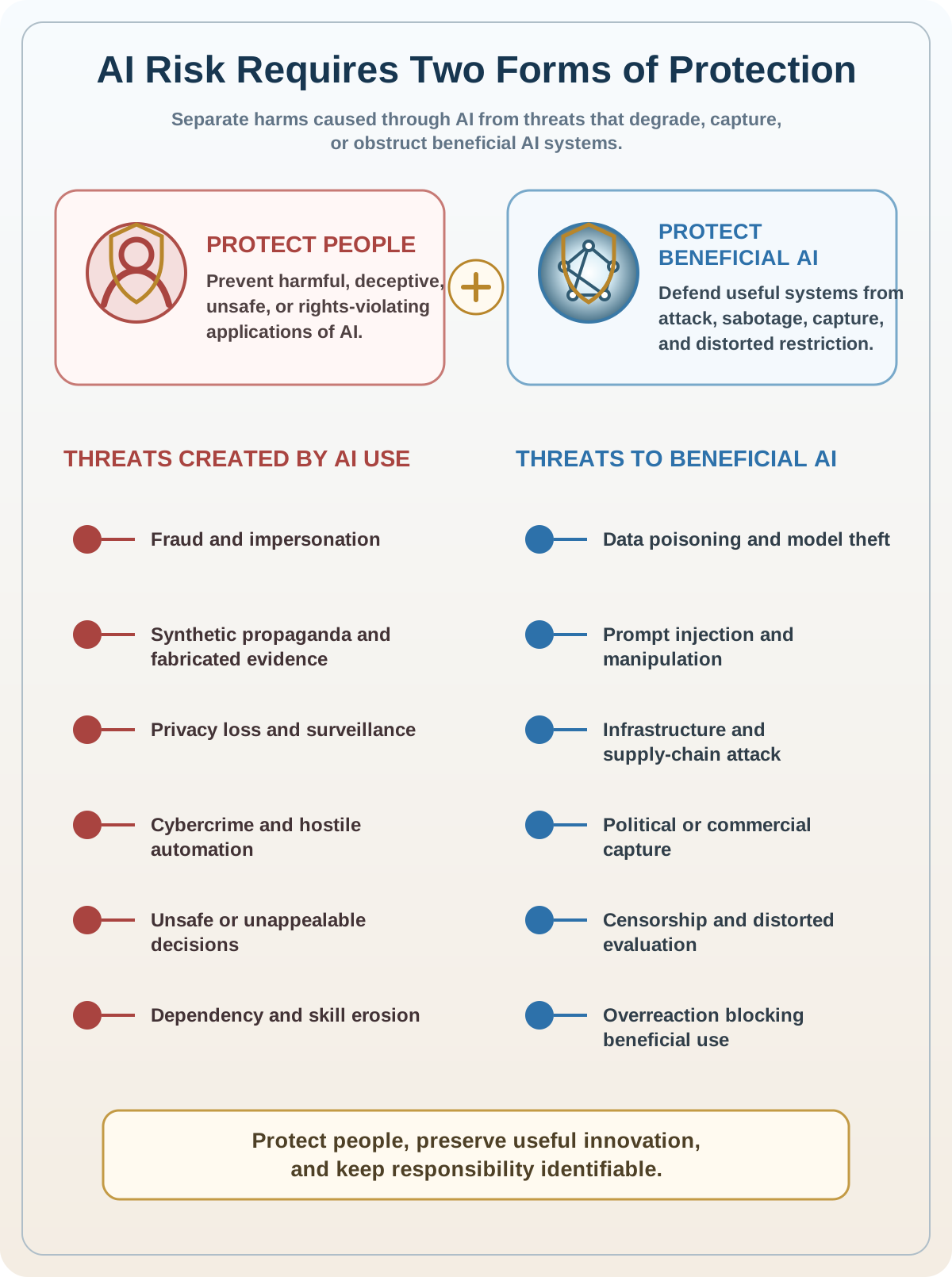
People
Risks include incorrect health, legal, or financial advice; deepfake fraud; identity theft; privacy invasion; surveillance; discriminatory decisions; emotional manipulation; sycophancy; dependency; skill loss; and decisions that cannot be explained or appealed.
Institutions and Democracy
AI can generate false documents, recordings, citations, comments, evidence, and identities at scale. It can increase propaganda, make authentic evidence easier to dismiss, overwhelm public processes with synthetic submissions, centralize control over information, and conceal accountability behind automation.
Businesses
Businesses face confidential-data leakage, fraud, cyberattack, inaccurate automated decisions, intellectual-property disputes, regulatory liability, vendor lock-in, model outages, workforce deskilling, and dependence upon a small number of technology providers.
Industries and Critical Infrastructure
In health, finance, energy, water, transportation, communications, manufacturing, and defense, a faulty or compromised system can produce cascading consequences. Critical systems require independent validation, controlled access, manual fallbacks, incident response, and clear human responsibility.
United States Government
Government AI deserves a particularly high standard because it can affect liberty, benefits, taxation, immigration, law enforcement, military action, and access to essential services.
The investigation should examine classified or personal data leakage, foreign supply-chain dependence, prompt injection through submitted documents, incorrect intelligence, discriminatory administrative decisions, surveillance, vendor lock-in, political manipulation, unauthorized agent actions, inadequate logs, weak appeals, and loss of institutional expertise.
National Security
AI may increase the speed, scale, personalization, or accessibility of cyberattacks, phishing, malware, foreign influence, synthetic political media, financial fraud, military targeting, autonomous weapons, biological or chemical misuse, surveillance, and strategic technology theft. It can also strengthen cyber defense, intelligence analysis, scientific discovery, emergency response, and infrastructure monitoring. Offensive and defensive capabilities must be compared rather than assumed.
19. Criminal and Hostile Use of AI Today
AI is already being used to support crime and hostile activity. Its role is often to increase speed, scale, personalization, translation, concealment, or credibility rather than to invent a wholly new offense. The investigation should cover fraud and impersonation; phishing and social engineering; malware and vulnerability research; identity theft and fraudulent remote-worker schemes; nonconsensual sexual imagery and child sexual abuse material; extortion and cyberstalking; manipulated streaming and royalty systems; propaganda and covert influence; state-affiliated cyber operations; theft of models, data, chips, and intellectual property; export-control evasion; and criminal marketplaces.
The FBI reported that its 2025 Internet Crime Report recorded 22,364 complaints containing an AI-related descriptor and nearly $893 million in associated losses. The figure measures reported complaints and losses, not every AI-enabled crime or a court finding that AI caused each loss. The FBI has also warned of criminals using AI-generated voice messages to impersonate senior United States officials. Treasury’s Financial Crimes Enforcement Network has warned financial institutions about fraud schemes involving deepfake media.
Law-enforcement cases illustrate the range and the need for careful legal wording. The Department of Justice reported a conviction involving receipt and possession of AI-generated child sexual abuse material. Europol announced arrests in an international operation involving AI-generated child sexual abuse material. In a separate American case, prosecutors charged a musician with using AI-generated songs and automated accounts in an alleged streaming-fraud scheme; a charge is an accusation and does not establish guilt.
Provider reports have associated AI-assisted malicious activity with actors linked to China, Russia, Iran, and North Korea. OpenAI and Microsoft reported disrupting accounts associated with groups they track as Charcoal Typhoon, Salmon Typhoon, Crimson Sandstorm, Emerald Sleet, and Forest Blizzard. Such reports can provide valuable operational evidence, but they remain provider attributions unless corroborated by government findings, court records, or independent research.
Country attribution must be exact. “Linked to a country” can mean a state agency, a state-directed or state-affiliated group, an independent criminal group operating from that territory, or merely infrastructure located there. A provider’s removal of accounts does not by itself prove that a national government ordered the activity. Broader United States intelligence assessments identifying China, Russia, Iran, North Korea, and ransomware groups as cyber threats should not be misquoted as proof that every named actor used AI.
Maintain a threat-actor ledger recording:
- Person, organization, criminal group, provider-assigned alias, or country connection
- Alleged or established conduct and the affected people or systems
- AI’s specific role and whether that role is confirmed or inferred
- Source type: victim report, company report, intelligence assessment, indictment, trial evidence, conviction, or sanctions action
- Legal status and date
- Attribution confidence, corroboration, competing explanations, and unresolved questions
- Current defensive measure and evidence that it works
This ledger prevents a list of dramatic names from becoming a list of untested accusations. It also makes visible when the same technique migrates from state actors to organized crime or ordinary fraud.
September 2026 case study: AI-assisted naval reconnaissance
Anthropic reports that an Iran-nexus actor used Claude to assemble publicly accessible information on U.S. naval movements and personnel, research known shipboard-system vulnerabilities, and develop targeting recommendations. The actor built a Python pipeline with Claude’s help to compile targeting handbooks. Anthropic says it banned the account, strengthened detection, and shared intelligence with authorities. This is a provider-documented misuse case; the public report does not establish that a U.S. warship was attacked using the recommendations, that Claude controlled a weapon, or that the Iranian government directed the actor.
Distinct cases in the same report
A northern Yemen-based cell used Claude in guided-rocket and missile software work. Anthropic reports a guided-rocket field test that appears to have failed and says it has no evidence of an operational device being fielded. Other cases describe China-linked surveillance of diaspora and religious communities, a China-based anti-torpedo development effort, and covert influence operations. Each has a different actor, AI role, attribution basis, and outcome; none should be folded into the Iran naval case.
CSIS assesses that these cases often accelerate established reconnaissance, cyber, surveillance, and propaganda methods. The important additional risk is that less experienced actors may acquire technical capacity they previously lacked. Anthropic has direct platform visibility but a commercial stake in the policy debate; CSIS supplies strategic interpretation, not independent access to every account log. Public government confirmation of the specific naval operation and evidence of downstream harm remain open.
20. Protecting People and Systems
Safeguards should include authenticated and traceable data, secure-by-design development, least-privilege access, tool restrictions, independent evaluations, red-team testing, human approval for consequential actions, continuous monitoring, incident disclosure, meaningful appeal rights, manual fallbacks, recovery plans, vendor diversity, and clear liability.
The phrase “human in the loop” is insufficient by itself. The human must have the knowledge, time, authority, evidence, and independence required to challenge or stop the system.
Nondelegation Test
Before an AI system participates in a consequential decision, require a written answer to four questions: What may the system do? What must a human independently decide? What evidence must the human inspect? Who is accountable when the system or the human is wrong? If the responsible person cannot override the output, understand its basis, or operate without it, the decision has effectively been delegated regardless of the formal policy.