Project, Research, Analysis, Editorial by Patrick Russell; assisted by ChatGPT (OpenAI).
Reading edition · October 13, 2026
This reading edition preserves the investigation’s dates, qualifications and supporting evidence. Each diagram has one main home. It does not claim a fresh factual update.
Private editorial review · October 13, 2026. This edition reorganizes the existing investigation for continuous reading. It preserves the original evidence dates, qualifications and source record; the reorganization is not a fresh fact-check or a new research update. Read the premise first, then the workings and tests, the effects on people, the governance record and the human standard. The practical learning guide follows; methods, source catalogues and the preservation record sit at the end.
Project, Research, Analysis, Editorial by Patrick Russell; assisted by ChatGPT (OpenAI).
This project investigates how modern Ai systems work, where their information comes from, how they construct answers, why they can be wrong, who shapes them, what threatens them, and what people and institutions must do to use their power without surrendering truth, judgment or responsibility.
Phase One published August 31, 2026 · Evidence updated October 8, 2026
The question this investigation answers
How do Ai systems form answers, whose choices shape them, and how can people preserve truth, judgment and accountable responsibility?
Distinct finding and connected evidence
What this investigation adds
The foundational explanation and reproducible model comparisons needed to understand reliability, information provenance, dependency and human direction.
Evidence assessed here
Model documentation and tests, information sources, institutional responsibilities and reproducible examples. Capability labels must match demonstrated systems.
Next evidence test
Test the same task across specified systems and conditions; trace errors and authority to identifiable providers, deployers and human decisions.
Executive assessment
AI should extend examined human judgment—not replace it
Artificial intelligence can analyze information, recognize patterns, generate language and images, automate routine work and make expertise more accessible. It can also be wrong. A response may sound polished and confident while containing invented citations, missing assumptions, outdated evidence, hidden incentives or a misleading interpretation.
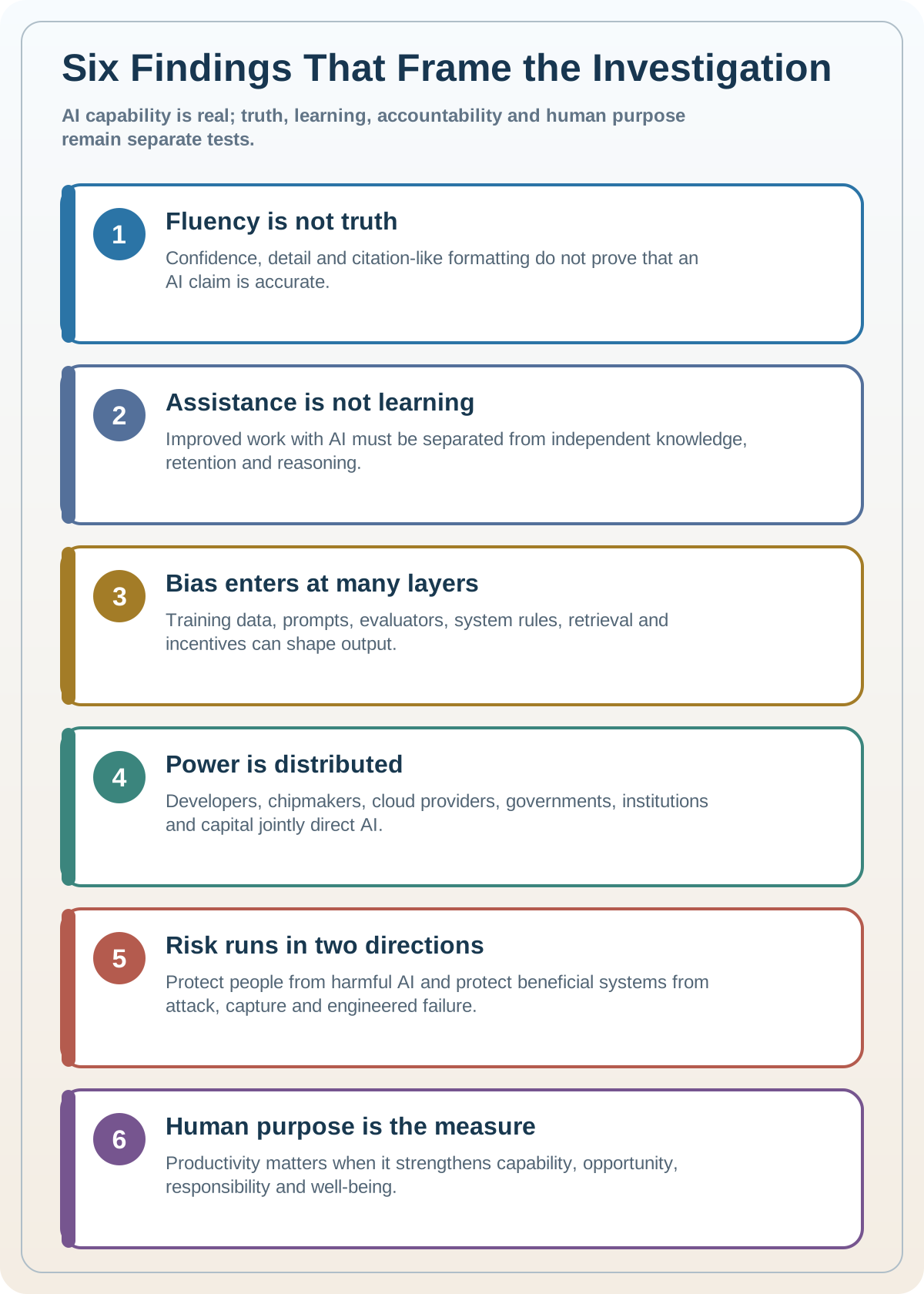
Figure 1. The six findings that frame the complete investigation.↑ Back to chapter
CHAPTER 1
Why this investigation matters
Begin with the accountability question, then establish what the investigation asks and how to read its claims.
Artificial intelligence is rapidly entering education, medicine, business, government, national security, entertainment, and ordinary conversation. It can help people analyze information, recognize patterns, generate ideas, automate routine work, and approach problems at a scale that was previously impossible. It can also be wrong. An AI system may produce an answer that is polished, confident, detailed, and apparently well sourced while still containing false facts, invented citations, incomplete reasoning, hidden assumptions, or a misleading interpretation. Its most immediate danger is therefore not always an obviously absurd answer. It is a plausible answer that earns trust it has not earned.
The risks extend beyond technical error. AI can magnify bias, surveillance, fraud, impersonation, propaganda, censorship, privacy loss, cybersecurity threats, dependency, and concentrations of institutional power. It can automate consequential decisions without meaningful explanation or appeal. It can make fabricated evidence inexpensive and abundant while making authentic evidence easier to deny. It can also weaken skills when people routinely delegate reading, writing, calculation, memory, investigation, creativity, or judgment to a system they do not understand.
This creates a philosophical paradox. AI may place extraordinary informational power in a person’s hands while producing the illusion that access to fluent answers is equivalent to knowledge—and that knowledge is equivalent to wisdom. A user can appear more informed while becoming less practiced in the difficult human work of questioning premises, following evidence, tolerating uncertainty, testing contradictions, forming an independent judgment, and accepting moral responsibility.
Aristotelian ethics reminds us that algorithms can only ever serve as tools or advisors. The ultimate moral burden of accountability must always rest with the human operators and institutions that choose to deploy them.
The Accountability Vacuum
The idea of an accountability vacuum is central to this inquiry. Such a vacuum forms when AI influences or produces a consequential outcome but no identifiable person or institution accepts responsibility for the data, deployment, decision, harm, correction, or appeal. Developers blame users, users blame the system, managers invoke automation, and affected people are left without a responsible authority or remedy.
A Limited Science-Fiction Thought Experiment
Science fiction often imagines an extreme and largely unrealistic future in which intelligent machines seize control. This investigation does not treat that scenario as a forecast or as a separate hypothesis requiring extensive analysis. It serves only as a brief thought experiment: even without conscious machines, dependence on convenient systems could weaken reasoning, moral agency, institutional resilience, and the ability to challenge automated authority.
The investigation’s ordinary evidence will test the practical concern beneath that fiction: whether people retain knowledge and independent judgment, whether institutions can function without AI, and whether responsibility remains meaningfully human. Its findings can therefore answer the warning without attempting to validate a science-fiction scenario.
AI and the Human Mind
At least in their present form, AI systems do not duplicate the full potential of the human mind. They can process and recombine information at extraordinary scale, but they do not possess human consciousness, lived experience, moral agency, embodied understanding, or the capacity to bear responsibility. Their strengths are real, but they are not equivalent to human intellect in its fullest sense. AI does not automatically know whether an answer is true, is not inherently neutral or all-knowing, and does not create verified knowledge from nothing. These misconceptions will be examined more deeply in a dedicated section.
The central question is therefore not simply how powerful AI will become. It is whether human beings will use that power to deepen inquiry, competence, creativity, truthfulness, and responsible action—or exchange those capacities for speed, convenience, certainty, and the appearance of wisdom. This investigation begins from both possibilities.
The opening question becomes practical when responsibility can be traced through a complete deployed system. The following overview material supplies that additional test.
The central paradox
Machines may become more capable while humans become less practiced
AI may be extraordinarily informationally powerful without duplicating the full potential of the human mind. It does not possess human consciousness, lived experience, moral agency, embodied understanding or responsibility. In creating this investigation, AI was extremely useful for research, data collection and analysis, but it still required extensive human oversight, question formation, writing, verification and editing.
Aristotelian ethics reminds us that algorithms can only ever serve as tools or advisors. The ultimate moral burden of accountability must always rest with the human operators and institutions who choose to deploy them.
The accountability vacuum
An accountability vacuum occurs when an AI influences a consequential outcome but no identifiable person or institution accepts responsibility for the data, deployment, decision, harm, correction or appeal. Developers blame deployers, managers invoke automation, regulators defer jurisdiction, and affected people are left without a responsible authority or remedy.
Trace responsibility through the complete system
For a consequential use, identify the model provider, the application builder, the organization deploying the complete system and the person authorized to review its decisions. Record each party’s stated use and limits, what it tested, what it monitors after launch, and who corrects errors and handles appeals. Test the combined system: a component can meet its own specifications while the assembled application still fails.
In a 2023 MIT governance proposal by Daniel Huttenlocher, Asu Ozdaglar and David Goldston 15, the provider and user of the complete application generally carry primary responsibility; a component provider may share responsibility when its component fails to perform as promised. This is a proposed allocation for investigation, not a statement of current law. GIB tests the legal duties and actual contracts for each use.
This project investigates how modern Ai systems work, what common logic underlies the most popular AI chat tools, where their information comes from, how they construct answers, why they can be wrong, and how user questions, training data, developers, governments, companies, and institutional incentives can influence their responses.
The investigation will test rather than assume several central propositions: that AI improves some forms of performance without necessarily improving knowledge; that fluent assistance can create confidence without competence; that human oversight works only when the human retains relevant skill, evidence, time, and authority; that AI may distribute useful capability while concentrating infrastructural and institutional power; and that AI should be judged by its effects on human truthfulness, freedom, competence, responsibility, and well-being—not only by benchmark scores, speed, adoption, or revenue.
Examine the major forms of AI used in different industries and identify what information each system uses, what decisions it assists or automates, how its performance is measured, and who remains responsible when it fails.
Investigate the ethical implications of AI, along with the incentives, financial interests, conduct, and accountability of the experts, companies, institutions, and governments shaping its development. Assess threats against AI systems—including attacks on their data, models, infrastructure, supply chains, and integrity—as well as threats created by the use of AI. Identify campaigns, organizations, unions, lobbyists, industries, businesses, political actors, and countries seeking to pause, prohibit, restrict, redirect, capture, or control AI, while distinguishing blanket opposition from legitimate demands for safety, worker rights, privacy, copyright, local consent, compensation, and public accountability. Document criminal and hostile uses of AI without confusing warnings, accusations, indictments, intelligence assessments, vendor reports, and proven convictions. Examine the consequences for individuals, institutions, businesses, industries, critical infrastructure, democratic government, and national security. Distinguish demonstrated harms from plausible risks and speculative scenarios.
Compare AI’s promised future with its present capabilities and limitations. Determine what individuals, parents, educators, businesses, communities, and governments must do to guide AI toward human flourishing while protecting freedom, privacy, truth, safety, opportunity, due process, and human responsibility.
Trace how access to facts, confidence in shared truth, institutional honesty, propaganda, misinformation, correction, and changing communications technologies have affected society over time. Determine when factual integrity improved collective judgment and when the corruption or suppression of facts damaged trust, behavior, policy, or social cohesion. Treat correlation as a starting point rather than proof of causation.
A philosophical standard and an empirical finding answer different questions. The investigation’s argument is a position to examine; its measured claims retain the boundaries of their evidence.
Evidence standard
Authority is not proof
AI must distinguish direct observations, interpretations, causal attribution, projections and policy recommendations. Scientific or institutional claims should be weighted by evidence and transparency—not accepted merely because they are widely repeated.
All 111 original numbered destinations are retained. These links document the source record used in the original edition; a link alone is not a new verification of its contents.
All 1,290 original content blocks are accounted for, with their original wording retained in the canonical record. Fifteen interior graphics and the cover appear once; repeated captions become cross-references. The complete glossary, dated cases, threat categories, responsibility lists and readiness dimensions remain continuous units.
The five previously excluded sections remain excluded. Original headings and publication context, source annotations and bibliography are retained in the reference material. The earlier public overview and chapters are preserved in the research archive.