Political Counteroffensive / Deep Dive 2
Lawfare, Elections & the Legal Record
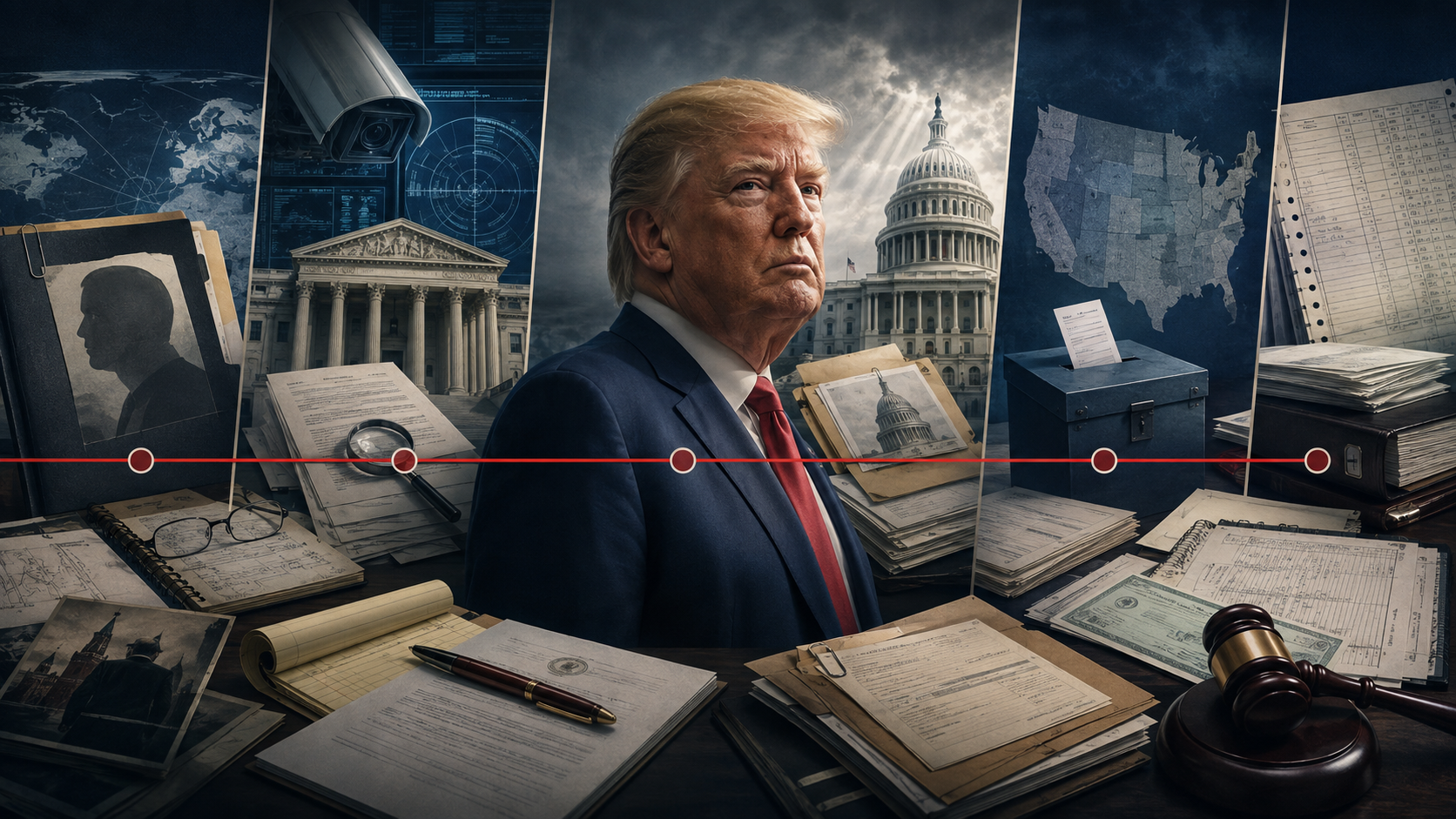
A chronological account separating Russian activity, cyber attribution, disputed intelligence judgments, campaign contacts and legal proof before tracing surveillance, former-official media pressure, impeachment, election conflict, ballot exclusion and criminal prosecutions.
Project, Research, Analysis, Editorial by Patrick Russell; assisted by ChatGPT (OpenAI).
Chronological orientation
How the Legal Conflict Developed
Read left to right on larger screens or top to bottom on iPhone. Each phase created the setting for the next, but the connecting line represents sequence—not proof that one authority directed every event. Expand any phase to examine the record and its limits.
- 012026 / Witness updateCohen’s Pressure AllegationLater statements and the missing primary record.
View research+
Allegation reported; coercion not establishedThe update below separates the reported pressure allegation, the civil-case records request and the September pardon discussion.
- January 16: reported allegation involving James and Bragg.
- March 11: reported request for Cohen communications in the civil case.
- September 9: Reuters reports Trump would consider a pardon.
- 022015–2016Opposition ResearchThe Steele dossier, Russian interference and campaign-contact questions emerge.
View research+
Documented funding; separate Russian operationTwo facts became politically fused but must be graded separately: Democratic-funded opposition research produced the Steele reports, while Russian actors conducted distinct cyber and influence operations.
- Hillary for America and the DNC paid Perkins Coie, which retained Fusion GPS; the FEC later resolved disclosure violations concerning how those payments were reported.
- Mueller and Senate investigators documented Russian interference, but Mueller did not establish that the Trump campaign conspired or coordinated with the Russian government.
- Campaign contacts, cyber attribution and the truth of individual dossier allegations are separate evidentiary questions.
Primary recordsNew York Post — Cohen alleges prosecutorial coercion (January 16, 2026) ↗New York Post — Trump seeks Cohen communications (March 11, 2026) ↗Reuters — Trump says he would consider a Cohen pardon (September 9, 2026) ↗Federal Election Commission — MUR 7449 ↗Department of Justice — Mueller Report ↗Senate Intelligence Committee — Russian Active Measures, Volumes I–V ↗ - 032016–2019Intelligence, FBI & MediaBrennan, Clapper, Comey, Crossfire Hurricane, surveillance and public accusations.
View research+
Valid predicate; serious execution failuresOfficial reviews support a dual finding: the FBI had an authorized basis to open Crossfire Hurricane, yet the surveillance process later accumulated consequential accuracy, disclosure and supervisory failures.
- The inspector general found sufficient predication to open the investigation and did not find documentary or testimonial evidence that political bias caused the opening decisions.
- The same review identified 17 significant inaccuracies or omissions in the Carter Page FISA applications and failures to meet the FBI's accuracy obligations.
- Mueller established extensive Russian activity and contacts but did not establish a chargeable campaign conspiracy; Durham later criticized the FBI's analytical rigor and use of uncorroborated information.
- 042019–2021Impeachment & ElectionUkraine impeachment, COVID-era rule changes and post-election litigation.
View research+
Real events; sharply contested conclusionsThe Ukraine pressure campaign and extraordinary 2020 election-rule changes are documented. Their constitutional meaning, legal authority and effect must be judged jurisdiction by jurisdiction rather than collapsed into a single claim.
- The House impeached Trump over Ukraine and the Senate acquitted him; the underlying call and pressure were real, while removal remained a constitutional and political judgment.
- States changed deadlines, mail-voting procedures and administrative rules through different combinations of legislatures, executives and courts during the pandemic.
- Many post-election suits ended on standing, timing, jurisdiction or pleading grounds; the public record has not established enough invalid presidential votes to reverse the certified result.
- 052021–2024Pressure & ExclusionFederal-platform contacts and attempts to remove Trump from state ballots.
View research+
Contacts and litigation proven; merits partly unresolvedGovernment pressure on social platforms and Fourteenth Amendment ballot challenges created two distinct constitutional disputes. The Supreme Court disposed of them on different, relatively narrow grounds.
- The record documents repeated federal contacts with platforms concerning disputed information; platforms also made independent moderation decisions under their own rules.
- In Murthy v. Missouri, the Supreme Court found the plaintiffs lacked standing and therefore did not decide the underlying First Amendment merits.
- In Trump v. Anderson, the Court held that Colorado could not use its state process to remove a federal candidate under Section 3; it did not decide whether Trump engaged in insurrection.
- 062023–2026Criminal ProsecutionsFour cases create legal and campaign risk during Trump's return bid.
View research+
34 records from one reimbursement arrangementThe New York verdict did not concern 34 separate hush-money payments or 34 independent schemes. One reimbursement stream generated 34 accounting documents, and prosecutors charged each document separately.
- Exact breakdown: 11 Michael Cohen invoices, 12 ledger or voucher entries, and 11 checks with check stubs. The 34-count headline therefore multiplies records—not underlying transactions, victims or payoffs.
- The routine-business argument is substantial: companies commonly classify payments to lawyers as legal expenses, and invoice–ledger–check records are the normal mechanics of paying a bill. The nondisclosure agreement and payment were not themselves the 34 charged offenses.
- The prosecution's answer was intent. It argued that the invoices falsely described legal services under a retainer and that the records disguised reimbursement of Cohen's $130,000 payment through a larger $420,000 package. The defense argued Cohen was Trump's lawyer, the legal-expense description was reasonable, accounting staff created the entries, and Trump did not personally falsify them.
- Cohen pleaded guilty federally to eight offenses, including two campaign-finance counts, but his plea was not a contested trial and adjudicated only Cohen's guilt. His three-year sentence also covered tax evasion and a bank-related false statement—not merely the Daniels payment. The FEC later deadlocked 2–2 on finding reason to believe Trump knowingly accepted unlawful contributions and closed the matter; that was neither a Trump conviction nor a merits exoneration.
- To make each entry a felony rather than a misdemeanor, prosecutors also had to establish intent to commit, aid or conceal another crime. They relied on an alleged New York election-law conspiracy, with federal campaign-finance, other-records or tax violations offered as possible unlawful means.
- Jurors had to agree that unlawful means were used, but did not have to agree on which of those three means applied. The court also instructed that the additional intended crime did not have to be successfully completed. Thus, the verdict does not reveal whether every juror accepted the disputed federal campaign-finance theory arising from Cohen's payment.
Primary recordsNew York Supreme Court — Trump Indictment and 34 Charged Records ↗New York Supreme Court — Jury Instructions and Charges ↗New York Courts — People v. Donald J. Trump Case Record ↗Department of Justice — Michael Cohen Federal Guilty Plea ↗Federal Election Commission — Cohen and Trump Payment Matter, MUR 7313 ↗ - 072024–2026Political OutcomeTrump wins; federal and Georgia cases terminate while the New York appeal continues.
View research+
Electoral return proven; causation mixedTrump's 2024 victory prevented the prosecutions from achieving political incapacitation and changed the legal posture of the federal cases, but no single factor explains the election result.
- Trump returned to office through the electoral process while facing multiple criminal cases.
- His campaign converted court appearances and prosecution claims into fundraising, media attention and a shared-grievance appeal.
- Inflation, immigration, candidate performance, cultural issues and coalition shifts also contributed to the result.
- 082025–presentDeclassification & AccountabilityNew records, referrals and investigations test whether misconduct was systemic and criminal.
View research+
Significant new record; criminal conclusions unresolvedLater declassification has deepened the case for institutional scrutiny while also showing why the underlying claims require proposition-by-proposition grading rather than one sweeping verdict.
- A 2025 CIA tradecraft review called the overall 2017 intelligence assessment defensible but found procedural anomalies and said the high-confidence judgment that Putin aspired to help Trump was overstated.
- ODNI and congressional releases allege more deliberate manipulation by senior officials; those allegations are disputed and have not been converted into criminal judgments.
- Inspector-general findings, Durham's review and declassified material establish serious institutional failures even where criminal intent has not been proved.
01 / 2015–2016: Opposition research and Russian interference
The Conflict Began Before Trump Took Office
Democratic-funded opposition research, Russian activity, cyber attribution, the purpose attributed to Putin, campaign contacts and the effect on the election are not one claim. Mueller supplied a major criminal-investigative record, but later oversight and declassification disputes require each proposition to receive its own verdict.
ProvenClinton/DNC payment chainFunds flowed through Perkins Coie to Fusion GPS, which hired Christopher Steele.Review full evidence
Funds flowed through Perkins Coie to Fusion GPS, which hired Christopher Steele.
Sources: Federal Election Commission — MUR 7449ProvenCampaign-finance reportingThe FEC imposed $105,000 and $8,000 civil penalties on the DNC and Clinton campaign for reporting opposition-research expenditures as legal services.Review full evidence
The FEC imposed $105,000 and $8,000 civil penalties on the DNC and Clinton campaign for reporting opposition-research expenditures as legal services.
Sources: Federal Election Commission — MUR 7449FalseEvery Steele allegation was trueSome underlying contacts existed, but central dossier allegations remained unverified or were contradicted.Review full evidence
Some underlying contacts existed, but central dossier allegations remained unverified or were contradicted.
UnprovenClinton personally fabricated every claimThe record does not establish her personal authorship or knowledge that every disputed claim was false.Review full evidence
The record does not establish her personal authorship or knowledge that every disputed claim was false.
ProvenRussian active measures against the 2016 electionMueller, the bipartisan Senate Intelligence Committee and multiple intelligence records describe a Russian operation using social media, stolen political material, covert personas and information releases to aggravate division, damage confidence in the political system and influence the election environment.Review full evidence
Mueller, the bipartisan Senate Intelligence Committee and multiple intelligence records describe a Russian operation using social media, stolen political material, covert personas and information releases to aggravate division, damage confidence in the political system and influence the election environment.
Sources: Department of Justice — Mueller Report; Senate Intelligence Committee — Russian Active Measures, Volumes I–V; ODNI and Senate Intelligence — January 2017 Russia Assessment RecordSupportedGRU responsibility for political hacking and releasesThe Special Counsel's indictment identified twelve Russian military-intelligence officers, operational units, spearphishing, malware, cryptocurrency payments, online personas and the staged release of stolen DNC, DCCC and Clinton-campaign material. Mueller and the Senate investigation adopted the same basic attribution.Review full evidence
The Special Counsel's indictment identified twelve Russian military-intelligence officers, operational units, spearphishing, malware, cryptocurrency payments, online personas and the staged release of stolen DNC, DCCC and Clinton-campaign material. Mueller and the Senate investigation adopted the same basic attribution.
Sources: Department of Justice — GRU Officers Indictment; Department of Justice — Mueller Report; Senate Intelligence Committee — Russian Active Measures, Volumes I–VSupportedInternet Research Agency influence operationAccounts, advertisements, false American identities, payment trails and organizing activity support the finding that the St. Petersburg-based Internet Research Agency conducted an influence operation intended to inflame distrust and political conflict in the United States.Review full evidence
Accounts, advertisements, false American identities, payment trails and organizing activity support the finding that the St. Petersburg-based Internet Research Agency conducted an influence operation intended to inflame distrust and political conflict in the United States.
Sources: Department of Justice — Internet Research Agency Indictment; Department of Justice — Mueller Report; Senate Intelligence Committee — Russian Active Measures, Volumes I–VDisputedPutin specifically intended to elect TrumpThe January 2017 assessment judged that Putin aspired to help Trump, with CIA and FBI expressing high confidence and NSA moderate confidence. A 2025 CIA tradecraft review called the overall assessment defensible but found that this particular judgment did not merit high confidence, rested heavily on one sensitive report, omitted plausible alternatives and was weakened by references to unsubstantiated Steele material. Later ODNI and House majority releases went further and alleged deliberate manipulation.Review full evidence
The January 2017 assessment judged that Putin aspired to help Trump, with CIA and FBI expressing high confidence and NSA moderate confidence. A 2025 CIA tradecraft review called the overall assessment defensible but found that this particular judgment did not merit high confidence, rested heavily on one sensitive report, omitted plausible alternatives and was weakened by references to unsubstantiated Steele material. Later ODNI and House majority releases went further and alleged deliberate manipulation.
Sources: ODNI and Senate Intelligence — January 2017 Russia Assessment Record; CIA — 2025 Tradecraft Review of the 2016 Election ICA; ODNI — 2016–2017 Intelligence Assessment RecordsUnprovenTrump campaign conspired with the Russian governmentMueller documented numerous contacts, offers, expectations and counterintelligence concerns but did not establish that the Trump campaign entered the charged criminal conspiracy or coordinated with the Russian government in its election-interference operations.Review full evidence
Mueller documented numerous contacts, offers, expectations and counterintelligence concerns but did not establish that the Trump campaign entered the charged criminal conspiracy or coordinated with the Russian government in its election-interference operations.
Sources: Department of Justice — Mueller Report; Senate Intelligence Committee — Russian Active Measures, Volumes I–VUnprovenRussian activity altered vote totals or determined the winnerThe intelligence community reported no evidence that Russian actors altered vote tallies, and it expressly did not assess how the activity affected voter decisions or the election's outcome. Mueller likewise did not prove that Russian actions changed enough votes to determine the winner.Review full evidence
The intelligence community reported no evidence that Russian actors altered vote tallies, and it expressly did not assess how the activity affected voter decisions or the election's outcome. Mueller likewise did not prove that Russian actions changed enough votes to determine the winner.
Sources: ODNI and Senate Intelligence — January 2017 Russia Assessment Record; Department of Justice — Mueller Report; Senate Intelligence Committee — Russian Active Measures, Volumes I–VFalseThe Mueller report conclusively resolved every Russia disputeMueller remains a central and extensive criminal-investigative record, but it did not adjudicate most foreign defendants, measure electoral effect or validate every judgment in the separate January 2017 intelligence assessment. The inspector general, Durham, the Senate investigation, the 2025 CIA tradecraft review and later ODNI releases reached overlapping conclusions in some areas and serious disagreements in others.Review full evidence
Mueller remains a central and extensive criminal-investigative record, but it did not adjudicate most foreign defendants, measure electoral effect or validate every judgment in the separate January 2017 intelligence assessment. The inspector general, Durham, the Senate investigation, the 2025 CIA tradecraft review and later ODNI releases reached overlapping conclusions in some areas and serious disagreements in others.
Sources: Department of Justice — Mueller Report; DOJ Inspector General — Crossfire Hurricane Review; Department of Justice — Durham Report; Senate Intelligence Committee — Russian Active Measures, Volumes I–V; CIA — 2025 Tradecraft Review of the 2016 Election ICA; ODNI — 2016–2017 Intelligence Assessment Records02 / 2016–2019: Investigation and surveillance
Campaign Questions Became a Federal Investigation
Crossfire Hurricane opened during the campaign. Mueller later examined Russian interference and campaign contacts, while the inspector general reviewed FBI surveillance procedures. The record supports both a legitimate investigative basis and serious failures in execution.
ProvenBrennan, Clapper and Comey's institutional rolesThe CIA director, director of national intelligence and FBI director each occupied central positions in the intelligence and investigative response surrounding Trump. Later declassified material intensified disputes over the January 2017 assessment and the handling of contrary intelligence.Review full evidence
The CIA director, director of national intelligence and FBI director each occupied central positions in the intelligence and investigative response surrounding Trump. Later declassified material intensified disputes over the January 2017 assessment and the handling of contrary intelligence.
Sources: ODNI — 2016–2017 Intelligence Assessment RecordsUnprovenTrump-campaign criminal conspiracyMueller documented contacts but did not establish the charged conspiracy commonly described as collusion.Review full evidence
Mueller documented contacts but did not establish the charged conspiracy commonly described as collusion.
Sources: Department of Justice — Mueller ReportFalseComplete obstruction exonerationMueller expressly declined to make that declaration.Review full evidence
Mueller expressly declined to make that declaration.
Sources: Department of Justice — Mueller ReportProvenCarter Page FISA applicationsThe DOJ inspector general identified 17 significant inaccuracies or omissions.Review full evidence
The DOJ inspector general identified 17 significant inaccuracies or omissions.
Sources: DOJ Inspector General — Crossfire Hurricane ReviewUnprovenEntire Russia inquiry as Democratic crimeDocumented errors support institutional-failure claims but do not establish that the DNC directed the entire investigation.Review full evidence
Documented errors support institutional-failure claims but do not establish that the DNC directed the entire investigation.
ProvenFormer intelligence leaders in the mediaBrennan and Clapper carried the institutional conflict into television, interviews and public commentary. Their former titles gave added authority to claims that Trump was dishonest, unfit, compromised or engaged in conduct they characterized as potentially criminal or treasonous.Review full evidence
Brennan and Clapper carried the institutional conflict into television, interviews and public commentary. Their former titles gave added authority to claims that Trump was dishonest, unfit, compromised or engaged in conduct they characterized as potentially criminal or treasonous.
Sources: Brennan — Public Accusations Against Trump; CNN — James Clapper on Trump and Institutional Assault03 / 2019–2021: Impeachment and election conflict
The Conflict Shifted to Removal and Election Rules
After the Russia investigation, the confrontation moved into impeachment and then the extraordinary election-administration changes made during COVID-19. These events intensified claims that institutions were being used for partisan advantage, but each claim still requires its own evidence.
ProvenFirst impeachment factual basisThe Ukraine call and pressure concerning investigations and military aid were real events.Review full evidence
The Ukraine call and pressure concerning investigations and military aid were real events.
ProvenImpeachment as partisan processHouse and Senate voting divided overwhelmingly by party; whether conduct warranted removal remained a constitutional judgment.Review full evidence
House and Senate voting divided overwhelmingly by party; whether conduct warranted removal remained a constitutional judgment.
ProvenCOVID-era election changesStates changed deadlines, voting methods and administration through differing combinations of statutes, officials and courts.Review full evidence
States changed deadlines, voting methods and administration through differing combinations of statutes, officials and courts.
FalseEvery 2020 claim tried on the meritsMany cases ended on standing, jurisdiction, timing or pleading defects.Review full evidence
Many cases ended on standing, jurisdiction, timing or pleading defects.
UnprovenOutcome-changing presidential fraudProven fraud and vulnerabilities do not publicly establish enough invalid votes to reverse Biden's certified victory.Review full evidence
Proven fraud and vulnerabilities do not publicly establish enough invalid votes to reverse Biden's certified victory.
04 / 2021–2024: Information pressure and ballot exclusion
Two New Legal Fronts Reached the Supreme Court
Federal contacts with social-media platforms created a dispute over pressure and coercion. Separately, litigants sought to remove Trump from state ballots under the Fourteenth Amendment. The Supreme Court resolved the cases on different and relatively narrow grounds.
ProvenFormer-intelligence-officials letterBrennan, Clapper and other former officials used their national-security credentials to cast the Hunter Biden email story as bearing characteristics of a Russian information operation. The Biden campaign and media used the statement politically.Review full evidence
Brennan, Clapper and other former officials used their national-security credentials to cast the Hunter Biden email story as bearing characteristics of a Russian information operation. The Biden campaign and media used the statement politically.
Sources: House Judiciary — Former Intelligence Officials and the Hunter Biden StatementProvenBiden officials pressured platformsGovernment communications and later acknowledgments establish pressure concerning misinformation.Review full evidence
Government communications and later acknowledgments establish pressure concerning misinformation.
FalseEvery moderation decision was orderedPlatforms also acted independently under their own rules.Review full evidence
Platforms also acted independently under their own rules.
FalseMurthy decided the censorship meritsThe Supreme Court dismissed for lack of standing and did not resolve the underlying constitutional question.Review full evidence
The Supreme Court dismissed for lack of standing and did not resolve the underlying constitutional question.
Sources: Supreme Court — Murthy v. MissouriProvenColorado ballot plaintiffsRepublican and unaffiliated voters represented by CREW sought Trump's disqualification; DNC direction was not established.Review full evidence
Republican and unaffiliated voters represented by CREW sought Trump's disqualification; DNC direction was not established.
Sources: Supreme Court — Trump v. AndersonProvenSupreme Court outcomeTrump v. Anderson held that Colorado could not enforce Section 3 against a federal candidate through that state process.Review full evidence
Trump v. Anderson held that Colorado could not enforce Section 3 against a federal candidate through that state process.
Sources: Supreme Court — Trump v. AndersonWitness update / Cohen’s 2026 statements
Michael Cohen: Alleged Pressure, Testimony and the Evidence Still Needed
Added September 19, 2026. Cohen’s later allegation of prosecutorial pressure is material to this investigation. It is recorded here as an allegation, separately from his sworn testimony, the civil-fraud case, the criminal verdict and any subsequent court ruling.
DisputedWhat Cohen reportedly allegedThe New York Post reported on January 16, 2026 that Cohen alleged pressure and coercion by New York Attorney General Letitia James and Manhattan District Attorney Alvin Bragg to give testimony supporting their cases against Trump. The report attributed the account to Cohen’s Substack post. This concerns both civil-fraud and criminal proceedings, which must not be conflated.Review full evidence
The New York Post reported on January 16, 2026 that Cohen alleged pressure and coercion by New York Attorney General Letitia James and Manhattan District Attorney Alvin Bragg to give testimony supporting their cases against Trump. The report attributed the account to Cohen’s Substack post. This concerns both civil-fraud and criminal proceedings, which must not be conflated.
Sources: New York Post — Cohen alleges prosecutorial coercion (January 16, 2026)SupportedRequest for records and later pardon discussionThe New York Post reported on March 11 that Trump’s lawyers sought communications between Cohen and James’s office in the civil-fraud litigation. Reuters reported on September 9 that Trump would consider a Cohen pardon and described Cohen’s pressure allegation. These are separate litigation and political developments, not rulings that coercion occurred.Review full evidence
The New York Post reported on March 11 that Trump’s lawyers sought communications between Cohen and James’s office in the civil-fraud litigation. Reuters reported on September 9 that Trump would consider a Cohen pardon and described Cohen’s pressure allegation. These are separate litigation and political developments, not rulings that coercion occurred.
Sources: New York Post — Trump seeks Cohen communications (March 11, 2026); Reuters — Trump says he would consider a Cohen pardon (September 9, 2026)UnprovenPressure, false testimony and recantation are different questionsThis update does not establish that prosecutors forced Cohen to lie, that he withdrew a particular sworn factual assertion, or that a court set aside a judgment because of coercion. Those conclusions require the exact allegedly false testimony, his specific correction, supporting records and the relevant judicial disposition.Review full evidence
This update does not establish that prosecutors forced Cohen to lie, that he withdrew a particular sworn factual assertion, or that a court set aside a judgment because of coercion. Those conclusions require the exact allegedly false testimony, his specific correction, supporting records and the relevant judicial disposition.
Sources: New York Courts — People v. Donald J. Trump Case Record; New York Post — Cohen alleges prosecutorial coercion (January 16, 2026); Reuters — Trump says he would consider a Cohen pardon (September 9, 2026)MixedWhy this matters and what to verify nextInference: substantiated improper pressure could materially affect the assessment of witness reliability and prosecutorial conduct. Priority evidence is Cohen’s complete original statement, contemporaneous interview notes and recordings, the testimony passages at issue, prosecutors’ substantive responses, and any motion and court decision addressing them.Review full evidence
Inference: substantiated improper pressure could materially affect the assessment of witness reliability and prosecutorial conduct. Priority evidence is Cohen’s complete original statement, contemporaneous interview notes and recordings, the testimony passages at issue, prosecutors’ substantive responses, and any motion and court decision addressing them.
Sources: New York Post — Cohen alleges prosecutorial coercion (January 16, 2026); New York Post — Trump seeks Cohen communications (March 11, 2026); Reuters — Trump says he would consider a Cohen pardon (September 9, 2026); New York Courts — People v. Donald J. Trump Case Record05 / 2023–2026: Prosecutions and outcomes
The Criminal Cases Failed to Prevent Trump's Return
Four prosecutions created imprisonment, campaign and ballot risks while Trump sought the presidency again. Their political effect was enormous, but conviction, dismissal, abandonment and procedural termination are legally different outcomes.
ProvenWhat the 34 New York counts actually representThe 34 counts were not 34 separate payoffs, victims or underlying schemes. They were 34 records produced while processing one reimbursement arrangement: 11 Michael Cohen invoices, 12 Trump Organization ledger or voucher entries, and 11 checks with their stubs. Each record became a separate count under New York's business-record statute.Review full evidence
The 34 counts were not 34 separate payoffs, victims or underlying schemes. They were 34 records produced while processing one reimbursement arrangement: 11 Michael Cohen invoices, 12 Trump Organization ledger or voucher entries, and 11 checks with their stubs. Each record became a separate count under New York's business-record statute.
Sources: New York Supreme Court — Trump Indictment and 34 Charged Records; New York Courts — People v. Donald J. Trump Case RecordDisputedRoutine accounting form versus alleged concealmentPaying a lawyer, recording the payment as a legal expense, issuing an invoice, posting a ledger entry and cutting a check are ordinary business practices. A nondisclosure payment was not itself one of the 34 charged crimes. Prosecutors argued, however, that the records were knowingly false because Cohen's invoices referred to legal services under a retainer while the payments actually reimbursed his $130,000 payment to Stormy Daniels through a larger $420,000 package. The defense argued Cohen was Trump's lawyer, the payments could reasonably be treated as legal expenses, accountants generated the descriptions, and Trump did not personally create the bookkeeping entries.Review full evidence
Paying a lawyer, recording the payment as a legal expense, issuing an invoice, posting a ledger entry and cutting a check are ordinary business practices. A nondisclosure payment was not itself one of the 34 charged crimes. Prosecutors argued, however, that the records were knowingly false because Cohen's invoices referred to legal services under a retainer while the payments actually reimbursed his $130,000 payment to Stormy Daniels through a larger $420,000 package. The defense argued Cohen was Trump's lawyer, the payments could reasonably be treated as legal expenses, accountants generated the descriptions, and Trump did not personally create the bookkeeping entries.
Sources: New York Supreme Court — Trump Indictment and 34 Charged Records; New York Supreme Court — Jury Instructions and Charges; New York Courts — People v. Donald J. Trump Case RecordProvenHow bookkeeping charges became feloniesFalsifying a business record is ordinarily a misdemeanor under New York law. The prosecution elevated each record to a Class E felony by proving, to the jury's satisfaction, an intent to defraud that included intent to commit, aid or conceal another crime. The specified predicate was an alleged conspiracy under Election Law §17-152 to promote Trump's election by unlawful means. Jurors could consider a federal campaign-finance violation, other false business records or tax violations as the unlawful means.Review full evidence
Falsifying a business record is ordinarily a misdemeanor under New York law. The prosecution elevated each record to a Class E felony by proving, to the jury's satisfaction, an intent to defraud that included intent to commit, aid or conceal another crime. The specified predicate was an alleged conspiracy under Election Law §17-152 to promote Trump's election by unlawful means. Jurors could consider a federal campaign-finance violation, other false business records or tax violations as the unlawful means.
Sources: New York Supreme Court — Jury Instructions and Charges; New York Courts — People v. Donald J. Trump Case RecordProvenCohen's federal plea did not adjudicate Trump's guiltCohen pleaded guilty in federal court to eight offenses, including tax evasion, a bank-related false statement and two campaign-finance violations. He admitted that the payments involving Stormy Daniels and Karen McDougal were intended to influence the 2016 election. That plea created a valid conviction against Cohen, but it was not a contested trial and did not constitute a verdict that Trump committed the same federal offense. The FEC later deadlocked 2–2 on finding reason to believe Trump knowingly accepted unlawful contributions and closed the enforcement matter.Review full evidence
Cohen pleaded guilty in federal court to eight offenses, including tax evasion, a bank-related false statement and two campaign-finance violations. He admitted that the payments involving Stormy Daniels and Karen McDougal were intended to influence the 2016 election. That plea created a valid conviction against Cohen, but it was not a contested trial and did not constitute a verdict that Trump committed the same federal offense. The FEC later deadlocked 2–2 on finding reason to believe Trump knowingly accepted unlawful contributions and closed the enforcement matter.
Sources: Department of Justice — Michael Cohen Federal Guilty Plea; Federal Election Commission — Cohen and Trump Payment Matter, MUR 7313; New York Supreme Court — Jury Instructions and ChargesProvenNew York verdict and appellate postureA jury returned guilty verdicts on all 34 document-based counts. The result was a conviction arising from one reimbursement course of conduct, not findings of 34 distinct payoffs.Review full evidence
A jury returned guilty verdicts on all 34 document-based counts. The result was a conviction arising from one reimbursement course of conduct, not findings of 34 distinct payoffs.
Sources: New York Courts — People v. Donald J. Trump Case RecordProvenFederal 2020 election caseThe case ended after Trump's victory under DOJ policy concerning a sitting president.Review full evidence
The case ended after Trump's victory under DOJ policy concerning a sitting president.
ProvenFederal classified-documents caseThe case was dismissed and the government later abandoned its appeal.Review full evidence
The case was dismissed and the government later abandoned its appeal.
ProvenGeorgia election caseThe remaining prosecution ended in November 2025.Review full evidence
The remaining prosecution ended in November 2025.
UnprovenBiden personally ordered every caseNo sufficient public evidence establishes personal command.Review full evidence
No sufficient public evidence establishes personal command.
SupportedCases as political incapacitationImprisonment exposure, campaign disruption and ballot consequences made incapacitation a foreseeable effect.Review full evidence
Imprisonment exposure, campaign disruption and ballot consequences made incapacitation a foreseeable effect.
06 / 2025–present: Declassification and unresolved accountability
Bigger and Broader Than Watergate
Watergate centered on a political break-in, a presidential cover-up and obstruction that produced convictions, judicial findings and resignation. The current institutional-corruption record potentially spans intelligence production, surveillance, law enforcement, leaks, media influence and election-period information control. Litigation may never approach that entire scope: criminal cases measure only conduct that can be charged, brought within legal time limits and proved in court—not the full extent of institutional abuse, political manipulation, misconduct or public deception revealed by the historical record.
ProvenDocumented FBI and surveillance failuresInspector-general and special-counsel records establish serious failures in accuracy, source evaluation, supervisory review and analytical rigor during the Trump-Russia investigation.Review full evidence
Inspector-general and special-counsel records establish serious failures in accuracy, source evaluation, supervisory review and analytical rigor during the Trump-Russia investigation.
Sources: DOJ Inspector General — Crossfire Hurricane Review; Department of Justice — Durham ReportDisputedIntelligence-assessment manipulationThe current ODNI and congressional record alleges that senior Obama-era officials selectively used, excluded or mischaracterized intelligence in the January 2017 assessment. Former officials dispute that account.Review full evidence
The current ODNI and congressional record alleges that senior Obama-era officials selectively used, excluded or mischaracterized intelligence in the January 2017 assessment. Former officials dispute that account.
Sources: ODNI — 2016–2017 Intelligence Assessment RecordsSupportedElection-period information interventionFormer intelligence officials, campaign contacts and media amplification helped suppress or discredit damaging reporting during the 2020 election period. The political effect was foreseeable and potentially substantial.Review full evidence
Former intelligence officials, campaign contacts and media amplification helped suppress or discredit damaging reporting during the 2020 election period. The political effect was foreseeable and potentially substantial.
Sources: House Judiciary — Former Intelligence Officials and the Hunter Biden Statement; Brennan — Public Accusations Against Trump; CNN — James Clapper on Trump and Institutional AssaultSupportedThe deep-state questionFor this investigation, “deep state” means entrenched officials or networks using governmental authority, access or credentials outside neutral and lawful administration to influence political outcomes. The documented record supports investigation of that possibility within parts of the intelligence and law-enforcement system.Review full evidence
For this investigation, “deep state” means entrenched officials or networks using governmental authority, access or credentials outside neutral and lawful administration to influence political outcomes. The documented record supports investigation of that possibility within parts of the intelligence and law-enforcement system.
SupportedLarger than WatergateMeasured by the number of institutions, years, surveillance powers, information channels and potential electoral consequences involved, the corruption and unresolved allegations are potentially broader than Watergate. The eventual volume of litigation cannot by itself establish—or contain—the full historical scope.Review full evidence
Measured by the number of institutions, years, surveillance powers, information channels and potential electoral consequences involved, the corruption and unresolved allegations are potentially broader than Watergate. The eventual volume of litigation cannot by itself establish—or contain—the full historical scope.
SupportedRequired next stepsA complete accounting requires continued lawful declassification, inspector-general review, sworn congressional testimony, preservation of records, protection for whistleblowers, investigation of false statements or unlawful surveillance, and prosecution only where admissible evidence establishes statutory offenses.Review full evidence
A complete accounting requires continued lawful declassification, inspector-general review, sworn congressional testimony, preservation of records, protection for whistleblowers, investigation of false statements or unlawful surveillance, and prosecution only where admissible evidence establishes statutory offenses.
Related evidence / September 2026
Donation Controls and Pending Election Cases
For the September 19 evidence updates, use the linked investigations below. Congressional records and criminal charges have different evidentiary meanings.
MixedActBlue controls and DOJ voting casesThe financial-influence investigation examines the ActBlue exhibits and their limits. The Election Integrity tracker separates announced charges, reported admissions and adjudicated outcomes.Review full evidence
The financial-influence investigation examines the ActBlue exhibits and their limits. The Election Integrity tracker separates announced charges, reported admissions and adjudicated outcomes.
Sources: ActBlue donation-control records — September update; Election Integrity — September legal-case trackerEvidence and reporting
Sources for This Deep Dive
These records directly support the findings above. The master ledger includes the complete source collection.
Focused exhibit analysis, response and unresolved transaction questions; synthesis, not independent corroboration.
Pending cases, reported admission, verification limits and direct DOJ sources.
Reporting on Cohen’s allegation concerning Letitia James and Alvin Bragg; not a judicial finding or independently verified account of coercion.
Reporting on a request for communications in the civil-fraud litigation; requesting records does not establish their contents or a court finding.
Later reporting on Cohen’s pressure allegation and the pardon discussion; no independent finding that testimony was fabricated.
Clinton campaign and DNC reporting settlements and civil penalties.
Russian interference, campaign contacts, conspiracy and obstruction conclusions.
Detailed allegations attributing the DNC, DCCC and campaign-account intrusions and staged releases to named Russian military-intelligence officers and units.
The alleged Russian social-media, identity, payment and organizing operation intended to sow distrust and interfere in U.S. political processes.
The bipartisan Senate investigation of election infrastructure, social media, the U.S. response, the 2017 intelligence assessment and counterintelligence vulnerabilities.
The original intelligence judgments, confidence levels and express limits concerning vote tallies and the effect on the election outcome.
The later finding that the overall assessment was defensible while the judgment that Putin aspired to help Trump suffered from procedural anomalies, overstated confidence, omitted alternatives and improper reliance on the Steele-dossier annex.
Carter Page FISA errors, omissions and investigative findings.
FBI handling of Crossfire Hurricane, investigative standards and intelligence analysis.
Declassified records and the disputed official assessment of Brennan, Clapper, Comey and the January 2017 ICA.
Origins, signatories and political use of the October 2020 former-intelligence-officials statement.
Brennan's public allegations of high crimes, treasonous conduct and subordination to Putin.
Clapper's claim that American institutions were under internal assault by President Trump.
State authority to enforce Fourteenth Amendment Section 3 against federal candidates.
Standing disposition in federal-platform pressure litigation.
The count-by-count identification of eleven invoices, twelve ledger or voucher entries, and eleven checks or check stubs arising from the Cohen reimbursement stream.
The felony elements, election-law predicate, three alleged forms of unlawful means and the unanimity instruction applied at trial.
The official verdict sheet, trial instructions, post-trial filings and court decisions.
Cohen's plea to eight federal counts, including tax, bank and campaign-finance offenses, and his admission concerning the election-related purpose of two payments.
The Commission's 2–2 deadlock on finding reason to believe Trump knowingly accepted unlawful contributions and its closure of the enforcement file.
Federal campaign, civil-service, election, appropriations and criminal-law authorities.