Continuing forensic investigation / Political infrastructure
Tracing Political Financial Influence
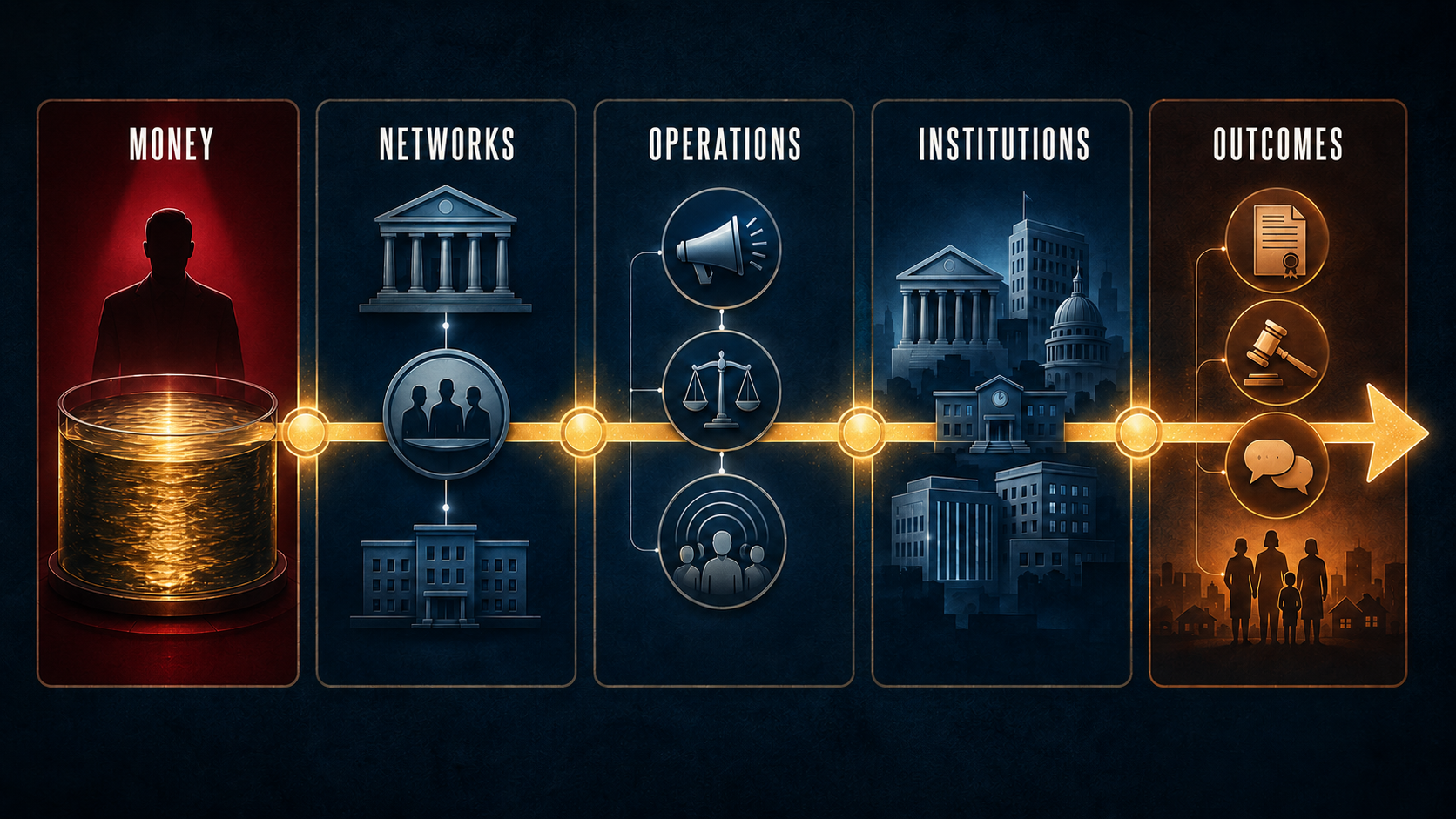
Project, Research, Analysis, Editorial by Patrick Russell; assisted by ChatGPT (OpenAI).
How private money can become political, institutional and societal power—and what evidence is required before financial proximity may be called influence, direction, corruption or criminal support.
Executive summary
A durable political system is built between the donor and the final decision
The investigation finds a large, lawful and strategically organized progressive funding infrastructure spanning philanthropy, political committees, fiscal sponsors, litigation, research, media, protest support, candidate development and institutional policy. Its depth matters because influence is often produced by many reinforcing investments rather than a single payment to an officeholder.
The public record strongly establishes money flows, shared objectives, election support and multiple policy outcomes. It does not establish that every recipient is controlled by the donor, that aligned organizations form one command structure, or that political giving alone constitutes corruption. The forensic task is to prove each link in the chain.
Investigation at a glance
Documented pathways, official allegations and current evidence boundaries
This portrait map summarizes the investigation before the detailed records below. It separates the documented political-influence pathway from distinct extremist-finance branches and shows where the public evidence presently stops.
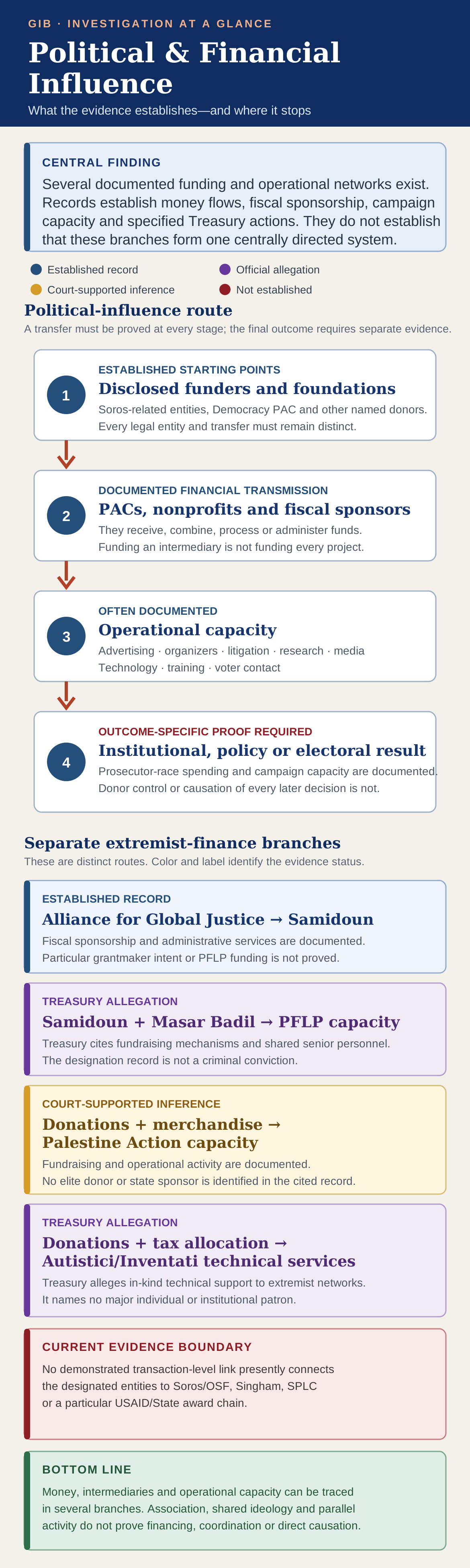
Political-infrastructure model and documented scale
Scale markers
These figures measure different legal entities and periods and must not be added together as though they were one fund. They demonstrate the scale and diversity of the infrastructure.
Democracy Alliance
The organization says its donor community has mobilized more than $2 billion since 2005 to build progressive institutions and infrastructure.
Soros → Open Society Foundations
OSF states that George Soros has given the Foundations more than $32 billion since 1984.
OSF United States initiative
A May 2026 initiative announced for economic security and civil-liberties work; an announced initiative is not the same as money already disbursed.
Democracy PAC receipts
FEC total receipts from January 1, 2025 through June 30, 2026.
ActBlue receipts
FEC total receipts from January 1, 2025 through July 31, 2026; ActBlue is a conduit, so gross receipts are not a single donor's deployable fund.
New Venture Fund revenue
FY2024 Form 990 revenue; fiscal sponsorship can obscure the public-facing project's separate legal identity.
Sixteen Thirty Fund revenue
FY2024 Form 990 revenue; the 501(c)(4) is not generally required to publicly identify every donor.
Forensic addition / Funding-to-Outcome Influence Map
Follow the money through six auditable stages
The map prevents two opposite errors: stopping at a disclosed donation and assuming nothing followed, or jumping from a donor's name directly to a social outcome without proving the intervening mechanism.
Origin
Individual donor, corporation, foundation, foreign-linked benefactor or government source
Required proof: Bank record, filing, audited statement or donor disclosureIntermediary
PAC, donor-advised fund, fiscal sponsor, nonprofit, payment platform or shell entity
Required proof: Exact legal entity, tax status, account and transfer dateOperational capacity
Advertising, staffing, litigation, research, training, technology, protest support or voter contact
Required proof: Invoice, grant restriction, contract, payroll, ad buy or operational recordInstitutional access
Candidate, prosecutor, judge-selection network, agency, school system, media outlet or policy coalition
Required proof: Meeting, communication, endorsement, appointment or formal participationDecision or outcome
Election result, directive, charging practice, settlement, curriculum, regulation, legislation or public narrative
Required proof: Official record plus a before/after comparison and plausible counterfactualDurability and feedback
Staff pipelines, repeat grants, precedent, enforcement practice and reinvestment after success
Required proof: Multi-year funding and measurable continuation after the original campaignPolitical influence infrastructure
Political Influence Infrastructure
Who funds it, how money moves, where influence is applied and which outcomes are being investigated. The categories below separate actors and financial mechanisms from the institutions and policy campaigns they may affect.
Origins
Funders and funding networks
What this category means: Funders supply the original capital and can establish priorities, sustain organizations across election cycles and make long-term political infrastructure possible. Their significance is the scale and continuity they provide; a donation establishes financial support, but it does not by itself prove that the donor controlled every recipient, tactic or later policy decision.
Soros network
George Soros's personal political giving, Democracy PAC activity, OSF philanthropy, Open Society Policy Center advocacy and independent grantee conduct are distinct. Every claim must identify the exact legal entity and payment route.
Democracy Alliance and donor coalitions
Donor coalitions coordinate long-term support for organizations, leadership pipelines and policy infrastructure. Democracy Alliance says its community has mobilized more than $2 billion since 2005; individual donors, recipients and restricted purposes still require separate tracing.
Transmission
Financial and operational intermediaries
What this category means: Intermediaries receive, combine, process or redirect money and then convert it into usable political capacity—advertising, staff, litigation, research, technology, organizing or voter contact. They matter because they can greatly expand a donor's reach and make the original funding route harder to see; the exact account, restriction and recipient must still be traced.
ActBlue and political conduits
ActBlue processes very large volumes of Democratic contributions. Gross conduit receipts must not be portrayed as ActBlue's own ideological treasury; donor identity, recipient, refund, earmark and reporting records control each transaction analysis.
Long-term operational infrastructure
Influence beyond elections can be built through fiscal sponsors, litigation, policy research, communications, leadership pipelines, local organizing, professional associations and administrative expertise that survives individual election cycles.
Access points
Institutions where influence is exercised
What this category means: Institutions are the decision points where financed advocacy can become durable public authority—a prosecution policy, court precedent, curriculum, administrative rule or professional standard. This is the most consequential transition in the chain because an institutional decision can affect people who never participated in the original campaign; access or ideological agreement alone does not establish improper control.
Judicial and legal infrastructure
Judges, prosecutors, public-interest law firms, bar networks and legal scholarship may shape durable outcomes. Donations or ideological agreement do not prove judicial misconduct; appointment, recusal, case-funding and ruling evidence must be evaluated separately.
Education systems
Grants can influence research agendas, curricula, teacher training, campus organizations and professional standards. The investigation distinguishes academic freedom and ordinary philanthropy from restricted grants, undisclosed conflicts and donor-directed programming.
Campaign-to-power pathways
Policy and Social Campaigns as Influence Vehicles
Why this belongs in a financial-influence investigation: A policy or social campaign can do more than advocate for an issue. Crisis framing may attract donations; donations can finance organizers, advertising, litigation, research, technology and voter contact; that capacity can create institutional access, electoral leverage and durable policy. This section tests every link in that chain rather than treating shared messaging as proof of one centrally directed operation.
- Crisis framingCreates urgency and public attention
- Donor mobilizationConverts urgency into financial support
- Operational capacityFunds staff, media, litigation and technology
- Institutional powerCreates access, leverage and durable influence
- Policy or electoral outcomeProduces a measurable public consequence
Evidence rule: Every connection must be documented. Shared messaging alone does not prove central coordination.
Green New Deal and climate politics
Climate-catastrophe messaging made the Green New Deal a high-urgency political vehicle. Organizations used that urgency to raise money, recruit and train organizers, promote candidates and move climate policy toward the center of Democratic electoral strategy.
- Donor generation
- Sunrise Movement says donations support Green New Deal organizing, training, housing, travel, technology and advocacy. Its own appeals describe recurring donations as a way to build a larger organizer base.
- Electoral function
- Sunrise says it helped elect Green New Deal champions, made climate a major election issue and mobilized young people in 2020 to defeat Trump and deliver Democratic control of the White House and Congress.
- Institutional consequence
- Campaign money and organizing can persist beyond an election through legislative agendas, administrative rules, litigation, education and energy policy. Each claimed policy result still requires a grant-to-activity-to-decision record.
- Evidence judgment
- Documented: open fundraising, organizing and electoral mobilization. Not established by this record: that all climate participants knowingly promoted a false catastrophe narrative or operated under one donor's control.
COVID-19: research, emergency power, money and elections
COVID-19 concentrated scientific funding, emergency authority, corporate revenue, relief spending, information control and election-administration changes into one period. Those branches are relevant to political-finance analysis because money and institutional power moved through each of them, even where a single coordinated design remains unproved.
- Origin and research
- U.S. funds passed through EcoHealth Alliance to coronavirus work involving the Wuhan Institute of Virology, and federal auditors documented serious NIH oversight and reporting failures. CIA later assessed a research-related origin as more likely than a natural origin, with limited confidence. The public record does not establish intentional release or conclusively prove that SARS-CoV-2 was engineered.
- Compliance and information
- Lockdowns, mandates and official risk messaging expanded emergency authority and encouraged social compliance. Government contacts with technology platforms and disputed suppression of dissenting experts are documented subjects of litigation and congressional inquiry; the Supreme Court's Murthy decision did not resolve the censorship claims on their merits.
- Religious liberty
- Some jurisdictions imposed restrictions that burdened in-person worship while allowing comparable secular activity. The Supreme Court intervened where unequal treatment triggered constitutional scrutiny, providing a documented civil-liberties consequence rather than proof of a single nationwide anti-church plan.
- Corporate and relief money
- Pfizer reported extraordinary vaccine- and treatment-related revenue, while federal reviews estimated enormous pandemic-relief fraud and potentially fraudulent activity. Revenue, fraud estimates and criminal convictions must be kept distinct; none alone proves that a pharmaceutical company or political party designed the pandemic.
- Election administration
- COVID-era election changes substantially expanded mail voting and altered election administration during the 2020 presidential contest. Whether those changes materially affected the final outcome remains an active evidentiary question requiring state-level analysis.
- Evidence judgment
- Documented: research funding and oversight failures, emergency controls, platform contacts, unequal religious restrictions, major corporate revenue, relief fraud and voting-rule changes. Unresolved: the broader allegation that these branches formed a centrally planned social-compliance operation intended to elect Joe Biden.
Cross-border pathways
Foreign-linked and national-security networks
What this category means: Foreign-linked pathways introduce money, direction, technology, personnel or organizational support originating outside the United States. They are significant when they conceal a foreign principal, influence American audiences or institutions, evade disclosure rules, support a sanctioned organization or advance a state-directed operation. Ordinary international cooperation and foreign funding are not automatically hostile activity.
Neville Roy Singham and China
Traceable funding, fiscal sponsors, nonprofit recipients, media organizations, residence, personnel overlap and pro-China messaging warrant examination. None alone proves Chinese-government direction, a FARA duty, espionage or criminal conspiracy.
United Kingdom
UK charities, political networks, financial institutions and activist groups can connect American issues to transatlantic policy. The record must separate formal partnership, parallel advocacy and state direction.
International terrorist finance
Front companies, commodities, charities, couriers, exchange houses and digital systems can move funds across jurisdictions. Treasury records establish specific sanctioned networks—not guilt by association for every organization supporting the same population or cause.
“Globalists” as a classification
The term describes a political interpretation, not one legal entity. GIB identifies the specific institution, personnel, authority, funding, policy objective and measurable action rather than using the label as proof.
Forensic addition / Local prosecutor case studies
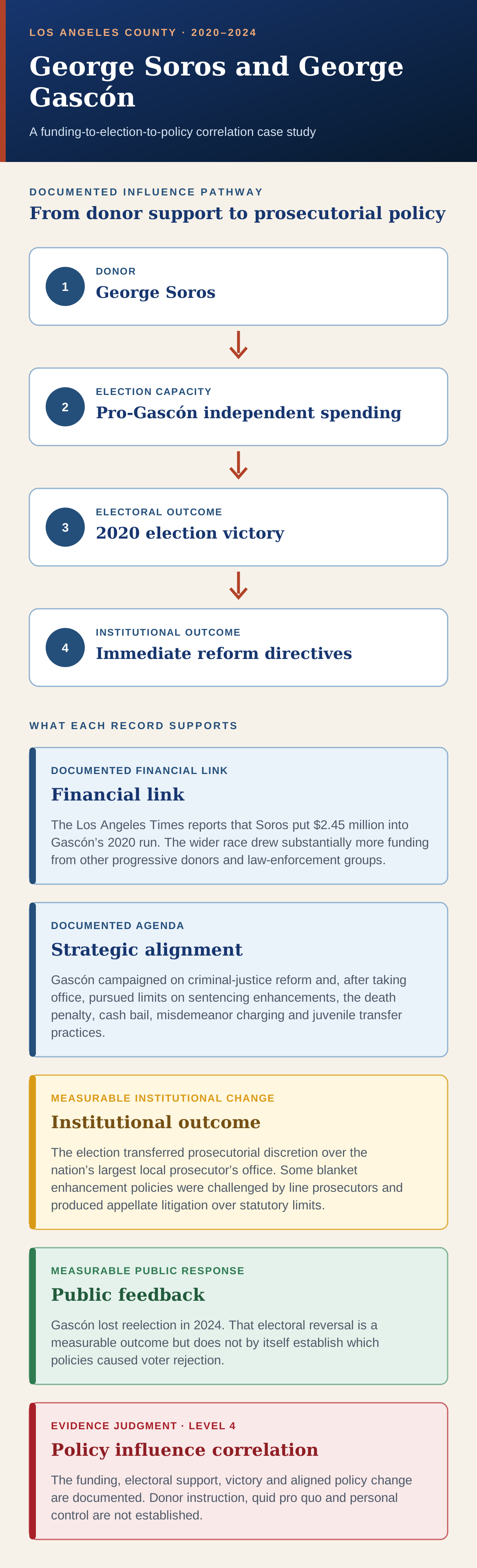
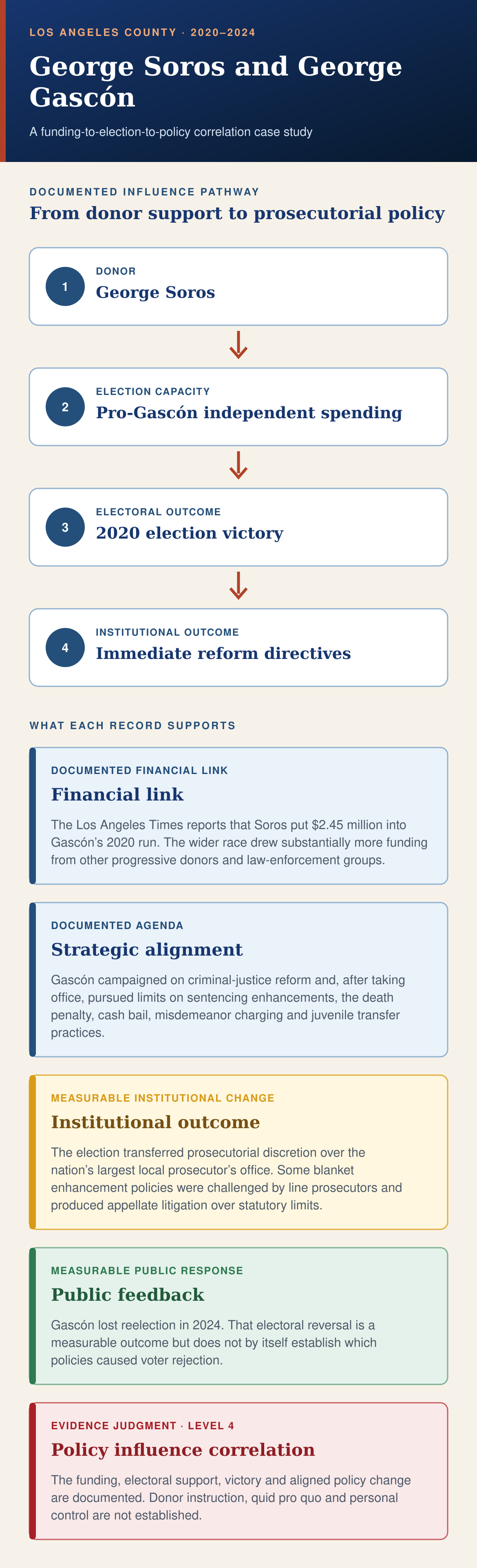
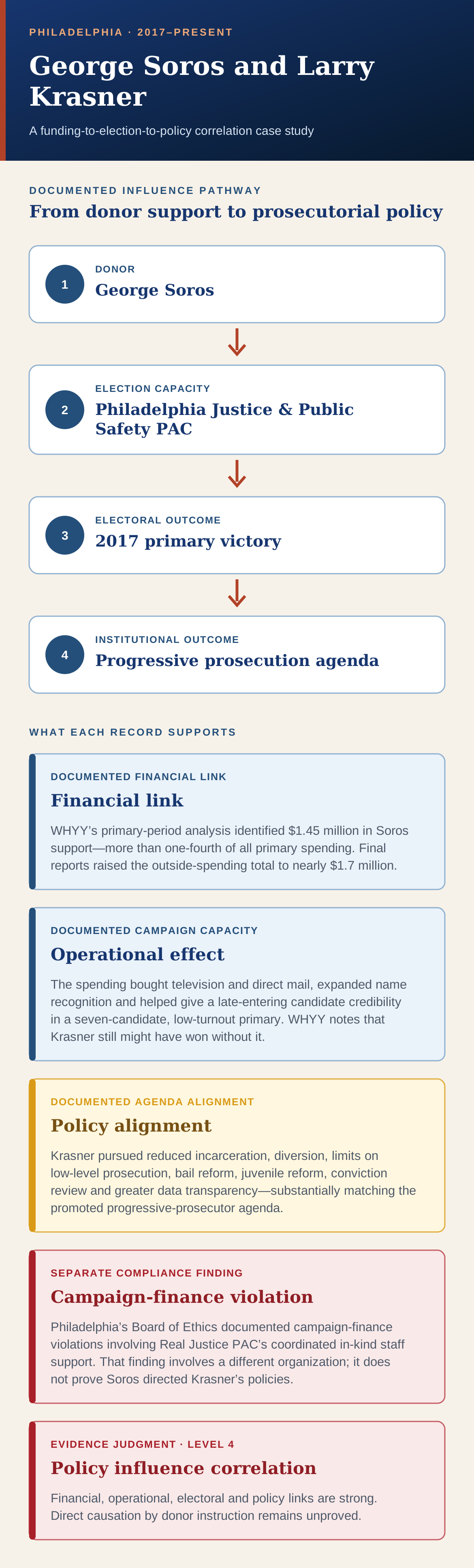
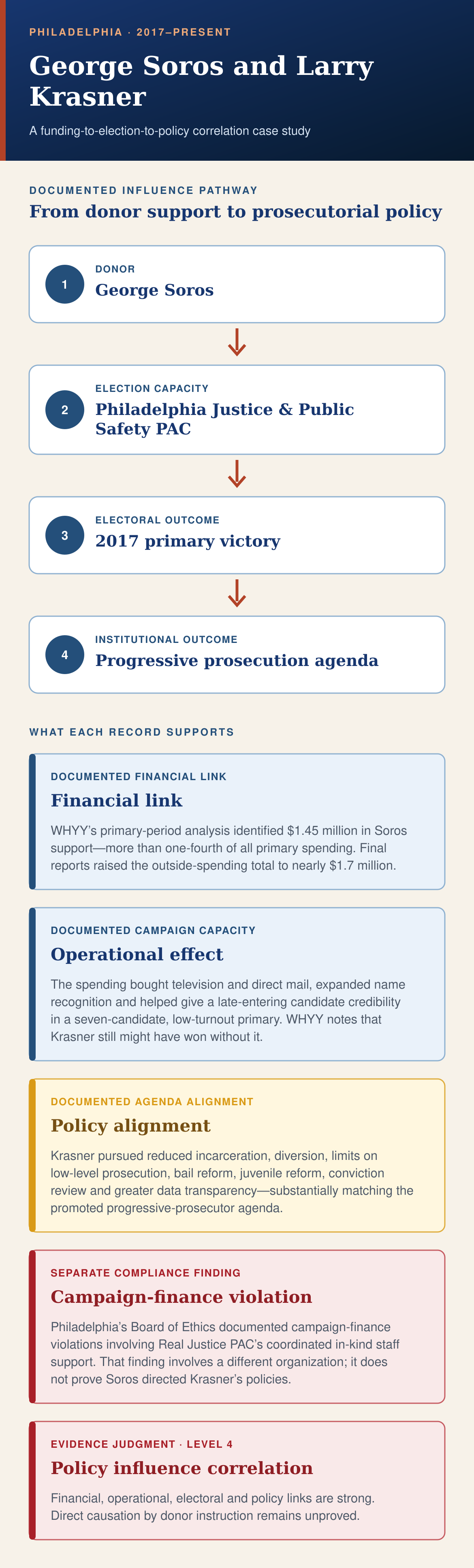
Soros → election capacity → prosecutorial policy
These cases are among the strongest examples of funding-to-outcome correlation because the donor, election vehicle, candidate, result and later policy agenda are public. The final step—proof that Soros personally ordered particular directives—remains absent.
Election Integrity: Evidence, Manipulation & the Public Record
Political donations and independent expenditures may influence campaigns, but they are not themselves election fraud. The related investigation tests voting, administration, interference and outcome claims under a separate evidence standard.
Read the election-integrity investigation →Forensic addition / Network Leadership and Funding Pathways
Trace leadership, money and services before assigning an outcome
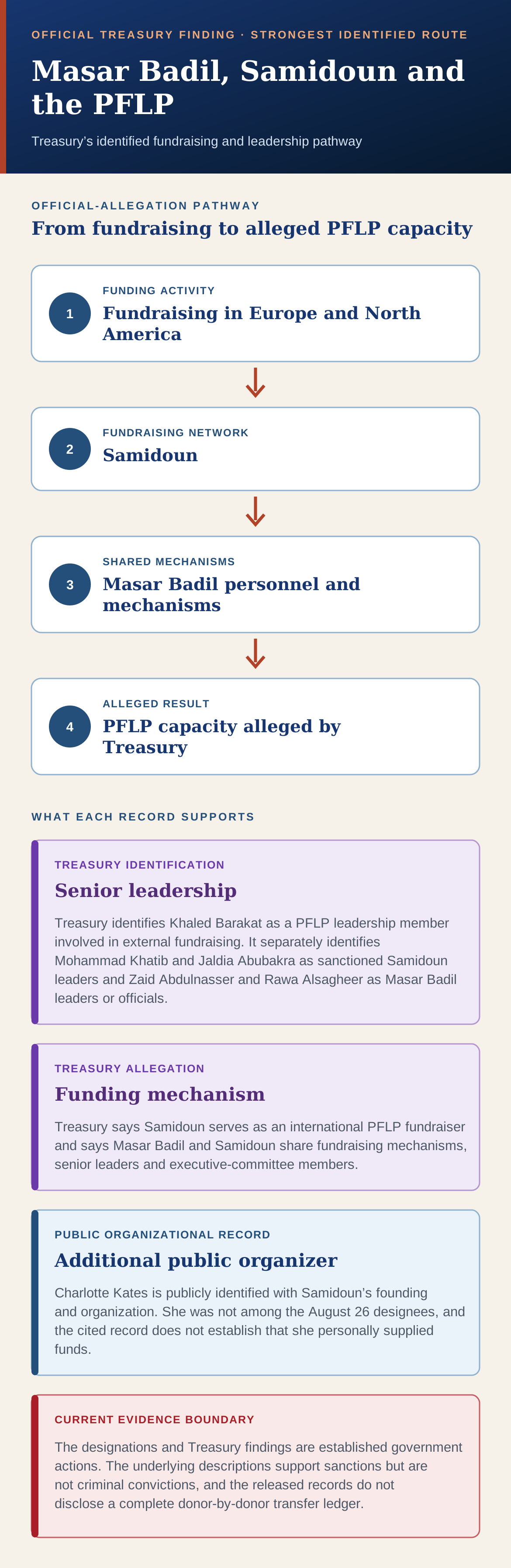
This branch separates senior leadership, original donors, fiscal sponsorship, payment processing and in-kind support. A leadership role is not necessarily a personal donation; a grant to a fiscal sponsor is not automatically a grant to every sponsored project; and ideological association is not a financial transfer.
- Funding originIdentifies the original source of the money
- IntermediaryReceives, combines, processes or redirects funds
- Recipient networkConverts funds into organizational resources
- Operational capacityPays for staff, media, research, litigation or organizing
- Documented outcomeTests what changed and whether the funding caused it
Evidence rule: Trace each transfer. Association, alignment or timing alone does not prove a funding connection or outcome.
Palestine Action
The UK High Court identifies Huda Ammori as one of Palestine Action's co-founders. A founder or spokesperson is an organizational actor, not automatically the source of the organization's funds.
The open judgment records fundraising through the organization's website, individual donations and merchandise sales.
Because the claimant did not explain how the money was used, the court considered it reasonable to infer that a major portion supported Palestine Action's direct-action campaign.
The cited court and Treasury records do not identify a billionaire, major foundation, foreign government or other elite patron as Palestine Action's proven financier.
Autistici/Inventati
Autistici/Inventati describes voluntary community donations and Italian tax-allocation support for its technical infrastructure.
Treasury's designation concerns alleged hosting, encrypted communications and other digital services supplied to vetted extremist or sanctioned organizations—including the PKK—not a disclosed cash payment to those users.
Technology, hosting and secure communications can constitute consequential in-kind support even when the underlying organization is funded principally by small donations.
Treasury disclosed no individual Autistici donor, controlling billionaire or major institutional patron. The designation does not establish that every user, donor or hosted project participated in prohibited conduct.
Funding-to-outcome evidence / Consequences and unresolved exposure
Documented Outcomes, Exposure and Public Impact
This section examines what documented financial, administrative or technological support enabled or exposed. It does not presume that every upstream donor, intermediary or associated person knew of, intended or controlled the downstream conduct. Responsibility is assigned only where transaction records, official findings, court records or verified operational evidence establish the connection.
Legal and financial consequences
Designations, blocked property, transaction prohibitions, settlements and enforceable compliance obligations.
Operational outcomes
Money, services or infrastructure can be tied to fundraising, communications, organizing or direct-action capacity.
Institutional and public effects
A measurable policy, electoral, reputational, security or financial consequence follows the supported activity.
Unresolved exposure
A credible pathway or oversight failure exists, but donor intent, final transfer or causal outcome remains unproved.
Treasury-designated networks: operative consequences and enabled capacity
U.S.-controlled property of designated persons is blocked and reportable; covered transactions are generally prohibited, and facilitating financial institutions may face sanctions exposure.
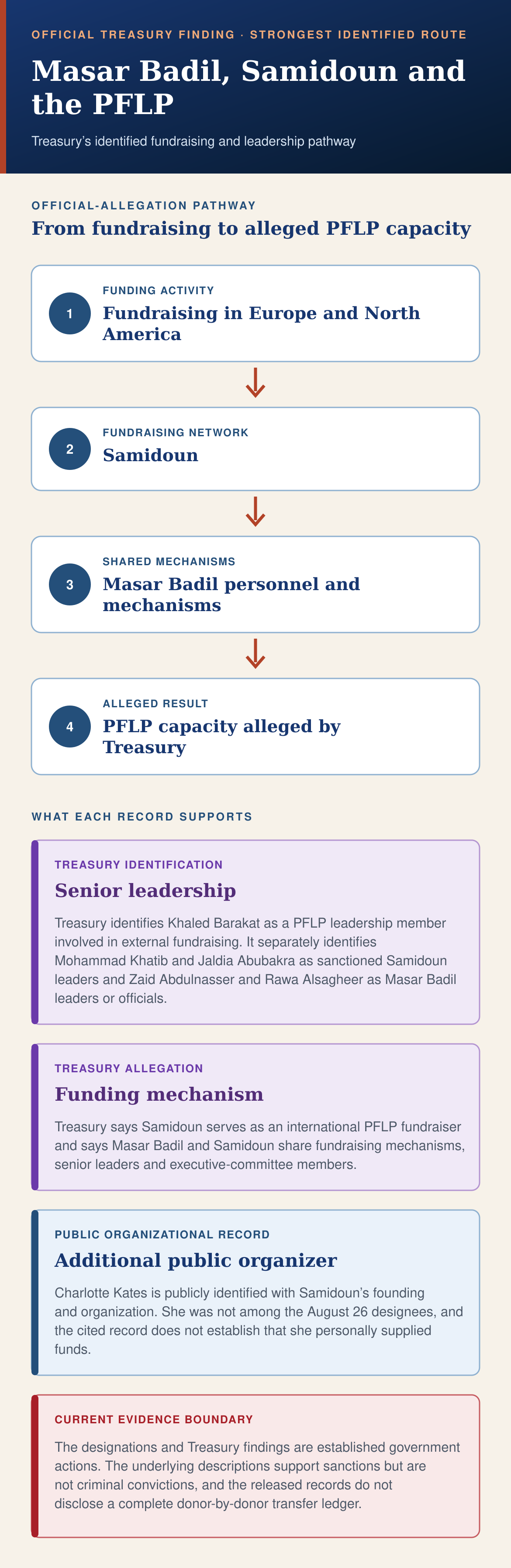
Treasury officially alleges a shared fundraising and leadership structure that supports PFLP capacity. The designation is established; the underlying conduct description has not been converted into a disclosed criminal conviction.
Treasury alleges attacks on defense and military infrastructure and injuries to law enforcement. Separately, the UK court record supports an inference that donations and merchandise revenue financed direct-action capacity.
Treasury alleges that donation-supported digital infrastructure provided technological services to violent extremist and sanctioned organizations. No public dollar amount for the alleged in-kind support is identified.
Southern Poverty Law Center classification and settlement
SPLC's FY2024 Form 990 reports $129.1 million in revenue, $822.2 million in assets and $786.8 million in net assets.
SPLC apologized and paid $3.375 million after including Maajid Nawaz and Quilliam in its anti-Muslim-extremist field guide. This establishes one consequential classification failure—not that every SPLC designation is false.
Litigation, policy advocacy, research, training, public classifications and grantmaking can affect media, employers, financial platforms and government debate. Each downstream adoption requires its own record.
SPLC says its 2022 Vote Your Voice round awarded $4.6 million to 39 organizations for voter mobilization. Lawful participation activity is not itself harm; its importance is that SPLC operates beyond research and litigation.
The People's Forum, BreakThrough News and Tricontinental
Congressional investigators cite more than $20 million in reported Singham-linked funding to The People's Forum routed through shell companies and donor-advised funds. Exact beneficial-source records remain central to the inquiry.
The People's Forum supplies convening, political education and organizing; BreakThrough News supplies media amplification; Tricontinental produces research and ideological material. This creates a repeatable funding-to-operations pathway.
House Ways and Means issued July 2026 subpoenas seeking financial, governance, fiscal-sponsorship and foreign-principal communications after the organizations did not provide records voluntarily.
The subpoenas and committee allegations are significant but not judgments that the organizations acted as illegal foreign agents or that Singham received operational instructions from the Chinese government.
Justice & Public Safety PAC network and prosecutor-policy organizations
A 2025 Washington Post analysis identified at least 62 prosecutor races supported by Soros-backed Justice & Public Safety committees, with a 77 percent win rate.
Large independent expenditures can dominate low-information local races through television, mail, digital advertising and field capacity. The Gascón and Krasner cases provide transaction-level examples.
Successful candidates acquired charging, plea, sentencing, bail, juvenile-transfer and death-penalty discretion affecting millions of residents. This is a durable policy outcome even where the merits remain disputed.
Crime rose nationally during portions of this period. Citywide crime trends cannot be attributed to a donor, PAC or prosecutor without offense-level comparisons, controls, policy timing and credible counterfactual analysis.
USAID-era prime recipients, subrecipients and local implementing partners
Congress appropriated funds; USAID issued awards to UN agencies, international NGOs and contractors; those prime recipients used local partners, vendors and subawards to deliver assistance.
The May 2026 inspector-general audit found selective vetting, policy exemptions, weak independent verification, poor data quality and automated-reporting problems in four selected West Bank and Gaza awards.
The State Department assumed responsibility for USAID's remaining awards and activities by July 1, 2025, including partner vetting. Historical USAID awards must therefore be distinguished from State-administered continuation.
The audit establishes reduced assurance and diversion risk. It does not establish that every prime recipient was negligent or that a named prohibited organization received U.S. funds.
Government Waste, Fraud & the National Debt
Examine improper payments, questioned spending, recoveries and fiscal consequences. Funding an NGO or foreign recipient does not by itself establish waste, fraud or improper political direction.
Read the debt and accountability investigation →Expanded forensic branch / Foreign donors, recipients and U.S.-directed activity
This branch expands the investigation beyond domestic funding networks. It compares foreign money and direction country by country, traces each route from principal to operator and outcome, and distinguishes state operations, private funding, contracts and ideological alignment rather than treating them as one coordinated network.
Country-by-country influence ledger
This ledger tests foreign pathways using the same Funding-to-Outcome method applied to domestic political finance. “Anti-American activity” is not defined as criticism of U.S. policy. It means documented covert propaganda, unlawful foreign-agent activity, election interference, material support, attacks on U.S. personnel or infrastructure, or concealed operational influence intended to weaken U.S. institutions or policy.
- Foreign principalIdentifies the government, official, party or foreign-linked source
- Money or directionTransfers funds, instructions, benefits or covert tasking
- IntermediaryMoves, administers or conceals support through another entity
- Recipient or operatorReceives resources or carries out the activity
- Activity and outcomeMeasures the operation and its documented U.S. impact
Evidence rule: Trace money or direction across every stage. Foreign origin, alignment or contact alone does not prove unlawful influence.
China
- Current finding
- Congressional investigators cite more than $20 million in Singham-linked funding and have subpoenaed financial, governance and foreign-principal records. Separately, U.S. universities reported more than $528 million in reportable 2025 gifts and contracts from China.
- Evidence boundary
- The subpoenas are not a judgment that the NGOs acted as illegal CCP agents. University disclosures prove financial exposure, not propaganda, policy capture or donor-directed conduct.
Russia
- Current finding
- DOJ charged two RT employees with deploying nearly $10 million to covertly finance and direct a Tennessee content company. A separate court-authorized action seized 32 domains allegedly operated under the Russian Presidential Administration’s direction.
- Evidence boundary
- The seizures and official records establish an operation and its infrastructure. Indictment allegations against individual defendants are not convictions, and unwitting U.S. commentators are not automatically Russian agents.
Iran
- Current finding
- DOJ seized 92 IRGC-used domains in 2020, including four masquerading as independent news outlets targeting Americans. Treasury records also document Iranian support routes to Hizballah and other proxies.
- Evidence boundary
- The state operation and international proxy-finance routes are documented. The present record does not connect those funds to the mainstream U.S. progressive nonprofits examined elsewhere on this page.
Qatar and Gulf states
- Current finding
- Education Department disclosures list more than $1.1 billion from Qatar in 2025, alongside more than $285 million from Saudi Arabia. Reporting gaps remain material: universities disclosed more than $2 billion late during 2025.
- Evidence boundary
- A gift or contract is not evidence of anti-American activity. Restricted terms, undisclosed conflicts, curriculum changes, research conditions or communications are required to connect funding to a specific outcome.
Switzerland and Europe
- Current finding
- House Ways and Means says Wyss-linked entities have transferred more than $280 million to tax-exempt organizations and cites nearly $31 million sent by Sixteen Thirty Fund to PACs during the 2024 cycle.
- Evidence boundary
- These are committee findings supporting a transparency inquiry, not an adjudication that foreign money was earmarked for an illegal campaign contribution. Fungibility concerns require account-level tracing.
United Kingdom
- Current finding
- U.S. universities reported more than $633 million from UK sources in 2025. Separately, Treasury designated UK-based Palestine Action on August 26, 2026 after the UK proscribed it in 2025.
- Evidence boundary
- These are two separate records. No evidence presented here connects UK university funding, the British government or ordinary UK donors to Palestine Action.
Cuba and Venezuela
- Current finding
- Former ambassador Victor Manuel Rocha admitted in 2024 that he had acted covertly for Cuba for decades. The case proves foreign operational influence at a high institutional level without establishing a public donation chain.
- Evidence boundary
- The current record does not identify a Cuban payment ledger for Rocha or prove Venezuelan-state funding of the Singham-linked U.S. organizations. Support for Maduro is not itself proof of payment or direction.
Latest forensic branch / August 26, 2026
This branch begins with the organizations and individuals Treasury designated on August 26, then traces backward toward their leaders, donors, fiscal sponsors, payment routes and operational support. It separates confirmed government actions and documented links from Treasury allegations, disputed associations and connections that remain unproved.
Treasury opens a new backward-tracing line into far-left and extremist finance
OFAC designated three organizations and two leaders under Executive Order 13224. The designations themselves and their legal consequences are established federal actions. Treasury's descriptions of the underlying conduct and relationships are official government findings supporting sanctions—not criminal convictions or adjudicated findings—and they do not automatically attach to every person who communicated with, protested alongside or supported a related political cause.
Autistici Inventati
Treasury says it provided specialized digital architecture and services to violent far-left extremists and sanctioned organizations, including hosting, encrypted communications and the Noblogs platform.
Palestine Action
Treasury designated the group for material support to acts of terrorism after the UK proscribed it in July 2025. Treasury cited attacks on defense and military infrastructure and injury to law enforcement.
Masar Badil
Treasury described it as linked to and acting for Samidoun, which the United States and Canada sanctioned as a PFLP front. Treasury identified shared fundraising mechanisms, leaders and committee members.
Named leaders: OFAC separately added Germany-based Zaid Abdulnasser and Brazil-based Rawa Alsagheer to the Specially Designated Nationals list as leaders or officials of Masar Badil. This establishes their designation status; it does not substitute for a criminal trial.
Operational link and legal effect: Treasury formally linked Masar Badil to Samidoun through shared fundraising mechanisms and senior personnel. U.S.-controlled property and interests in property of the designated persons are blocked and reportable; transactions involving them are generally prohibited, and financial institutions facilitating significant transactions may face sanctions exposure. These restrictions can disrupt access to the U.S. financial system and create a documented starting point for tracing donors, processors and intermediaries.
The next forensic task: trace backward from each designated node
- Identify every disclosed bank, processor, crowdfunding page, cryptocurrency address, fiscal sponsor and fundraising mechanism.
- Resolve the exact donor, date, amount, intermediary and ultimate recipient—not merely a shared campaign or event.
- Separate humanitarian, legal, speech and protest support from funds, goods or services provided to a designated person.
- Test whether any U.S. nonprofit, political committee, foundation or donor knowingly supported the designated entity or whether the apparent link stops at an unrelated intermediary.
- Record frozen property, blocked transactions, enforcement actions, charges and adjudicated outcomes as separate stages.
International finance comparison
This comparison uses established terrorist-finance cases as an evidentiary benchmark. It shows what complete tracing looks like when records identify named financial institutions, front companies, payment channels, transactions, frozen assets, penalties and recovered funds—and highlights what remains missing from the newer extremist-finance investigation.
Known terrorist-finance mechanisms show what complete tracing looks like
Iranian procurement and aviation networks — new sanctions records
Focused evidence update · September 30, 2026
Treasury’s September 29 action designated 10 individuals and entities accused of procuring weapons and components for Iran’s Ministry of Defense and Armed Forces Logistics. The combined Treasury and State actions covered 13 targets according to Reuters; these counts describe different scopes. The records identify procurement channels, not a quantified recovery of money or a criminal conviction.
Treasury’s September 8 aviation action separately targeted 36 parties, including intermediaries and firms supporting aircraft procurement and military logistics, and suspended aviation authorizations. Together these records extend the investigation’s examples of cross-border financing and material supply. Actual denied shipments, blocked funds and lasting weapons-production effects still require outcome evidence.
No transaction-level connection between these newly designated networks and the domestic political-finance subjects discussed elsewhere on this page is established by these actions. The September 30 Flydubai cockpit incident has no verified Iran or IRGC connection and is not evidence of a financing chain.
October 3 follow-up: Treasury’s refinery and procurement records identify oil-revenue, intermediary and component channels linking Iran with Chinese and Hong Kong actors. This adds a specific sanctions-evasion mechanism, without establishing a connection to the domestic political-finance subjects on this page. October 3 evidence and video
Read the full Iran/IRGC article
Sources: Treasury · September 29 procurement action · Treasury · September 8 aviation action · Reuters · combined agency sanctions count
Treasury's March 20 record described a Hizballah-linked commercial network that enabled diversion of more than $100 million since 2020. Its August 20 action described a courier network capable of moving up to hundreds of millions of dollars between Lebanon, Türkiye, the UAE and Iran. Other Treasury actions document sham charities, commodities, front companies, exchange houses and cryptocurrency. These are models for the records required before a political-finance investigation may claim material support or terrorist financing.
Ethical analysis, central question and investigative standard
Five evidence levels
Did the money merely support lawful speech and shared ideas—or did it purchase operational capacity that materially changed an election, institution, policy, legal outcome or violent capability?
Ethical concern can exist below criminal liability. Large outside spending may legally nationalize a local race, create unequal access or reduce transparency without constituting bribery. Criminal conclusions require the elements of the specific offense, admissible evidence and due process.
Evidence dashboard / Current judgment
What the record supports now
Large progressive funding infrastructure exists
Directly established by FEC records, Forms 990, donor disclosures and the organizations' own descriptions.
Soros-funded prosecutor election support
The Gascón and Krasner spending is documented, as are the candidates' subsequent policy agendas.
Funding changed electoral capacity
Large outside spending paid for advertising and visibility in low-information local races; the exact vote effect cannot be isolated.
Policy alignment followed election support
Criminal-justice directives substantially matched the openly promoted reform agenda.
Donor-directed policy decisions
No public instruction, contract or quid pro quo establishes that Soros personally ordered the specific policies examined.
Cross-border extremist-finance infrastructure
Treasury's August 26 designations establish named technical, organizational and fundraising nodes under E.O. 13224.
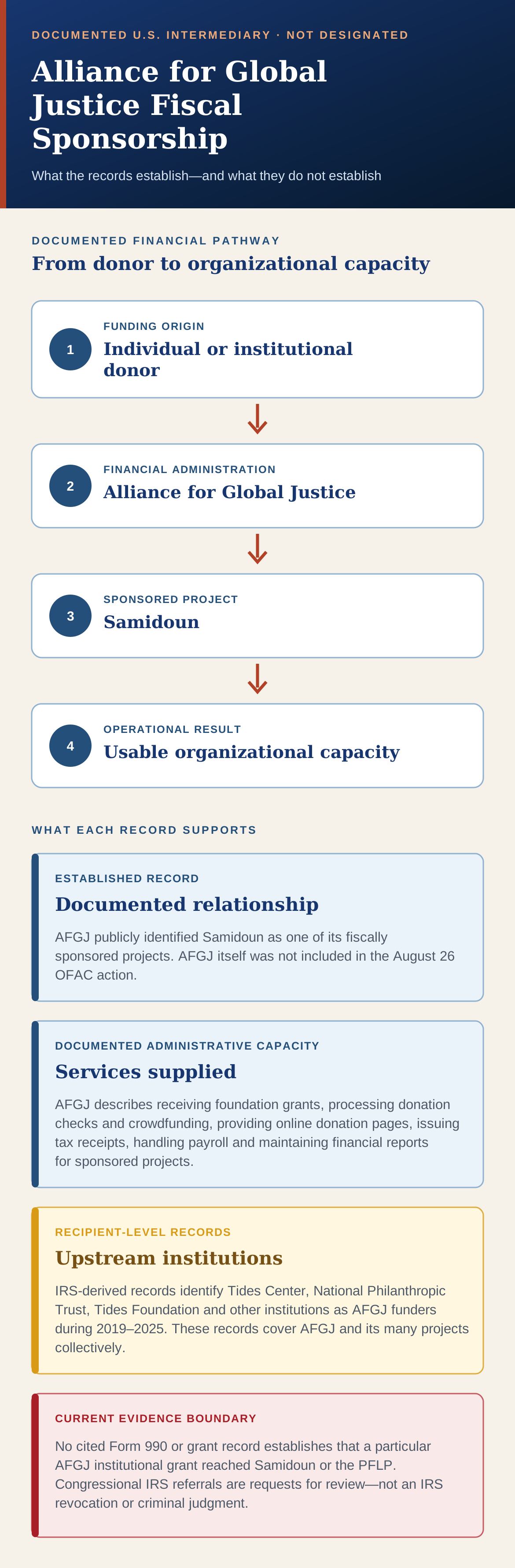
AFGJ served as Samidoun's fiscal sponsor
AFGJ's own account establishes the administrative relationship and donation-processing capability; it does not identify which upstream grants reached Samidoun or establish donor intent.
Major AFGJ grantmaker money reached Samidoun or the PFLP
Recipient-level Forms 990 identify AFGJ's general funders, but project-level earmarks and transfers must be proved before attributing Samidoun support to any particular grantmaker.
Unified global command structure
Overlapping donors, institutions, ideologies and personnel establish networks, not one centrally controlled organization.
SPLC acknowledged a harmful false designation
SPLC apologized and paid $3.375 million after placing Maajid Nawaz and Quilliam in its anti-Muslim-extremist field guide.
Singham-funded operational infrastructure
Funding and organizational capacity involving The People's Forum, BreakThrough News and Tricontinental are documented; congressional allegations of CCP direction remain under investigation.
USAID partner-vetting vulnerability
The inspector general documented exemptions, weak independent verification and data-quality problems; diversion to a particular prohibited recipient requires separate proof.
Russian and Iranian state-directed influence operations
DOJ seizure records establish covert U.S.-directed propaganda infrastructure; criminal allegations against named defendants remain allegations until adjudicated.
Foreign funding exposure at U.S. universities
Federal disclosures establish large reportable gifts and contracts from Qatar, the UK, China and other countries; they do not by themselves prove donor control or an anti-American outcome.
One foreign-donor command structure
The country branches contain different funders, intermediaries, recipients and methods. The current record does not establish one coordinated foreign network.
Interim judgment
Political infrastructure is the finding; omnipotent control is not
The evidence shows that concentrated private wealth can build electoral and institutional capacity capable of producing durable political change. The Gascón and Krasner cases reach Level 4 because the financial route, operational mechanism, election result and aligned policy outcomes are documented. They do not reach Level 5 because donor instructions or a quid pro quo have not been established. The extremist-finance branch now contains a documented U.S. fiscal-sponsor relationship—AFGJ to Samidoun—and a Treasury-identified leadership and fundraising hierarchy connecting Samidoun, Masar Badil and the PFLP. It does not yet contain project-level evidence attributing that support to AFGJ's general grantmakers, Soros, Singham, SPLC or a USAID/State award chain. Those links must be traced one transaction at a time.
Current case updates
These focused reviews apply the investigation’s funding-to-outcome framework to individual cases. Each retains its original evidence and review dates.
The question this investigation answers
Which money moved between identifiable entities, what activity did it support, and what influence or direction can the record establish?
Distinct finding and connected evidence
- What this investigation adds
- A transaction-to-activity record separating a donor, intermediary, independent recipient, funded operation and demonstrated consequence.
- Evidence assessed here
- Grant, tax and campaign filings; recipient receipts; agreements; expenditures and action-specific records. A pledge, transfer and final expenditure are separate stages of the same flow.
- Next evidence test
- Reconcile payer and recipient records, restrictions and dates, then test each link from funded activity to institutional or policy effect.
- Political Counteroffensive
Uses verified funding pathways to explain capacity and strategy; this investigation establishes the financial pathway rather than retelling the political chronology.
- Election Integrity
Tests election-administration conduct. Campaign contributions or donation-control concerns need separate evidence before implying ballot manipulation.
- California Accountability
Examines California decisions and outcomes; this investigation supplies the exact funding connection without assuming donor control.
Midterm influence: named funding leads and actual oversight status
Focused update · October 5, 2026
Concern addressed: Financing can give opposition messaging scale and conceal responsibility. This record asks who supplied money, through which entity, for which activity, and whether a regulator or court established a violation. Political Narrative Watch owns the messaging review.
ActBlue — September 28 testimony request and disputed donor controls
Chairmen Jim Jordan, Bryan Steil and James Comer requested a transcribed interview with WilmerHale attorney Ronald C. Machen about his defense of CEO Regina Wallace-Jones’s November 2023 donor-vetting representations. Their September 28 letter contrasts that defense with concerns attributed to former outside counsel Dana Remus. It names board chair Kimberly Peeler-Allen and former counsel Zain Ahmad.
The committee alleges gaps in passport collection, including third-party payment apps, and challenges Machen’s review period. Its cited figure of up to $38 million concerns contributions with foreign indicators; it is not an adjudicated total of prohibited donations. A placeholder after alternative eligibility verification does not, by itself, prove an ineligible donor. The earlier exhibit assessment below remains material.
Status: Congressional allegations and a testimony request, not a criminal verdict. Machen’s involvement is as counsel and reviewer, not a charged defendant in this record. Original committee letter · September 28, 2026.
Response: ActBlue’s September 16 response disputes the allegations and defends eligibility checks for Americans abroad. Its position does not settle the disputed transactions.
Court result that must accompany the allegation: Judge Richard Stearns’s June 11 preliminary injunction blocked Texas Attorney General Ken Paxton’s challenged civil enforcement lawsuit, finding evidence of retaliatory enforcement. The court expressly did not decide whether campaign-finance violations occurred. This is neither a conviction nor a merits exoneration on donation eligibility. Read the court’s order. Paxton’s August 18 announcement confirms an appeal and disputes the court’s jurisdiction and reasoning; no appellate disposition was identified in this review.
Next test: Identify actual donor eligibility, payment origin, recipient, refund and the applicable duty and knowledge. FEC guidance permits eligible U.S. citizens abroad and lawful permanent residents to contribute. A foreign address or IP is a warning indicator, not proof of a prohibited foreign national.
George and Alex Soros — committee identity before expenditure attribution
The Soros record below separates personal giving, Democracy PAC, Democracy PAC II, nonprofit grants and recipients. The Democracy PAC filings are the starting point for election-cycle receipts and disbursements. Committee-level resources establish capacity; they do not establish who commissioned a particular misleading ad.
Next test: Reconcile a dated donor transfer with the recipient’s receipt, vendor payment and actual communication. Do not count a transfer and its later spending twice. Foreign birth, political views or a donor’s name do not establish prohibited foreign-government funding or criminal coordination.
Neville Roy Singham — nonprofit foreign-influence inquiry
Ways and Means Chairman Jason Smith’s May 5 record names BreakThrough News, Tricontinental and The People’s Forum and seeks records of funding, fiscal sponsorship, governance and communications involving Singham and foreign principals. The committee alleges Chinese Communist Party connections. That is a documented oversight inquiry; the committee’s allegations are not adjudicated findings of government direction.
Connection still required: A transaction, governing relationship or instruction linking a foreign principal to a specified activity. Residence in Shanghai and shared ideology do not supply that chain. This reviewed record does not establish an unlawful 2026 midterm operation or a criminal conviction. The detailed foreign-influence records elsewhere on this page retain their dates.
Permanent political infrastructure and federal research funding
Focused historical review · October 5, 2026 · Original records: 2016 and 2021
Democracy Alliance: private donors, labor and lasting institutions
Democracy Alliance's February 9, 2016 account describes more than 100 wealthy individuals and families and eight labor organizations participating in its community. It identifies Catalist for voter data; Center for American Progress, ColorOfChange and Demos for policy and communications; and State Voices, America Votes, Center for Community Change and Center for Popular Democracy for organizing. It explicitly describes building infrastructure to help candidates win and advance progressive government afterward.
Finding: An enduring progressive institutional strategy is established by the organization's own account. Its participation and recommendation list is not a recipient-by-recipient payment ledger. The cumulative amount already shown on this page is not exclusively an attack-ad budget and must not be added to overlapping PAC spending.
Democracy Alliance's 2016 strategy and named organizations · InfluenceWatch: donor-network background and documentary leads
NSF, UW and Stanford: verified funding; political purpose requires separate proof
On August 17, 2021, the University of Washington announced a $3 million collaborative NSF grant for rapid-response disinformation research with Stanford, including approximately $2.25 million for UW. The same account identifies $5 million from Knight to establish UW's Center for an Informed Public, additional Hewlett support, and rapid-response support from Newmark and Omidyar, including $1 million in new Newmark funding.
These are distinct awards and institutional disclosures, not an audited aggregate or traced Democratic campaign expenditure. Stanford says its five-year NSF award was $748,437 and that no government funding supported its 2020 election work or Virality Project. The 2021 grant cannot be treated as financing the earlier 2020 election project. The institutions describe the work as nonpartisan; congressional investigators dispute aspects of its content-reporting relationships.
Next test: Reconcile award numbers, recipients, obligations, disbursements and allowable costs with project expenditure records, then identify any specified campaign service or government instruction. Federal support for research alone does not establish a grant to the DNC or funding intended to discredit Republicans.
UW funding announcement · August 17, 2021 · Stanford's funding and project response · Related election-information review
Ukraine laboratories: tracing the alleged funding network
Focused connection reviewed October 10, 2026 · Original evidence dates retained
Status: Documentary review open.
The next financial test is to match grants and contracts to a named recipient, facility, research purpose and disbursement, then identify any documented instruction from a donor or official. Russia’s diagram supplies alleged connections, not a reconciled transaction chain. Documented U.S. support does not establish that Soros, USAID or the CIA directed biological weapons development.
Anti-Fraud/Corruption
The Anti-Fraud/Corruption directive connects donation controls, nonprofit spending and public-integrity enforcement. This investigation retains the transaction and influence analysis; Dismantling the Corruption retains the primary enforcement cases. A funding relationship requires its own legal and documentary test before it establishes corruption.
Open Strategic Directive · Current enforcement review and primary case records
Cross-reference added October 3, 2026. Original case review dates remain attached to their records.
ActBlue: donation controls and the September document release
Focused evidence update · September 19, 2026
This update examines the September 16 congressional report’s underlying exhibits. The report’s accusations are committee conclusions, not court findings.
A — Documented procedure: Exhibit 13 describes a passport field that checks character count without authenticating the number. It also requires legal review of alternative citizenship evidence before a placeholder is entered. That qualification contradicts a blanket claim that the written policy authorized donations without eligibility verification.
B — Control concerns strengthened: Exhibit 16 records approval despite several fraud indicators. It supports concern about how controls were applied; the reviewer also expressly says fraud could not be determined with certainty.
C — Unresolved: These records alone establish neither an illegal foreign contribution nor knowing criminal conduct or coordinated election manipulation. They concern earlier practices and do not demonstrate that those practices continue today. Donor eligibility, transaction origins, refunds and intent require separate evidence.
Response: ActBlue denied wrongdoing and false statements to Congress on April 2. That earlier response supplies its position but does not resolve the September exhibits.
Read the report and exhibits 13 and 16 ↗ · ActBlue’s response ↗
Related: September election-case tracker. Voting eligibility and contribution eligibility are different legal questions; these records do not establish a connection between the cases.
Soros case record / September 2026 review
Which money moved, and which conclusions remain open?
The project record separates George Soros’s personal giving, two distinct federal committees, Open Society philanthropy, Open Society Policy Center advocacy, and independent recipients. A contribution, pledge, committee receipt, transfer and final expenditure describe different stages; adding them together would count some money twice.
Documented advocacy objective
On April 7, 2021, Open Society announced a $20 million pledge across several U.S. advocacy coalitions, largely through its 501(c)(4) affiliate, the Open Society Policy Center. THRIVE was one coalition named. The whole pledge cannot be assigned to THRIVE, and the announcement does not establish payments, passage of every proposal, or a measured policy effect.
Separate election vehicles
Federal Election Commission records identify Democracy PAC (C00693382) and Democracy PAC II (C00786624) as separate committees. The project’s 2022 account and submitted 2024 recipient amounts must be checked against dated disbursements and recipient receipts by committee and election cycle before publication as transaction findings.
Local prosecutor cases
The Gascón and Krasner records below connect outside election spending, a successful campaign and subsequent prosecution policies. They support a bounded influence assessment. They do not establish a personal instruction from Soros, a quid pro quo, or that a donor caused a citywide crime trend.
Open financial leads
The project also lists a claimed January 2024 nonprofit transfer, 2022 cycle totals, candidate contributions, state-party transfers and a count of individual contribution records. Each needs an identified donor and recipient, date range, filing or grant schedule, amendment treatment and overlap check. These leads have no established total on this page.
Next evidence test: reconcile committee filings to recipient-side receipts, then identify the expenditure, advocacy activity or decision claimed as the outcome. The source ledger below links the original committee and Open Society records.
Source ledger
Primary and corroborating records
Campaign filings, tax records, court materials, sanctions designations, organizational disclosures and independent reporting.
Source ledger
Primary and corroborating records
Campaign filings, tax records, court materials, sanctions designations, organizational disclosures and independent reporting.
Exhibits 13 and 16: written procedures and review log; committee conclusions are distinguished from the underlying records.
Denies wrongdoing and false statements; predates the September report.
Organization's own description of more than $2 billion mobilized for progressive causes and infrastructure.
Primary organizational record of more than $32 billion given to OSF.
Primary announcement; deployment and outcomes require separate verification.
Federal receipts, disbursements and filings for the 2025–2026 cycle.
Separate committee; compare cycle-specific filings rather than combining its transfers with Democracy PAC.
The $20 million announcement covered several advocacy coalitions, largely through the Open Society Policy Center; it is a pledge, not proof of final payments or enactment.
Federal conduit receipts and disbursements through July 31, 2026.
IRS-derived FY2024 Form 990 financial data.
IRS-derived FY2024 Form 990 financial data.
Reports $2.45 million from Soros in Gascón's 2020 run and the wider independent-spending context.
Judicial record concerning the legal limits of blanket sentencing-enhancement directives; later review history must be stated.
Campaign-finance analysis documenting $1.45 million in Soros support by the primary.
Final reports increased the reported outside spending to nearly $1.7 million.
Primary committee filing for Philadelphia Justice & Public Safety PAC.
Separate, documented in-kind contribution and disclosure violations; not evidence that Soros directed Krasner's policies.
Primary OFAC designation record for Autistici Inventati, Palestine Action, Masar Badil and named leaders.
Operative sanctions-list record adding Autistici Inventati, Palestine Action, Masar Badil, Zaid Abdulnasser and Rawa Alsagheer.
Primary sanctions record describing a network that enabled diversion of more than $100 million since 2020.
Primary August 20 record describing a network capable of moving up to hundreds of millions of dollars.
Primary record of designated charities alleged by Treasury to fund Hamas's military wing.
Primary May 2026 record describing Samidoun as a fundraising platform for the PFLP where the organization faces legal restrictions.
Primary October 2024 sanctions record identifying Samidoun as an international PFLP fundraiser and Barakat as a PFLP leadership member involved in external fundraising.
AFGJ's description of receiving foundation grants, processing checks and crowdfunding, providing donation pages, payroll and project accounting.
AFGJ's own statement identifying Samidoun as one of its fiscally sponsored projects; sponsorship establishes an administrative route, not donor intent.
IRS-derived financial and governance records for the fiscal sponsor; organization-wide figures do not identify the destination of every grant.
Recipient-level compilation identifying major AFGJ grantmakers; it does not establish that a listed grant funded Samidoun or another particular project.
Open judgment identifying Huda Ammori as a Palestine Action co-founder and recording website donations, individual contributions, merchandise revenue and the court's inference about support for direct action.
The organization's own donation page; Treasury's designation separately concerns alleged technological and material support.
The organization's description of voluntary support and Italy's five-per-mille tax-allocation option.
Committee-majority account of referrals and allegations; a referral is not an IRS adjudication, revocation or criminal judgment.
Official parliamentary record of a member's statement concerning Khaled Barakat and Charlotte Kates; the statement is not itself a judicial finding or Treasury designation.
Official July 2026 record of subpoenas to The People's Forum, BreakThrough News and Tricontinental; committee allegations are not adjudicated findings.
Official committee account citing more than $20 million in reported Singham-linked funding and seeking records about organizing and foreign influence.
May 2026 audit documenting exemptions, information shortfalls, weak independent verification and data-quality problems.
IRS-derived filing reporting $129.1 million in revenue, $822.2 million in assets and $786.8 million in net assets.
Independent account of SPLC's apology and $3.375 million settlement after its anti-Muslim-extremist designation.
Organization's own record of $4.6 million awarded to 39 groups for voter mobilization.
Independent analysis of at least 62 prosecutor races, a 77 percent win rate and the unusually high leverage of outside money in low-information local elections.
Official indictment announcement alleging that RT employees deployed nearly $10 million to covertly finance and direct a Tennessee content company.
Court-authorized seizure record describing 32 domains allegedly used under Russian Presidential Administration direction to influence U.S. audiences and elections.
Primary seizure record for 92 IRGC-used domains, including four disguised news outlets targeting U.S. audiences.
Official 2026 record summarizing Rocha's 2024 admission that he acted covertly for Cuba for decades.
Primary Section 117 disclosure summary listing reportable gifts and contracts by source country and late-reported funding.
Primary explanation of the federal reporting system and $250,000 annual disclosure threshold.
Committee account of Wyss-linked nonprofit transfers and political-committee spending; allegations and policy conclusions are not judicial findings.
The organization's own account of how donations fund Green New Deal organizing, training, travel, materials and advocacy.
The organization's own account of helping elect Green New Deal champions and making climate an election issue.
Post-election statement describing youth mobilization to defeat Trump, elect Green New Deal candidates and move Democratic climate policy.
Official intelligence assessment reporting that CIA considered a research-related COVID-19 origin more likely than a natural origin, with limited confidence.
Audit testimony documenting monitoring, reporting and referral failures; the audit did not determine gain-of-function status or the origin of COVID-19.
Republican-led committee findings favoring a laboratory origin and criticizing pandemic policy; a congressional finding is not a final scientific adjudication.
The Court dismissed the government-platform censorship case for lack of standing and did not resolve the merits of the coercion allegations.
Official religious-liberty ruling applying strict scrutiny where COVID restrictions treated comparable secular activity more favorably.
SEC-filed results showing $81.3 billion in 2021 revenue and the contribution of Comirnaty and Paxlovid.
Federal estimates of unemployment-insurance fraud and potentially fraudulent PPP and EIDL activity; estimates are not the same as adjudicated losses.
Contemporaneous state-legislative review of absentee and mail-voting expansions during the pandemic.