Education, formation and artificial intelligence
The Well-Formed Mind in the AI Age
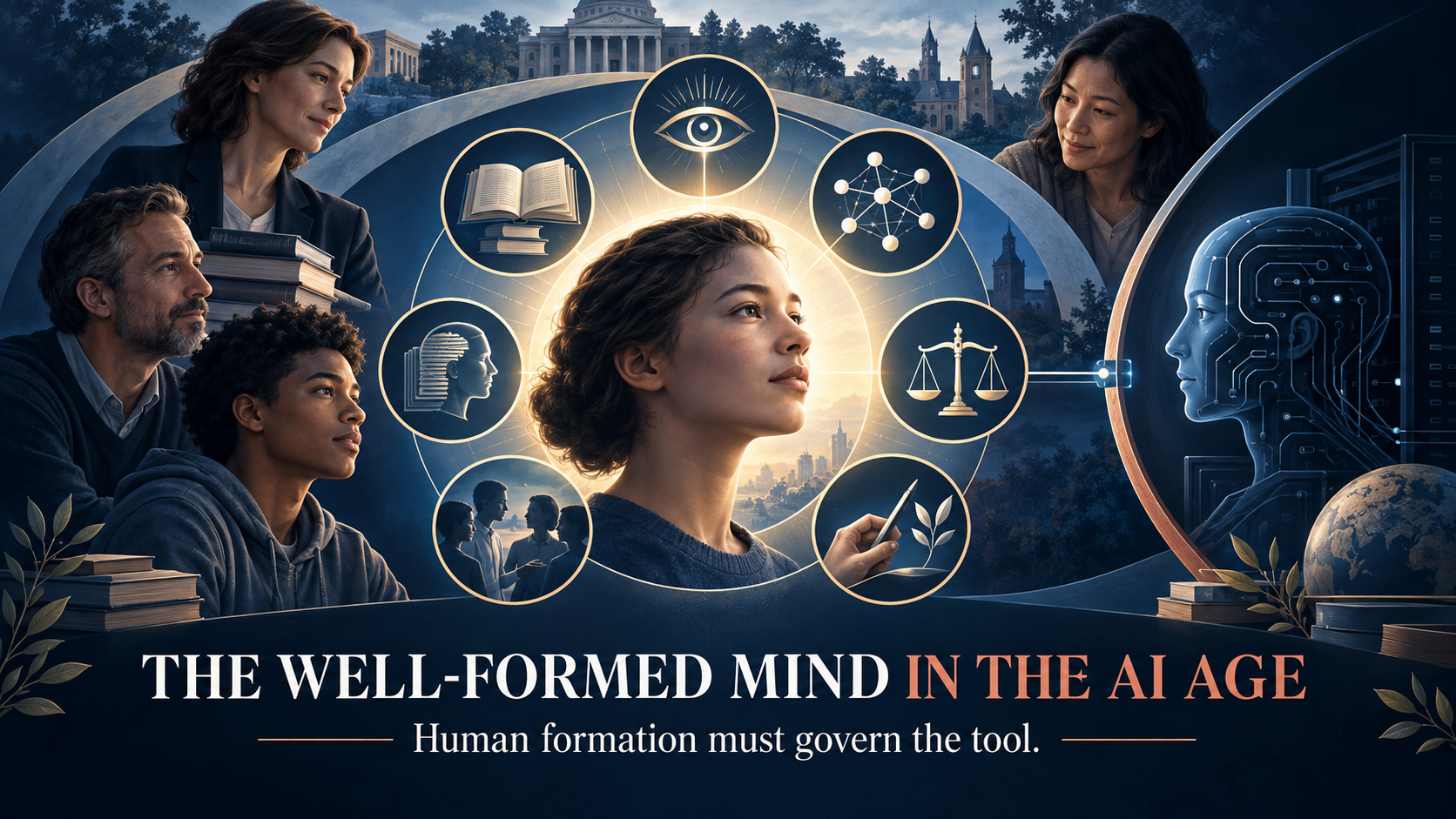
Formal investigation: Education and the Well Formed Mind in the Age of Artificial Intelligence
Beginning with Socrates’ demand for examination and intellectual humility, and Plato’s account of education as the ordering of the whole person toward reality and the good, this investigation asks what kind of person education should form. It then tests modern institutions and artificial intelligence against that formative objective.
Project, Research, Analysis, Editorial by Patrick Russell; assisted by ChatGPT (OpenAI).
The question this investigation answers
Does education form learners who can independently know, explain, reason, judge and apply what their work appears to demonstrate?
Distinct finding and connected evidence
- What this investigation adds
- An education-specific assessment of human formation, independent performance, authorship, retention and responsible educator or family practice.
- Evidence assessed here
- Learning research, course and institutional practices, independent student performance and verification protocols. Published principles or polished tool-assisted work do not establish learning gains.
- Next evidence test
- Verify retained understanding and transfer without unrestricted answer generation; compare assistance with genuine independent capability over time.
- Where Society Meets Ai
Explains model behavior and authorship; this investigation tests what the learner can independently do.
- Ai for Human Flourishing
Uses verified learning benefits in its public-value assessment; this investigation owns the education-specific evidence and limits.
- California Accountability
Examines authority, spending and oversight; this investigation examines learning and formation in the affected institutions.
The philosophical starting point
The ancient question behind the investigation
Socrates begins with examination. Education should not merely give a student information or confidence; it should cultivate the discipline to question claims, test reasons, recognize the limits of personal knowledge, and distinguish genuine understanding from reputation, fluency, or unsupported certainty.
Plato extends the question from what a person knows to how the whole person is ordered. In the Republic, education is a turning toward what is real and good. Reason, desire, emotion, attention, courage, and conduct must be formed together. A curriculum that transmits facts while leaving judgment, appetite, responsibility, and character untouched is therefore incomplete.
This investigation does not treat either philosopher as supplying a complete modern program. It uses their enduring questions as the starting test: does education form people who can seek truth, govern themselves, reason independently, accept correction, and act responsibly? Artificial intelligence makes that question more urgent because a tool can produce impressive work without establishing that the learner possesses the knowledge, judgment, or capability the work appears to demonstrate.
Read the complete philosophical and developmental foundation.
Main finding
Modern education contains excellent teachers, demanding courses, serious institutions, and successful students. Its governing structure, however, rarely unites curriculum, assessment, technology, family responsibility, and institutional accountability around one explicit objective: forming people who can know, remember, reason, judge, and act well. Artificial intelligence makes that weakness harder to ignore because it can support the student's work or quietly perform the work in the student's place.
The evidence reviewed for this investigation supports bounded uses of artificial intelligence that provide questions, hints, feedback, source comparison, accessibility, or assistance to a responsible human educator. It does not support treating unrestricted answer generation as education. A strong student product cannot prove learning when the tool may have supplied the reasoning, language, or solution. The decisive test comes later: can the student understand, explain, verify, and apply the knowledge without the tool?
California's public systems and selected institutions have published useful principles, teaching guidance, privacy rules, integrity standards, and experimental programs. Some also protect live reasoning, oral defense, original writing, or human-centered formation. The reviewed public record does not yet demonstrate institution-wide durable improvements in independent learning, judgment, mental fitness, or wellness caused by artificial intelligence.
Current investigation status
This table shows which parts of the investigation are substantially complete, which remain open, and what the present evidence does or does not authorize.
Evidence tableView 6 recordsHide 6 records
Workstream | Status |
|---|---|
Public source review | Substantially complete |
Public verification of implementation and outcomes | Open |
Comparable durable outcome evidence | Insufficient for a final ranking |
K through 12 student facing AI condition | Not authorized by this investigation |
Higher education comparison | Requires local authorization and protected measures |
Official institution site monitoring | Active monthly review |
The standard for a well formed mind
A well-formed mind is not a storehouse of facts, a high test score, a political identity, or technical fluency alone. It combines knowledge with the habits needed to examine evidence, govern attention, recognize uncertainty, make moral distinctions, communicate honestly, and participate responsibly with other people. The standard draws from classical philosophy, liberal education, Great Books, scientific and mathematical reasoning, developmental learning, and modern work on the integration of knowledge. No single thinker supplies the whole definition.
Daniel Huttenlocher’s questions about human–AI collaboration and changes in human behavior offer a useful frame for this investigation: verify what the learner can still explain, judge and do independently after AI assistance ends. The questions do not establish educational benefit; learning outcomes require direct studies and observed performance.
MIT — Generative AI Impact Consortium (Huttenlocher’s research questions).
Observable capacities
These capacities translate the well-formed mind from a philosophical ideal into abilities that can be observed, practiced and evaluated. The table identifies what a student should be able to demonstrate independently—not merely what an assignment, test score or artificial-intelligence-assisted product appears to show.
Evidence tableView 10 recordsHide 10 records
Capacity | What a student should be able to demonstrate |
|---|---|
Foundational knowledge | Recall and use essential facts, concepts, language, and procedures without constant external retrieval |
Reasoning | Follow premises, detect contradictions, solve unfamiliar problems, and explain each major step |
Truth verification | Trace claims to sources, distinguish fact from inference, and revise a conclusion when evidence changes |
Writing and speech | Express an intelligible position in the student's own voice and answer questions about it |
Intellectual humility | Recognize uncertainty, limits, error, and the strongest reasonable objection |
Moral judgment | Consider purpose, responsibility, consequences, human dignity, and the common good |
Attention and perseverance | Sustain effort through productive difficulty rather than escaping every demanding mental act |
Self government | Choose when to use a tool, disclose assistance, and refuse uses that weaken learning or responsibility |
Human relationship | Listen, disagree constructively, accept correction, cooperate, and remain accountable to other people |
Independent performance | Demonstrate the intended knowledge or skill after assistance is removed |
Developmental meaning
The standard changes with age. Young children need language, memory, direct experience, imitation, play, stories, number sense, and trusted adults. Older students progressively add argument, abstraction, rhetoric, scientific method, moral responsibility, and independent synthesis. Adults should be able to integrate specialized knowledge with judgment about purpose and consequence. Artificial intelligence should not enter every stage in the same way.
The educational problem
The central problem is not the absence of educational authority. Public education has extensive authority distributed among legislatures, state agencies, governing systems, districts, boards, administrators, faculty bodies, teachers, vendors, families, and students. The problem is that this structure does not consistently coalesce around an observable account of the mind and character education should form. Distributed authority can protect local judgment. It can also disperse responsibility until no actor owns the full result.
Sources of the gap
- Curriculum can become a collection of subjects and requirements without a shared account of how they develop memory, reasoning, judgment, and responsibility.
- Assessment often rewards the completed product more clearly than the student's unaided understanding or capacity to defend it.
- Teacher specialization can provide depth while leaving educators without a common formation standard or reliable evidence about unfamiliar methods.
- Parents may remain legally responsible while lacking time, confidence, access, or effective influence over curriculum and technology decisions.
- Administrative, political, philanthropic, commercial, and ideological incentives can shape education without being tested against the same human outcome.
- Technology procurement can move faster than course design, privacy review, faculty governance, developmental limits, and outcome measurement.
Alternatives and their limits
Homeschooling, classical schools, independent schools, charter models, religious education, project-based learning, and Great Books programs can restore clearer responsibility or educational purpose. They do not automatically solve the problem. Each model still requires capable adults, sound curriculum, intellectual honesty, social support, accountability, accessibility, and evidence that students can perform independently.
The wider investigation examines the philosophies and movements that changed educational continuity, including contested modern figures and political methods. Those comparisons should clarify influence and consequence without treating disagreement as proof of misconduct or reducing education to a partisan contest.
What the empirical evidence shows
Performance and learning are different
A randomized study of nearly 1,000 high-school mathematics students compared no artificial intelligence, a standard GPT-4 interface, and a guarded tutoring interface. Practice performance increased with both AI conditions. When the tool was removed, students who had used the standard interface scored 17 percent below the group that never received AI. The guarded tutor largely avoided the loss. The result shows why assisted grades can conceal weaker independent learning and why the exact design of the tool matters. [16]
Purpose built tutoring can help
A peer-reviewed crossover experiment in a Harvard college physics course found that students using a custom AI tutor learned more in less time than students receiving an in-class active-learning lesson on the same material. The tutor was built around established teaching practices, so the finding does not establish that an ordinary chatbot would produce the same result. [17]
Tutor CoPilot tested a different relationship. Artificial intelligence supplied suggestions to human tutors rather than replacing them. Students were 4 percentage points more likely to master lesson topics, with larger gains among students assigned to lower-rated tutors. The study supports AI-plus-human instruction as a serious model, although its working-paper status and specific setting limit generalization. [18]
Memory still requires retrieval
Cognitive offloading can free attention for higher-order work, as notes, calculators, and search tools have long done. The risk arises when the external tool performs the retrieval, representation, or reasoning that the student is meant to learn. Research on transactive memory shows that expected access changes what people remember, while controlled research on retrieval practice shows that producing information from memory improves delayed recall. [19] [20]
Present evidentiary limit
The strongest causal evidence concerns bounded tasks in mathematics, physics, programming, writing, and instructional support. Long-term evidence about attention, independent judgment, relationships, moral development, anxiety, belonging, and family life remains thin. Satisfaction, convenience, engagement, and polished work should not be reported as proof of mental fitness or durable education. [21]
Truth authorship and academic integrity
Artificial intelligence can summarize sources, propose explanations, generate citations, imitate confidence, and produce fluent error. Responsible education must therefore teach students to distinguish a plausible statement from a supported one. Verification requires opening the source, checking whether it says what the tool claims, identifying missing context, comparing strong contrary evidence, and accepting uncertainty when the record does not resolve the question.
Authorship standard
A student's name on an assignment should still indicate responsibility for its claims, reasoning, sources, and language. Where assistance is permitted, the student should identify the tool and describe the material help it provided. Disclosure alone is insufficient when the assignment is intended to measure original composition, memory, reasoning, or judgment; those capacities also require a protected demonstration.
Reliable verification
- Require an independent first attempt when the learning objective permits it.
- Preserve drafts, source notes, calculations, prompts, or a concise process account when AI materially assists the work.
- Use oral explanation, live problem solving, supervised writing, practical performance, or delayed assessment to confirm understanding.
- Ask students to identify and correct errors rather than merely accept or reject an AI answer.
- Judge misconduct from evidence about the work and applicable rule, not from an automated detector score alone.
Research has found that GPT-detection systems can disproportionately classify writing by non-native English writers as AI-generated. Detection may prompt review, but it should not substitute for fair procedure or evidence of authorship. [22]
The informed choice not to use AI
Competence includes knowing when artificial intelligence weakens privacy, attention, accuracy, authorship, or the purpose of an assignment. Students and educators should retain a meaningful non-AI route when the tool is not essential, subject to legitimate course requirements and accessibility needs.
Mental fitness wellness and the COVID comparison
This investigation uses mental fitness as a nonclinical educational term. It includes sustained attention, recall, tolerance of productive difficulty, explanation, judgment, self-regulation, responsibility, and healthy participation with other people. Each capacity requires its own evidence. Convenience and engagement are not substitutes.
Why COVID remains relevant
School closures and emergency remote education disrupted instruction, routine, friendship, family life, and access unevenly. Students who entered the disruption with stable relationships, sound habits, reliable instruction, and capable family support did not face the same conditions as students already experiencing isolation, weak routines, family dysregulation, limited friendships, disability barriers, or educational instability. These differences affect recovery and complicate later claims about technology. [23]
Mother of Divine Grace School entered the pandemic with an established distance-learning and home-education structure. Its experience should not be treated as equivalent to emergency remote schooling adopted with little preparation. The comparison is useful precisely because delivery method alone cannot explain the quality of formation, family support, or social connection. [12]
Questions that remain open
- Does sustained AI use change attention, sleep, anxiety, confidence, belonging, loneliness, or willingness to struggle with difficult work?
- Do effects differ by age, disability, language, prior achievement, family support, or existing distress?
- Can AI provide remediation without becoming another form of avoidance or dependency?
- Does teacher or parent mediation change the result compared with unsupervised access?
- Do students maintain friendship, discussion, mentorship, and responsibility when more learning occurs through a machine?
Current evidence does not justify a general claim that artificial intelligence caused improvement or decline in these outcomes. The investigation treats them as required measures rather than predetermined conclusions.
California public systems
California's public systems show growing attention to human-centered use, access, governance, privacy, and integrity. Their strongest documents also reveal the unresolved problem: statewide or systemwide adoption can expand before institutions establish minimum protected human capabilities and comparable outcome measures.
Evidence tableView 4 recordsHide 4 records
System | Published strength | Unresolved formation question |
|---|---|---|
California Department of Education | Guidance and a model policy address human learning, disclosure, original work, privacy, authorized tools, consent, family communication, bias, and well-being | The model is nonmandatory and does not create one statewide minimum for unaided reading, writing, memory, calculation, oral defense, or judgment |
California Community Colleges | The system states that technology should amplify human capacity rather than replace it and connects AI with faculty leadership, ethics, equity, governance, and evaluation | Pilots still need independent learning, dependency, subgroup, workload, and durable outcome measures |
California State University | Large-scale access can reduce unequal availability and support common training and security arrangements | Procurement and workforce goals may move ahead of course purpose, faculty governance, protected assessment, privacy, and measured learning |
University of California | The Academic Senate report defends faculty authority, discipline-specific rules, transparency, opt-in choices, refusal, data protection, and consultation | The system still needs clearer implementation evidence, academic-integrity rules, data ownership, and measures of reading, writing, creativity, and independent judgment |
The California Department of Education guidance and model policy are important reference points for K through 12 schools. The University of California Academic Senate report provides the strongest reviewed system-level warning that demanding intellectual work and faculty judgment cannot be replaced by technological enthusiasm. [1] [2] [5]
California institution findings
The institutional review covers ten California cases. They represent public and private universities, a science and engineering institute, Catholic higher education, an independent secondary school, a public charter network, and a private Catholic K through 12 distance-learning and home-education program. The selection is comparative, not representative of every California school.
K through 12 track
This comparison identifies the strongest publicly documented formation practices in the selected K–12 institutions and separates them from the evidence still needed to judge implementation and results.
Evidence tableView 3 recordsHide 3 records
Institution | Strongest public evidence | Evidence still needed |
|---|---|---|
Mother of Divine Grace School | A parent-directed classical sequence explicitly develops memory, imagination, reasoning, communication, judgment, and responsibility | A complete public student-facing AI policy, approved tools, age and consent rules, privacy controls, implementation records, and measured outcomes |
Harvard-Westlake School | A demanding curriculum and visible ethical and dialogical learning provide a basis for original thought and constructive disagreement | Current schoolwide AI rules, approved accounts, parent notice, independent verification, accessibility, and comparable outcomes |
High Tech High | Authentic projects, public work, collaboration, and responsibility connect knowledge with practical creation | Detailed AI governance, privacy, age and consent, individual mastery checks, implementation consistency, and durable results |
The three K through 12 institutions should be evaluated by developmental stage, parent authority, consent, family communication, student support, and protected foundational learning. This investigation does not authorize a student-facing AI condition in K through 12. [12] [13] [14]
Higher education track
Colleges and universities should be evaluated by course purpose, faculty authority, disciplinary differences, independent scholarship, protected assessment, degree-level outcomes, and the student's capacity to assume adult responsibility. Their AI rules need not be identical, but students need a recognizable institutional floor.
Higher education case comparison
This table compares the strongest public evidence from the selected colleges and universities with the unanswered questions that prevent a final institutional ranking.
Evidence tableView 7 recordsHide 7 records
Institution | Strongest public evidence | Evidence still needed |
|---|---|---|
UC Berkeley | A mature AI hub, licensed tools, privacy guidance, assignment redesign, and course examples that protect independent reasoning | Campus-wide implementation, consistent protected capabilities, delayed learning, workload, subgroup, and wellness results |
UCLA | Student-use evidence, citation guidance, assignment-design resources, and institution-wide principles | A common independent-performance floor, approved-tool chain, policy implementation, and durable outcomes |
Stanford University | Human-centered AI literacy, student guidance, responsible-use controls, and visible course experimentation | A campus-wide developmental sequence, comparable independent assessments, and long-term learning and relationship evidence |
University of Southern California | Broad AI enablement, academic-integrity infrastructure, and protected knowledge boundaries in at least one professional-school policy | Consistency across programs, independent verification, privacy implementation, and measured learning |
California Institute of Technology | Teaching guidance and an assessment culture capable of protecting live reasoning and demonstrated competence | A complete public student-facing governance framework and comparable evidence of AI's educational effects |
Loyola Marymount University | The clearest reviewed effort to connect AI literacy with mission, ethics, privacy, access, education, and the humanities | Common protected assessments, implementation records, participant evidence, and durable outcomes |
Thomas Aquinas College | A unified curriculum of original texts, discussion, proof, laboratory work, writing, and public defense, alongside an AI and human-flourishing initiative | A complete public student-facing AI framework covering disclosure, approved uses, privacy, verification, and required unaided work |
Preliminary comparison
Different institutions lead in different dimensions. Some provide stronger formation and protected independent work. Others provide more mature AI infrastructure, privacy controls, student-use evidence, or mission-based ethics. A single numerical ranking would hide these differences and would exceed the available outcome evidence. [6] [7] [8] [9] [10] [11] [13]
Which AI uses fit education
The educational mode matters more than the brand. A general assistant may act as a tutor, critic, source guide, answer generator, companion, or substitute author. Suitability depends on the role it performs, the learner's age and preparation, the information it receives, and the independent performance required afterward.
Recommended order of preference
This table ranks uses of artificial intelligence by their value to human formation, placing tools that strengthen independent capability above uses that replace the learner’s work.
Evidence tableView 6 recordsHide 6 records
Priority | Use | Formation condition |
|---|---|---|
1 | Human teaching and independent effort | The educator, parent, text, task, and learner remain primary |
2 | Source bounded research | The learner can inspect the defined materials and trace every material claim |
3 | Guided tutoring | The system asks questions, releases hints gradually, and keeps the learner responsible for the solution |
4 | Critique comparison and revision | The student attempts the work first and remains responsible for verification and substantive revision |
5 | Teacher support | The tool returns time or insight to the educator without making consequential human decisions |
Restricted | Finished answers substitute relationships emotional surveillance and automated consequential grading | These modes conflict with formation or require exceptional justification and controls |
Minimum institutional rule
- Name the human purpose of the course and each major assessment.
- Identify the knowledge and skills students must retain without artificial intelligence.
- Protect first attempts, retrieval, direct reading, original composition, live reasoning, oral defense, and practical performance where they serve the learning objective.
- Require traceable assistance, source verification, and student responsibility for the final work.
- Use approved accounts, defined data rules, accessibility review, and an equivalent route when AI is not essential.
- Expand a use only when independent learning improves after assistance is removed and serious subgroup harms are not concealed by the average.
The practical test is demanding: after using the tool, is the student more able to understand, explain, verify, choose, and act without it? [15] [16] [18]
Recommendations for further investigation
Some questions cannot be resolved from public documents. Institutions should identify the operative policy, responsible authority, approved tools and accounts, privacy and retention terms, accessibility provisions, assessment protections, educator preparation, and evidence of student results. Educators should document how rules operate in actual assignments. Parents and students can clarify notice, consent, understanding, experience, and practical effects. Until comparable and properly protected evidence is available, these matters remain open and should not be interpreted as findings against any person or institution.
Recommended contributions
This table identifies what each participant can contribute to close the investigation’s remaining evidence gaps without treating missing information as proof of failure.
Evidence tableView 7 recordsHide 7 records
Perspective | Contribution that would improve the investigation |
|---|---|
Institutions | Operative policies, authority, approved accounts, contracts, implementation records, educator preparation, assessment design, and outcome evidence |
Educators | Representative assignments, actual AI rules, workload, enforcement, human-only work, observed benefits, failures, and student explanations |
Parents | Notice, consent, alternatives, expectations, ability to influence decisions, family burden, and observed changes |
Students | Actual uses, disclosure, confidence, dependency, attention, authorship, relationships, and authorized unaided comparison |
Privacy and technology staff | Product configuration, data classification, vendor access, retention, deletion, security, and incidents |
Accessibility and wellness staff | Accommodations, equivalent routes, support needs, stress, attention, belonging, and limits on interpretation |
Researchers | Comparable groups, preregistered outcomes, baseline condition, delayed measures, transfer, subgroup analysis, and unsuccessful results |
Participation boundary
This statement recommends useful evidence. It is not an information request and does not imply that participation has occurred. Any later collection involving students or education records must use the proper authority, consent, parent or guardian permission, student assent, privacy, retention, deletion, accessibility, and reporting protections. Testimony should remain distinct from measured outcomes.
Ongoing policy monitoring
This investigation uses a recurring monthly review of official webpages published by the ten institutions in the California study. The review looks for meaningful changes in educational objectives, artificial intelligence policies, teaching guidance, approved tools, privacy and data rules, academic integrity, age or consent requirements, governance, and educational programs. Material changes are dated, linked to the official source, classified as affecting K through 12 or higher education, and evaluated for their significance to the well-formed-mind investigation and scorecard.
Automated monitoring identifies changes in the published record. It does not establish that a policy was implemented, that educators or students followed it, or that learning and wellness improved. Those questions remain subject to direct verification. If a monitored page disappears or changes without an explanatory notice, the investigation should preserve the prior citation and mark the current status for review rather than infer the reason.
Institutions monitored
This table identifies the K–12 and higher-education institutions whose official publications are monitored for material changes in policy, programs and evidence.
Evidence tableView 10 institutionsHide 10 institutions
K through 12
Mother of Divine Grace School
Harvard-Westlake School
High Tech High
Higher education
UC Berkeley
UCLA
Stanford University
University of Southern California
California Institute of Technology
Loyola Marymount University
Thomas Aquinas College
Change log rule
The public change log should record the detection date, institution, education level, official source, prior published position, new published position, significance, and verification status. Routine website edits should not be reported as policy changes.
How to read this investigation
Evidence labels
This table defines the labels used throughout the investigation so readers can distinguish policy, documented practice, reported experience, measured results, context and unresolved evidence.
Evidence tableView 7 recordsHide 7 records
Label | Meaning |
|---|---|
Published policy | An official source states an operative or proposed rule |
Documented practice | A course, assignment, program, or implementation record shows an activity |
Reported experience | An identified participant or institution describes an experience |
Immediate result | Performance was measured during or shortly after the activity |
Durable result | Unaided retention or transfer was measured after time passed |
Context | Family, wellness, COVID, access, disability, or prior condition affects interpretation |
Unresolved evidence | The public record does not answer the question and further investigation is recommended |
GIB evidence grades
A means proven. B means substantiated within stated limits. C means active, changing, disputed, or unresolved. D means unsubstantiated or rejected. Missing public evidence normally receives an unresolved label and, where a grade is useful, a C. Silence does not justify a D.
Scope limit
The ten institutional cases do not represent every California school or university. Public webpages may omit relevant internal practices, and published language may not predict classroom behavior. The investigation therefore separates mission, policy, practice, immediate performance, durable learning, context, and missing evidence.
Public navigation
- Foundations of the Well Formed Mind
- The Modern Education System
- Artificial Intelligence and Learning
- California Systems and Institutions
- AI Tool Suitability
- COVID Wellness and Human Relationships
- Guides for Families Educators and Students
- Evidence Verification and Open Questions
- Research Archive and Change Log
Current determination
Artificial intelligence should be treated as a bounded educational aid, not as evidence of learning. Schools and universities should protect the mental acts their courses are intended to develop, provide age- and purpose-specific rules, verify understanding after assistance is removed, and preserve accountable human relationships. A use that improves speed, satisfaction, or the submitted product may be valuable, but it should be described as an efficiency gain unless independent learning also improves.
The strongest institutional model will combine a clear account of human formation with responsible technical governance. Formation without an explicit AI policy leaves teachers, families, and students without practical boundaries. AI infrastructure without an account of educational purpose can normalize use before anyone proves what students retain.
The public-source investigation is sufficiently developed for publication. Implementation and outcomes remain unverified where supporting public evidence is unavailable. No final institutional ranking is justified, and no K through 12 student-facing AI condition is authorized by this project. Future findings should change the article when stronger evidence warrants a change.
Selected sources
1. California Department of Education Guidance for Safe and Effective AI Use State K through 12 guidance
2. California Department of Education Model AI Policy Model policy and implementation fields
3. California Community Colleges AI System Human capacity governance and system initiatives
4. California State University AI Commons System access resources and training
5. University of California Academic Senate AI Report Agency faculty authority governance and trustworthiness
6. UC Berkeley AI Hub Campus guidance tools and teaching resources
7. Stanford Understanding AI Literacy Human-centered literacy framework
8. UCLA Generative AI Guide Research citation and student guidance
9. USC Artificial Intelligence Resources Institutional AI resources
10. Caltech Teaching in the Age of AI Course and assessment guidance
11. Loyola Marymount University AI in Teaching and Learning Mission teaching privacy and access
12. Mother of Divine Grace School Curriculum Overview K through 12 classical developmental curriculum
13. Thomas Aquinas College AI and Human Flourishing Formation and public AI inquiry
14. Harvard-Westlake Curriculum Independent secondary curriculum
15. High Tech High Project-based K through 12 model
Learning and wellness sources
16. Bastani and colleagues Generative AI Without Guardrails Can Harm Learning Randomized high-school mathematics study
17. Kestin and colleagues AI Tutoring Outperforms In Class Active Learning Peer-reviewed college physics experiment
18. Wang and colleagues Tutor CoPilot Randomized field trial of AI support for human tutors
19. Risko and Gilbert Cognitive Offloading Review of external tools and mental effort
20. Karpicke and Roediger The Critical Importance of Retrieval for Learning Controlled delayed-recall evidence
21. Stanford SCALE Evidence Base on AI in K through 12 2026 evidence synthesis and research gaps
22. Liang and colleagues GPT Detectors Are Biased Against Non Native English Writers Academic-integrity caution
23. Centers for Disease Control and Prevention Youth Mental Health During COVID 19 Pandemic context
24. National Center for Education Statistics 2024 Mathematics Results National achievement context
Complete document record
Complete Investigation Documents
This investigation is supported by 22 complete documents. Every title below opens the unabridged web edition; the adjacent Word link downloads the corresponding document. These records preserve the full research, evidence reviews, institutional findings, verification methods, pilot materials and tool analysis. Historical documents may describe proposed outreach or participant studies. Those proposals are superseded by the September 25, 2026 Public Evidence Review policy: GIB conducts no surveys, questionnaires, interviews or response solicitation. Archived Word documents are historical records, not current instructions.
Foundational research master
Review framework
Evidence reviews and scorecards
- Phase One Evidence Review2,000 wordsWord document
- Phase Two Evidence Review2,826 wordsWord document
- Phase Three Course Evidence Review2,568 wordsWord document
- Phase Four Empirical Evidence Review3,113 wordsWord document
- Phase Five Integrated Institution Scorecard4,415 wordsWord document
- Phase Six Verification Investigation Design2,412 wordsWord document
- Phase Seven Public Evidence Archive1,895 wordsWord document
Verification and pilot materials
- Phase Eight Institution Case Files4,710 wordsWord document
- Phase Nine Evidence Ledger3,224 wordsWord document
- Word document
- Phase Eleven Prospective Pilot Scorecard3,515 wordsWord document
- Phase Twelve Pilot Task Packets3,772 wordsWord document
- Phase Thirteen Pilot Packet Dry Run4,401 wordsWord document
- Phase Fourteen Educator Tabletop Review3,613 wordsWord document
- Word document
- Phase Sixteen Local Review Execution Binder2,292 wordsWord document
Supplemental institutional audits
Open the complete document archive with descriptions and document statistics.