Opinion
Cartel Power, Imported Avocados and the Threat to California’s Growers
Cartel extortion, rising imports and punishing costs threaten California’s avocado farms

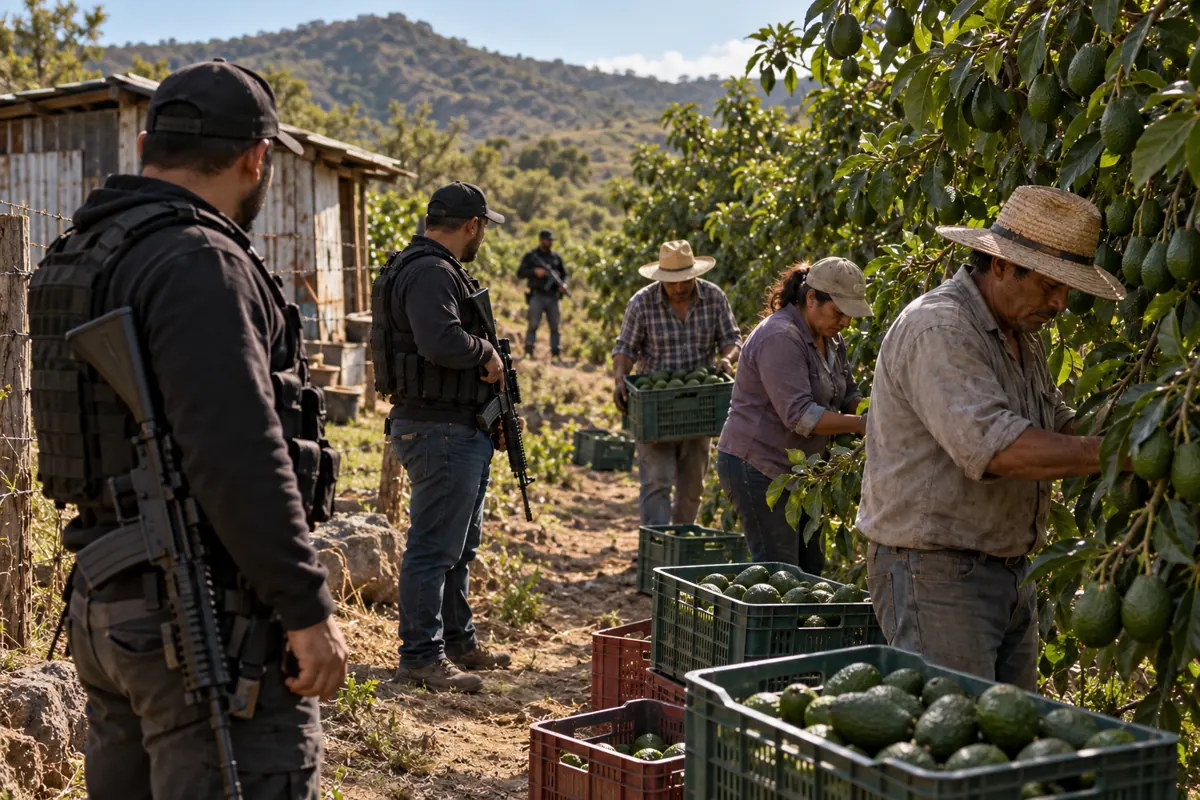
Cartel extortion reaches into the avocado industry supplying the American market. Criminal organizations demand payments from growers, packers and exporters, backed by threats to property and life.1 That supply-chain danger deserves Washington’s full attention as Mexican imports put pressure on California’s harvest. Protecting lawful trade requires confronting the criminal networks profiting upstream and preserving the domestic farms competing with the imported fruit.
USDA reports that U.S. fresh-avocado imports reached a record 2.87 billion pounds in 2025, with Mexico supplying 83 percent.2
Mexican shipments were 24 percent higher from January through mid-March 2026 than a year earlier. USDA reported that high Mexican volume and low prices slowed California’s early-season shipments: only three percent of the forecast crop had shipped by March 15, against the previous four-year average of eight percent. This puts pressure on California growers’ ability to market the crop to cover operating costs and keep their farms in production.2
The cartel problem has names. Treasury’s August 2025 sanctions identified Cárteles Unidos, headed by Juan José Farías Álvarez, “El Abuelo,” and Los Viagras, founded and led by Nicolás Sierra Santana, “El Gordo.” Treasury described Los Viagras as extorting avocado and citrus growers and allied with the Jalisco New Generation Cartel. These organizations extract revenue from agricultural commerce.1
One especially direct avocado connection was Luis Enrique Barragán Chávez, known as “Wicho” or “R5.” Treasury linked him to avocado extortion. Michoacán’s government later reported that he died in a military confrontation on August 30, 2026. The threat outlives an individual leader because the business is organized around extracting money from people who must keep growing, packing and selling their crops.1,3
“A respectable label on a box cannot substitute for accountability upstream.”
The method is brutally practical. Treasury describes compulsory payments demanded from farmers, packers and agricultural exporters, backed by threats to property and life. It also documents land seizures, illegal logging and forest clearing for agricultural production. Criminals need not own every orchard to profit from the trade. Extortion upstream can feed on fruit that moves through ordinary packing and export channels into American stores.1
The pressure upstream
Newer trade figures reinforce the scale of the competition. Mexico’s agriculture ministry reported 501,824 metric tons of avocado exports to the United States during January through April 2026, up 35 percent from 370,551 tons in the comparable period of 2025.4
That is the supply-chain danger accompanying the import flood. A rapidly expanding market gives extortion networks more commerce to prey upon, while the additional fruit competes with California’s harvest. Mexican growers forced to pay are victims of the criminal power Washington must confront. Washington should trace shipments and financial relationships, enforce sanctions, and insist that inspections can operate safely. A respectable label on a box cannot substitute for accountability upstream.
Who controls the imports? Commercial buyers include Mission Produce, which acquired Calavo in May 2026, West Pak and Index Fresh.5 Government controls admission: USDA’s APHIS sets plant-health requirements, Mexico’s SENASICA certifies orchards, and APHIS inspectors check fruit at Mexican packinghouses. CBP enforces entry requirements; FDA requires importers to verify foreign suppliers’ food-safety practices. USTR handles trade policy. These divided responsibilities demand coordinated enforcement. Passing a pest inspection does not establish freedom from criminal extortion.6
The American end deserves close scrutiny too. FDA’s July 2024 warning to California-based Greenfruit Avocados found that its supplier verification evaluated packers while failing to identify and evaluate the growers. That was a documented food-safety due-diligence failure. It strengthens the case for traceability all the way back to the orchard. Cartel-finance enforcement must follow the money as well as the fruit, and prosecute criminal collusion wherever the evidence leads.7
Enforcement and accountability
President Trump has taken steps that deserve credit. Treasury’s August 2025 sanctions targeted the organizations and people involved, and his administration designated Los Viagras a Foreign Terrorist Organization effective July 16, 2026. Those actions provide legal tools against designated interests and their support networks. The California Avocado Commission publicly praised his defense of American personnel and confrontation of cartels. Enforcement must now deliver sustained protection for lawful commerce.1,8,9
The inspection system itself came under threat in August. U.S. operations in Michoacán, including inspections, were suspended on August 5 after a security threat and fully resumed on August 13.10
Mexico has also announced new compliance measures. An October 6 agriculture ministry and tax authority announcement tied packinghouse tax deductions to documented sourcing directly from certified orchards, with the tax provision taking effect December 31. A separate labor certificate began operating October 1, with phased implementation into 2027. Enforcement will determine their value; neither measure establishes freedom from extortion.11,12
Trade and survival
California growers also need relief from damaging seasonal import surges. The Commission is seeking a tariff-rate quota for Mexican avocados during California’s March-through-September season: a defined volume at the standard tariff, with higher duties above that threshold. Its October 8 update was still pressing the request. Washington should deliver a workable seasonal safeguard, backed by credible inspections and tracing, that preserves domestic production while maintaining lawful trade. The USMCA review offers a practical opportunity to press that case.13,14
California’s avocado industry was already being worn down before this latest surge. In December 2025, the California Avocado Commission told federal trade officials that grower numbers had fallen 55 percent and production 46 percent over two decades. That decline should have forced California to examine the cumulative burden of farming here. Instead, growers are being asked to withstand another market shock with the same obligations waiting at home.14
The latest statewide figures show what growers are facing. California Avocado Commission assessment records put the average grower price at 96.3 cents per pound across all varieties from November 2025 through June 2026, roughly 40 percent below the comparable period a year earlier, when it was about $1.61. That is the reported grower price, not profit after water and other operating costs, and not a final full-season average.15,16
California’s farms are still producing fruit worth defending. In July, the Commission reaffirmed a 330-million-pound crop forecast for 2026 and reported strong quality and sizing. That remains a forecast, not a final harvest total. Good fruit still has to earn enough to cover the bills.17
The cost of farming
An avocado tree needs water whether prices are strong or weak. Harvesting requires people, and pumps require power. Fuel, equipment maintenance, insurance and the work of complying with government requirements compete for the same dollars. Cutting essential care to survive a bad market can damage the productive capacity needed for the next harvest. Borrowing to cover an operating loss merely moves the reckoning forward and adds another bill.
The affordability crisis reaches both sides of the grocery counter. Families struggle with utility, fuel and food bills; agricultural producers face the same pressures before a crop reaches the store. Years of Democrat policy choices have made it increasingly difficult for California’s agricultural producers to keep their farms operating. Growers competing with imports cannot simply dictate a higher selling price. Added costs can reach consumers or undermine the farms needed to supply them.
Water costs add to the pressure. UC Cooperative Extension’s 2020 high-density avocado model, using 2019 and 2020 prices, put water at 44 percent of total annual costs. Even at a high modeled yield, full-cost break-even was about one dollar a pound. That is a historical model, but its lesson is painfully current: the selling price must cover a formidable cost structure before an orchard earns anything.18
For example, a ten-acre grove using four acre-feet of water per planted acre annually and one two-inch meter would average roughly $2,500 to $8,800 a month in district water charges under the selected agricultural schedules reviewed. That estimate includes modeled fixed charges but excludes on-farm pumping; actual bills depend on the supplier, eligibility and seasonal demand, with summer costs potentially higher.19,20,21 That is water alone, on top of all other costs of keeping the grove in production.
For California growers, the economic mechanism is unforgiving. An import surge can depress returns while California’s operating costs remain due. A farm can lose money on the crop and still owe the water district, its workers, suppliers and taxing authorities. Land that looks valuable on paper does not automatically generate the cash to settle those bills. If losses persist and financing runs out, selling the property or seeking bankruptcy protection becomes a serious possibility. Waiting for more growers to reach that point would be an extraordinary definition of responsible government.
Keeping farms in the family
Sacramento must answer for the burdens it controls. Consider what can happen when a farm passes to the next generation. Proposition 13 made predictable property taxation a defining California promise. Proposition 19 changed the inheritance rules in 2020. It retains an exclusion for qualifying family farms, but a valuable parcel can still emerge from a family transfer with a sharply higher annual assessment.22
The current calculation is specific. For qualifying transfers from February 16, 2025, through February 15, 2027, each legal farm parcel has a limit equal to its previous taxable value plus $1,044,586. Market value above that limit is added to the old taxable value. The calculation is parcel by parcel, and an heir need not live on the farmland to qualify.22
Take a hypothetical qualifying parcel worth $3 million with an old taxable value of $400,000. Assuming a full transfer and no lower Williamson Act assessment, its new taxable value becomes $1,955,414. At the basic one-percent rate, the annual bill rises from $4,000 to about $19,554, before bonds and other charges. The orchard has produced no additional income to cover that roughly $15,554 increase. A family has simply tried to keep farming.22
That is how policy can make selling more attractive than continuing to produce food. The Legislative Analyst’s Office anticipated additional property-tax revenue for local governments and schools from Proposition 19’s inheritance changes. The family must find that revenue somewhere. A succession rule should protect genuine continued farming. A state concerned about preserving farmland should make it financially possible for farmers to remain on it.23
Trump’s July 2025 law raised the federal estate-and-gift tax basic exclusion to $15 million per person for 2026, helping qualifying large estates preserve capital. California’s recurring property-tax problem requires its own repair. A constitutional amendment must reach and win the voters; a governor cannot accomplish it by proclamation. The latest inheritance-rule repeal initiative failed to gather sufficient signatures in May. A serious renewed effort is overdue.24,25
A workable farm agenda
Steve Hilton should put the survival of working farms at the center of his California agenda. His platform proposes devoting two percent of the General Fund to water affordability and infrastructure, expanding storage and recycling, reducing regulatory burdens and protecting productive farmland from new solar development. Those proposals address costs and land-use pressures California growers actually face. He should pair them with an explicit farm-succession commitment and a credible route to voter approval.26,27

Growers deserve to see the timetable, the budget and the change in the bill they must pay. A governor has appointments, agency leadership and a legislative agenda to put behind those promises. Federal action against criminal networks and destructive import surges must be matched by state action that makes California agriculture competitive. Another declaration of affection for farmers will not do the work.
California’s growers know how to grow avocados. They need leaders willing to remove the obstacles they have placed between that work and a viable living. There is still time to keep productive orchards in production and give the next generation a reason to take them on. Confront the criminal networks. Make trade enforceable and farming affordable. Let the reward for growing food be the chance to keep growing it.
Sources
1. U.S. Treasury; avocado extortion sanctions; August 14, 2025.
2. USDA; March 2026 outlook pp 17–19.
3. Government of Michoacán; Barragán Chávez death; September 1, 2026.
4. Mexico agriculture ministry; January–April 2026 exports, July 31, 2026.
5. Mission acquisition; West Pak; Index Fresh.
6. USDA 2026 Mexico report; FDA import requirements; CBP agriculture.
7. FDA; Greenfruit warning letter July 8, 2024.
8. U.S. State Department; Los Viagras FTO designation; July 16, 2026.
9. CAC; inspection and security statement; August 6, 2026.
10. SENASICA; Michoacán operations resume August 13, 2026.
11. Mexico agriculture ministry and SAT; certified-orchard sourcing and tax documentation, October 6, 2026.
12. Mexico labor ministry; VELAGRO launch October 1, 2026; implementation schedule.
13. CAC; seasonal quota campaign update; October 8, 2026.
14. CAC; USMCA testimony; December 4, 2025.
15. CAC June 2026 production and value report; issued August 17, 2026; November 2025–June 2026; producer reporting definition.
16. CAC October 2025 final report; comparable November–June subtotal: $354,553,239 ÷ 220,419,000 pounds; calculated decline 40.15 percent.
17. CAC midseason update; July 14, 2026; crop forecast and quality.
18. UC Cooperative Extension; 2020 San Diego high-density cost study.
19. City of Escondido; 2026 water rates pp 1–2.
20. Rancho California Water District; July 2026 customer guide pp 1–2.
21. Carpinteria Valley Water District; July 2026 agricultural rates.
22. California BOE; family farm guidance August 3, 2026; current exclusion allowance.
23. Legislative Analyst’s Office; 2020 Proposition 19 fiscal analysis.
24. Public Law 119–21 §70106; IRS 2026 estate tax exclusion.
25. California Secretary of State; ballot routes; May 18, 2026 initiative failure.
26. Steve Hilton campaign; water; energy; business regulation.
27. AgNet West; Steve Hilton agriculture interview; July 24, 2026.
Image credits and permissions
Hero illustration: a California family avocado farm.
Salud Carbajal official portrait: U.S. House of Representatives / Leah Herman. Public domain. Source
Steve Hilton graphic: AgNet West.
Cartel intimidation in avocado agriculture. Illustration.
Project, Research, Analysis, Editorial by Patrick Russell; assisted by ChatGPT (OpenAI).