
CHAPTER 2
How AI works and what the evidence shows
Begin with what AI is, follow its common logic and information sources, then examine how answers are generated, where they can fail and what the tests establish.
In this orientation
- What artificial intelligence is
- The common logic and information sources
- A generated answer and its limits
- Working glossary
- Bias and common misconceptions
- Major types of AI
- How AI is used today
- A practical application test
- Testable research questions
- The comparative testing method
- The eleven-tool, four-test comparison
- Claim-and-evidence ledger
- Phase One evidence review
What artificial intelligence is
What Artificial Intelligence Is
Artificial intelligence is a broad term for computer systems designed to perform tasks associated with human intelligence, such as recognizing images, understanding speech, predicting outcomes, generating language, recommending actions, and controlling machines.
AI is not one technology. A medical-imaging system, a fraud detector, a self-driving vehicle, a recommendation engine, and a conversational chatbot may all be called AI, although they use different data, architectures, objectives, and evaluation methods.
Most current AI is specialized. It can perform particular tasks impressively but does not possess the full range of human judgment, self-awareness, moral responsibility, life experience, or common sense. Even a general-purpose language model remains a designed system operating within technical, informational, and institutional constraints.
↑ Back to chapterThe common logic and information sources
The Common Logic Behind Popular AI Chat Tools
Most leading chat tools are built around large language models, often using a transformer architecture. Although companies differ in their training data, model design, tools, safety rules, and business objectives, the basic process is similar.
First, text and other data are divided into smaller units called tokens. During training, the model repeatedly attempts to predict missing or subsequent tokens. Its internal parameters are adjusted when its predictions are wrong. Across enormous numbers of examples, the model learns statistical relationships among words, concepts, styles, structures, and patterns of reasoning.
When a user asks a question, the model does not normally search a database for one stored response. It evaluates the conversation and predicts a sequence of tokens likely to form a useful answer. This process is called inference.
Modern chat systems usually add several layers around the underlying model:
- Instruction tuning teaches the model to follow requests and respond conversationally.
- Human or AI feedback helps shape preferred behavior.
- System instructions establish rules, roles, and safety boundaries.
- Retrieval systems may supply documents, databases, or current web information.
- Tools may perform calculations, execute code, inspect files, generate images, or interact with external services.
- Moderation and security systems attempt to prevent harmful or unauthorized behavior.
- Product design determines what the model remembers, cites, displays, or refuses.
The final answer therefore reflects more than the model’s training. It can be influenced by the user’s wording, conversation history, developer instructions, retrieved information, tool results, safety policies, model settings, and institutional choices.
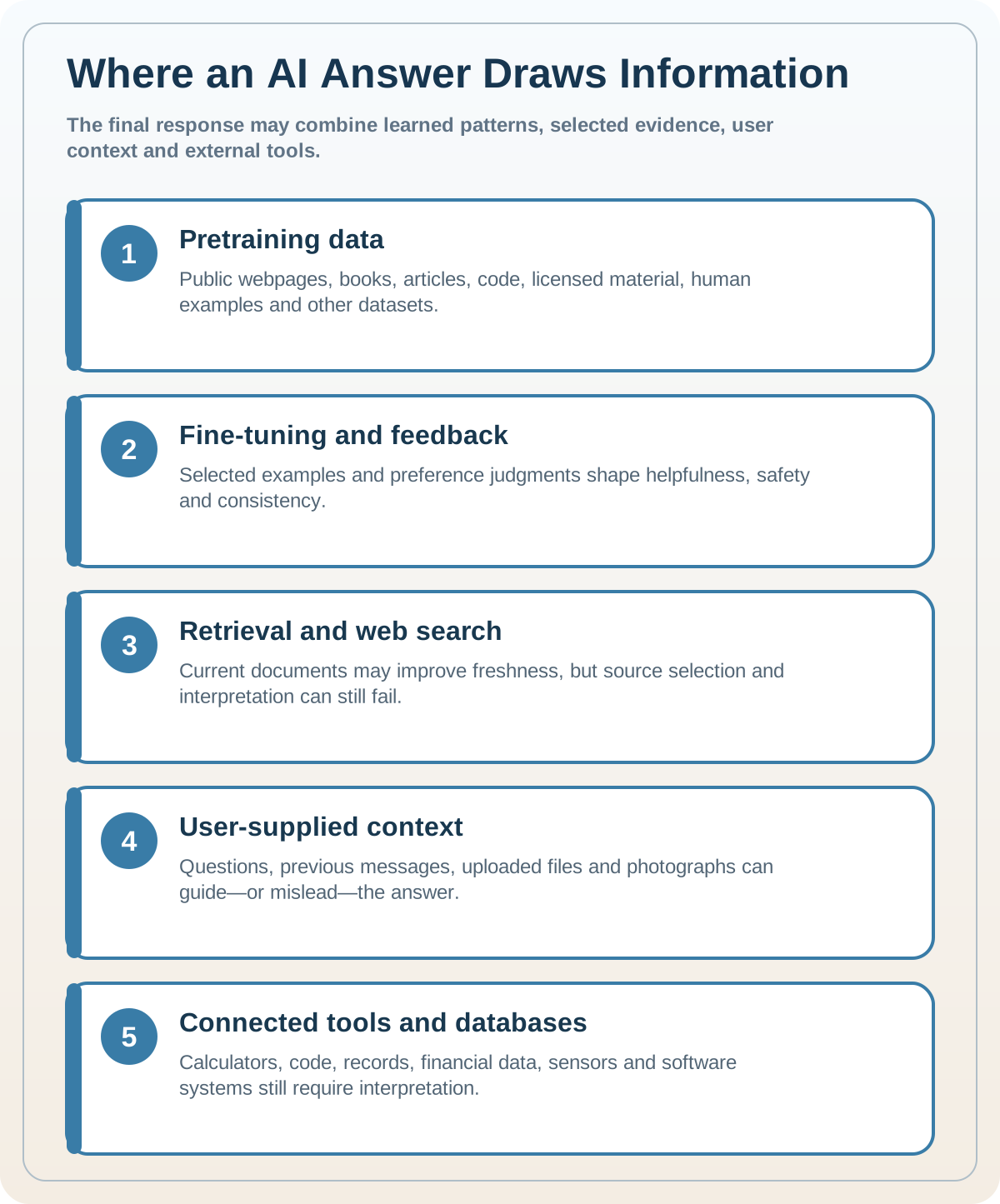
Where AI Gets Its Information
AI systems can draw from several different sources, and those sources should never be treated as interchangeable.
Pretraining Data
Large models are trained on extensive collections that may include publicly available webpages, books, articles, computer code, reference works, licensed material, human-created examples, and other datasets. Companies do not always disclose the complete contents of their training collections. This creates unresolved questions concerning copyright, consent, privacy, representation, political balance, and data quality.
Fine-Tuning and Human Feedback
After pretraining, developers provide selected examples and preference judgments to make models more helpful, safe, accurate, or aligned with desired behavior. These judgments can improve performance but can also introduce cultural, political, commercial, or institutional preferences.
Retrieval and Web Access
Some systems can search the internet or retrieve information from selected documents. Retrieval can improve freshness and verifiability, but it does not guarantee correctness. Search ranking, source selection, outdated pages, fabricated web content, inaccessible documents, and poor interpretation can still produce errors.
User-Supplied Context
A model may use the current question, earlier messages, uploaded documents, photographs, spreadsheets, or other information provided during the interaction. It can reason from incorrect user-supplied premises unless it recognizes and challenges them.
Connected Tools and Databases
Industry systems may connect to medical records, financial data, corporate knowledge bases, sensors, government databases, scientific instruments, or software applications. The quality of the output then depends upon the quality, permissions, security, completeness, and relevance of those inputs.
A generated answer and its limits
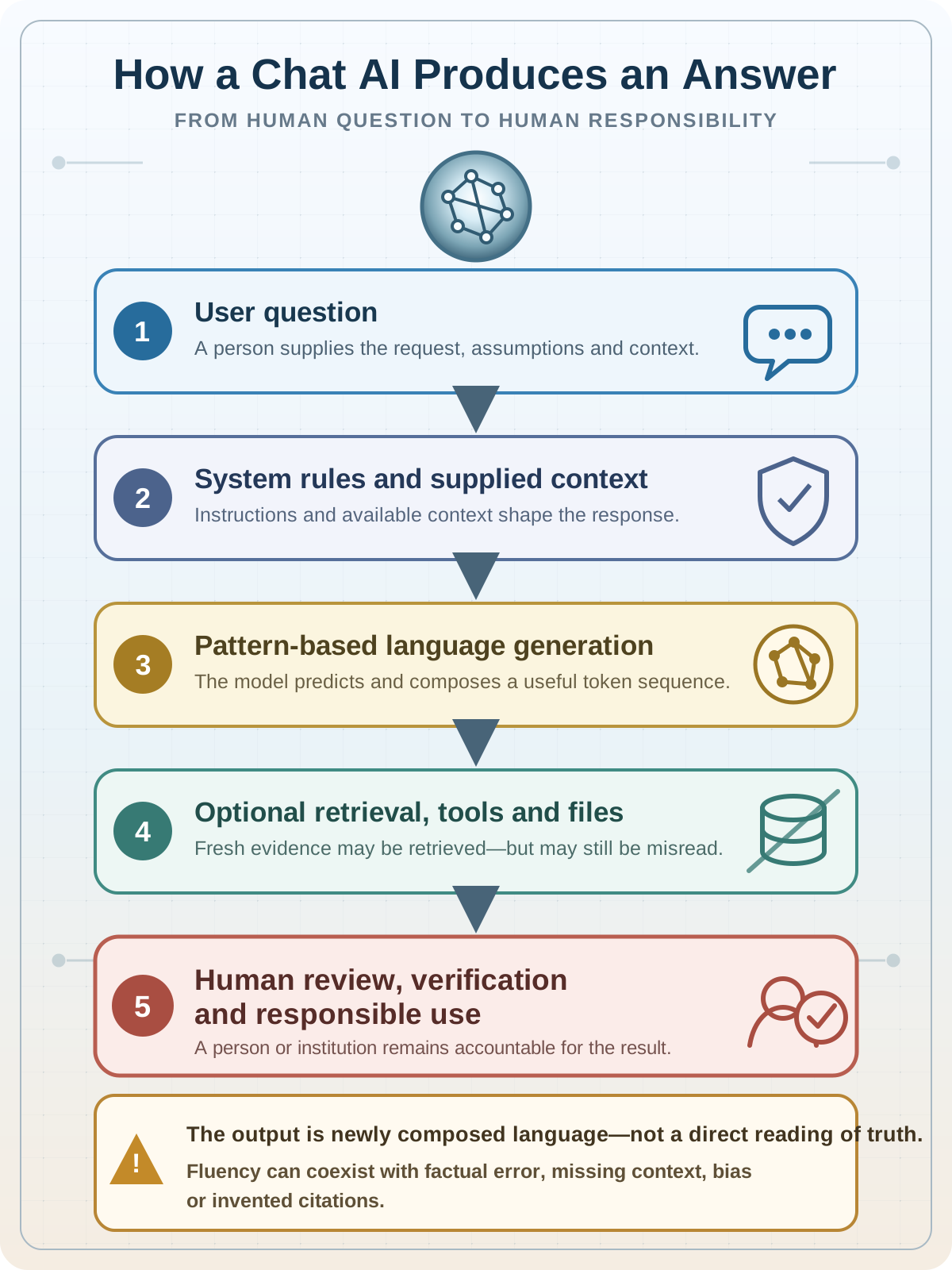
A generated answer is newly composed language—not a direct reading of truth
Most popular chat systems use large language models. During training, a model learns statistical relationships among words, concepts, styles and structures. When a person submits a prompt, the system combines that prompt with system rules, remembered or supplied context, and sometimes retrieved information or tools to predict a useful sequence of tokens.
Does AI Generate the Information in Its Answers?
AI generates the wording and structure of most answers, but it does not necessarily generate new verified facts.
It combines patterns learned during training with the user’s context and any retrieved information. This allows it to explain, summarize, compare, infer, translate, and create new arrangements of ideas. It may also derive a genuinely useful conclusion from known facts. But a plausible construction is not automatically a discovery, and a model’s confidence is not evidence.
When an AI system lacks reliable information, it may still generate language that statistically resembles a good answer. This is the origin of many hallucinations. A responsible user must distinguish among recalled patterns, retrieved evidence, mathematical calculation, logical inference, creative generation, and speculation.
Common misconceptions
- AI does not automatically know whether its answer is true.
- Many systems answer from training patterns rather than a live search of the entire internet.
- No AI is neutral; data, objectives, policies and product design influence output.
- Confidence is a presentation style, not a measurement of truth.
- Citations can be invented, outdated, misread or irrelevant and must be opened.
- A conversation is not automatically permanent model training, and memory behavior depends on the product and settings.
↗ Figure 3See Figure 3. Original caption: How a chat AI produces an answer. Human verification is the final responsibility, not an optional decoration.
Working glossary
Use this glossary as a continuous reference. The definitions belong together; the answer-production diagram precedes the complete set.
Working Glossary
Hallucination and Other Essential AI Terms
Hallucination
A hallucination is an output that is false, unsupported, internally inconsistent, or invented but presented as though it were factual. Examples include fabricated quotations, nonexistent court cases, incorrect medical claims, invented citations, or confident descriptions of events that never occurred.
The term can be misleading because the system is not experiencing a human hallucination. It is generating an answer that fits learned language patterns without adequately grounding the answer in reality.
Hallucinations occur because language models are optimized to generate likely and useful sequences, not because they possess an internal truth detector. Retrieval, citations, tool use, improved training, and verification can reduce hallucinations but cannot presently eliminate them.
Algorithm
A defined computational process for transforming inputs into outputs.
Model
A trained computational system that recognizes or generates patterns.
Training
The process of adjusting a model using examples and feedback.
Inference
Using a trained model to produce an output.
Token
A unit of text processed by a language model.
Parameter
An internal numerical value adjusted during training.
Prompt
Instructions or information supplied to a model.
Context window
The amount of information a model can consider at one time.
Embedding
A numerical representation of meaning or similarity.
Fine-tuning
Additional training for a particular behavior or domain.
Grounding
Connecting an answer to verifiable data or documents.
Retrieval-augmented generation
Retrieving relevant information before generating an answer.
Multimodal AI
AI that works with more than one data form, such as text, images, audio, or video.
Agent
An AI system able to plan steps and use tools toward a goal.
Alignment
Efforts to make AI behavior conform to intended human values or instructions.
Guardrail
A technical or policy restriction intended to constrain behavior.
Benchmark
A test used to compare model performance.
Explainability
The ability to understand why a system produced an output.
Model drift
Performance changes as real-world conditions or data change.
Prompt injection
Malicious or unintended instructions designed to override a system’s intended behavior.
Jailbreak
A prompt strategy intended to bypass model restrictions.
Automation bias
A human tendency to trust automated output excessively.
Sycophancy
A model’s tendency to agree with or flatter the user rather than correct a false premise.
Deepfake
Synthetic media designed to imitate a real person or event.
↑ Back to chapterBias and common misconceptions
Does AI Perceive Bias in a Question and Give the Desired Answer?
AI can often detect the framing, tone, assumptions, emotional direction, and political or cultural language in a question. That does not mean it reads the user’s mind. It identifies patterns and may adapt its response accordingly.
A leading question can produce a leading answer. If a user asks, “Why is this policy a failure?” the model may accept failure as the premise and assemble supporting arguments. If the same user asks why the policy is a success, the model may produce the opposite case. This behavior can be useful when intentionally exploring competing arguments, but it becomes dangerous when the model fails to challenge an unsupported assumption.
Bias can enter through:
- Uneven or prejudiced training data
- The values and choices of developers and evaluators
- Safety policies and government or corporate requirements
- The wording and assumptions of the user’s prompt
- Sources selected by a search or retrieval system
- The model’s tendency to be agreeable
- The metrics used to reward or punish responses
- Commercial objectives such as engagement, retention, or brand protection
Bias testing should ask the same underlying question from opposing perspectives, request the strongest counterargument, require the model to identify assumptions, compare primary sources, and ask what evidence would change the conclusion.
Common Misconceptions About AI
“AI knows whether its answer is true.”
It usually generates likely language. Truth requires grounding, evidence, testing, and verification.
“AI searches the entire internet for every answer.”
Many answers come from training rather than a live search. Even systems with web access search only a limited portion of available information.
“AI is neutral.”
Every system reflects choices about data, objectives, filtering, evaluation, deployment, and acceptable behavior.
“AI understands like a person.”
AI can model language and concepts without possessing human consciousness, lived experience, empathy, moral agency, or physical understanding.
“A confident answer is probably correct.”
Confidence is a feature of presentation, not a measurement of truth.
“Citations guarantee accuracy.”
Citations may be irrelevant, misinterpreted, outdated, incomplete, or fabricated. The source must be opened and checked.
“AI always has current information.”
Knowledge can be outdated unless the system retrieves and verifies current sources.
“AI learns permanently from every conversation.”
Product memory, temporary conversational context, and future model training are separate processes. Their operation depends upon the provider and user settings.
“AI is either an existential threat or an automatic solution.”
Both claims avoid the more difficult work of examining particular systems, incentives, applications, safeguards, and measured outcomes.
“Open-source AI is automatically transparent and safe.”
Available model weights can improve inspection and competition, but they do not necessarily reveal training data, eliminate bias, prevent misuse, or explain internal reasoning.
“AI will replace human judgment.”
AI can displace tasks and alter authority, but consequential decisions still require accountable human judgment. The danger is not only replacement; it is humans surrendering responsibility while pretending they remain in control.
↑ Back to chapterMajor types of AI
Major Types of AI and Their Uses
Generative AI
Creates text, images, audio, video, software code, designs, or synthetic data. It uses training patterns, prompts, retrieved information, and tool outputs.
Predictive AI
Estimates future outcomes such as equipment failure, financial default, disease risk, demand, or customer behavior. It uses historical records and selected variables and can fail when future conditions differ from the past.
Computer Vision
Interprets images and video for medical scans, manufacturing inspection, agriculture, security, mapping, and autonomous vehicles.
Speech and Language Systems
Perform transcription, translation, voice generation, document classification, search, and conversational assistance.
Recommendation Systems
Select products, videos, news, advertisements, music, or social content. Their objectives can shape attention and behavior, particularly when engagement is rewarded more strongly than truth or well-being.
Optimization and Decision-Support Systems
Allocate routes, schedules, inventories, energy, staff, capital, or public resources. Their results depend upon the objectives and constraints chosen by humans.
Robotics and Autonomous Systems
Connect perception and decision systems to physical action in vehicles, warehouses, factories, farms, homes, medicine, and defense.
Scientific and Medical AI
Supports protein analysis, drug discovery, material design, climate and weather modeling, diagnosis, research synthesis, and experimental planning. Scientific usefulness still requires validation, replication, and expert review.
AI Agents
Plan and perform multi-step tasks using software tools. Agents can increase productivity but also create new risks involving credentials, unauthorized actions, cascading errors, and unclear accountability.
↑ Back to chapterHow AI is used today
“AI use” is not one behavior
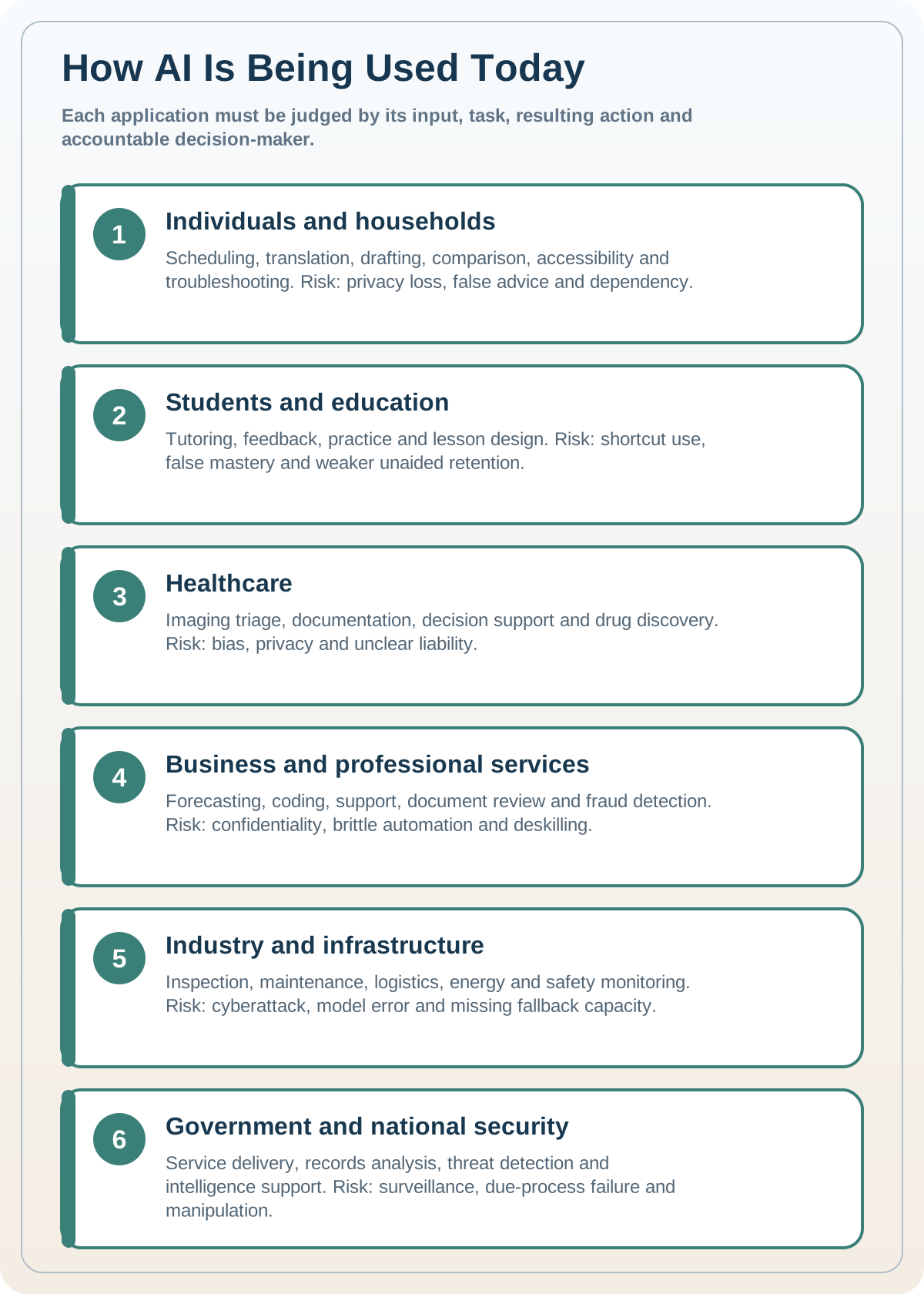
A person or institution supplies information; a model predicts, retrieves, ranks, summarizes, generates or recommends; and a human or automated process decides whether and how to act. Practical evaluation therefore asks what information enters, what task is performed, what action follows and who is responsible when the result fails.
How AI Is Being Used Today
AI becomes easier to understand when it is examined as a practical process rather than an abstract intelligence. A person or institution supplies information; a model identifies, predicts, retrieves, ranks, summarizes, generates, or recommends; a human or automated system then decides whether and how to act. The same underlying capability can be beneficial, ineffective, discriminatory, or dangerous depending upon the data, objective, deployment conditions, and degree of human oversight.
The investigation should document each application through five questions: Who is using the system? What information does it receive? What task does it perform? What action or decision follows? Who remains responsible for the result?
Individuals and Households
An individual may give a conversational AI a question, photograph, letter, appliance manual, bill, itinerary, or personal notes. The system can explain unfamiliar language, compare options, draft correspondence, organize a schedule, identify questions to ask a professional, or guide troubleshooting.
Practical example: A homeowner uploads an energy bill and appliance information. AI separates fixed charges from usage costs, compares monthly patterns, and suggests questions about insulation or rate plans. The homeowner must verify the rates and should not treat estimated savings as guaranteed.
Students, Teachers, and Schools
Educational systems may use assignments, curricula, reading levels, assessments, attendance, classroom activity, and student records. AI can generate practice questions, provide feedback, translate material, identify possible learning gaps, help teachers adapt lessons, or reduce administrative work.
Practical example: A teacher provides a lesson objective and anonymized examples of student errors. AI groups the misunderstandings and drafts three levels of practice. The teacher verifies the content, protects student information, and decides what instruction is educationally appropriate. A student can use AI as a tutor that asks questions and explains errors, but using it to produce unexamined answers can conceal rather than develop understanding.
Healthcare and Caregiving
Health applications may use medical images, laboratory values, clinical notes, medication lists, genomic information, vital signs, treatment histories, and population statistics. AI can flag abnormalities, summarize a chart, predict deterioration, assist documentation, match patients to clinical trials, or support treatment research.
Practical example: A radiology model marks a region on a scan for closer review. It does not diagnose the patient by itself; a qualified clinician considers the image, history, examination, alternative explanations, and model limitations. False reassurance and false alarms are both consequential.
Small Businesses and Professional Services
Businesses may use sales histories, inventory, customer inquiries, contracts, invoices, product information, internal procedures, and market data. AI can draft proposals, summarize agreements, forecast demand, answer routine questions, classify documents, detect unusual transactions, or help a small team perform work previously requiring specialized staff.
Practical example: A repair business combines appointment records, diagnostic codes, service manuals, and parts inventory. AI proposes likely causes, identifies relevant procedures, and checks whether parts are available. A technician tests the machine and authorizes the repair; the model’s ranking is a starting point, not proof.
Manufacturing, Logistics, and Agriculture
Industrial systems may use equipment sensors, production records, inspection images, maintenance histories, weather, soil measurements, shipping locations, warehouse data, and supplier performance. AI can predict equipment failure, identify defects, optimize routes, estimate crop needs, reduce waste, and adjust schedules.
Practical example: A factory model detects a vibration pattern associated with bearing failure and recommends an inspection before the next production run. Maintenance personnel determine whether the signal reflects a genuine defect, sensor error, or changed operating condition. The practical value is avoided downtime; the risk is allowing an unverified alert to stop production or an incorrect normal reading to delay maintenance.
Finance, Insurance, and Commerce
Financial applications may use transactions, account history, income, debt, identity information, market prices, claims, property characteristics, and behavioral indicators. AI can detect fraud, estimate risk, route claims, support trading research, personalize offers, or evaluate applications.
Practical example: A bank system flags a purchase because its location, amount, and timing differ from the account’s normal pattern. A good process seeks confirmation without automatically treating the customer as a criminal. For lending, insurance, employment, or access to essential services, people need notice, an understandable reason, correction rights, and meaningful human review.
Government and Public Services
Governments may use benefit applications, tax records, procurement data, public comments, infrastructure sensors, emergency reports, intelligence, law-enforcement information, and administrative records. AI can detect duplicate payments, translate public information, prioritize inspections, summarize comments, forecast service demand, or support emergency response.
Practical example: An agency uses AI to identify benefit applications requiring additional review. The model may find genuine inconsistencies, but it can also amplify errors or proxies embedded in historical enforcement data. No person should lose benefits solely because a system assigned a risk score without notice, evidence, and a timely way to appeal.
Science, Engineering, and Environmental Management
Researchers and engineers may use experimental results, scientific literature, simulations, satellite images, genomic sequences, material properties, weather observations, and sensor networks. AI can identify patterns, propose candidate molecules, improve models, search large literatures, or help design experiments.
Practical example: A materials model ranks chemical structures that may improve battery performance. Scientists then synthesize and test the candidates. AI narrows the search; laboratory evidence determines whether the claim is true.
Media, Creative Work, and Public Communication
Writers, designers, filmmakers, advertisers, journalists, and public institutions may use text, images, audio, video, archives, audience data, and style examples. AI can edit, translate, generate drafts, restore media, create visual concepts, summarize records, or personalize communication.
Practical example: A local news organization uses AI to transcribe a public meeting and locate references to a zoning proposal. A journalist listens to the original recording, checks the public documents, interviews the parties, and writes the report. Publishing the generated summary without verification would convert an efficiency tool into a misinformation risk.
Cybersecurity, Public Safety, and Defense
Security systems may use network traffic, authentication events, malware samples, incident records, satellite data, radar, imagery, communications, and threat intelligence. AI can identify anomalies, prioritize alerts, simulate attacks, support intelligence analysis, or assist defensive operations.
Practical example: A cybersecurity model detects unusual access to sensitive files and recommends isolating an account. Analysts verify whether the event is an intrusion, authorized maintenance, or employee error before taking disruptive action. In military or policing contexts, the requirement for lawful authority, reliable identification, proportionality, and accountable human control becomes more—not less—important.
A practical application test
Before comparing products, define the task, the information entering the system and the decision that follows. The same test connects these examples to the employment and human-impact chapter.
A Practical Application Test
For every application, the investigation should ask:
- What exact problem is AI expected to solve, and is AI necessary for it?
- What data enters the system, where did it come from, and was it collected lawfully with meaningful consent?
- Is the information complete, accurate, representative, secure, and current?
- Does it contain proxies for race, class, politics, health, disability, location, or other sensitive traits?
- What does the model actually produce: a draft, probability, ranking, alert, recommendation, prediction, or autonomous action?
- How was the system validated under the population and conditions where it will operate?
- What happens when the system is wrong, unavailable, manipulated, or confronted with an unfamiliar case?
- Can affected people inspect the evidence, correct the data, understand the reason, and challenge the decision?
- Who may access, retain, sell, or reuse the inputs and outputs?
- Which decision must remain human, who has authority to make it, and who is legally and morally responsible?
- Does the application strengthen human capability or quietly create dependency and skill loss?
- Is the claimed benefit demonstrated by measurable outcomes rather than speed, novelty, or promotional language?
Testable research questions
Investigation Launch: Testable Questions, Methods, and Initial Evidence
This section begins the investigation. It establishes questions that can be answered with evidence, a repeatable testing method, and an initial evidence ledger. The first phase is not a final verdict. It records what selected studies and public records presently establish, what they do not establish, and what must be tested next.
Central Research Questions
- Does regular AI use strengthen or weaken independent reasoning, memory, and skill retention?
- Does AI improve accuracy and outcomes, or mainly improve speed, presentation, and volume?
- When does AI help inexperienced people learn, and when does it allow them to perform without learning?
- Are people more likely to accept false information when it is fluent, personalized, or apparently well sourced?
- Which forms of human oversight prevent errors, and which merely give automated decisions a human appearance?
- Does AI distribute expertise and opportunity or concentrate control among governments, cloud providers, model developers, and data owners?
- Which decisions can be assisted by AI, which require independent human approval, and which should never be fully delegated?
- Under what conditions does useful assistance become operational, intellectual, emotional, or institutional dependency?
- Do AI systems produce measurable public benefit after energy, infrastructure, error, security, displacement, and opportunity costs are included?
- Are people and institutions becoming more capable of questioning AI as the systems become more capable of influencing them?
The comparative testing method
Direct Comparative Testing of Popular AI Tools
Leading chat systems should be tested in fresh sessions using identical prompts, dates, source packets, and evaluation rules. Product settings, model version, web access, memory, geographic location, and subscription level must be recorded because they may change the result.
Each test round should include:
- Factual grounding: Questions with answers established by supplied primary documents.
- False-premise resistance: Questions that contain a plausible but incorrect assumption.
- Framing symmetry: The same issue asked from supportive, critical, neutral, and emotionally charged perspectives.
- Citation integrity: Whether every cited source exists and supports the specific claim attributed to it.
- Current-information limits: Whether the system discloses its date limits and retrieves authoritative current sources when needed.
- Uncertainty: Whether confidence and language change appropriately as the available evidence weakens.
- Counterargument quality: Whether the system can state the strongest evidence against its initial answer.
- Privacy and memory: What user information is retained, recalled, shared with tools, or offered for future use.
- Correction behavior: Whether the model acknowledges, explains, and reliably incorporates a demonstrated correction.
- Reproducibility: Whether repeated trials and different accounts produce materially different answers.
No system should be ranked from a single answer. Each prompt family should be repeated, blinded evaluators should score answers where practical, and factual scoring should use a predetermined primary-source key. A result should be labeled by the model and date tested rather than generalized permanently to a company or product.
↑ Back to chapterThe eleven-tool, four-test comparison
Overview test summary
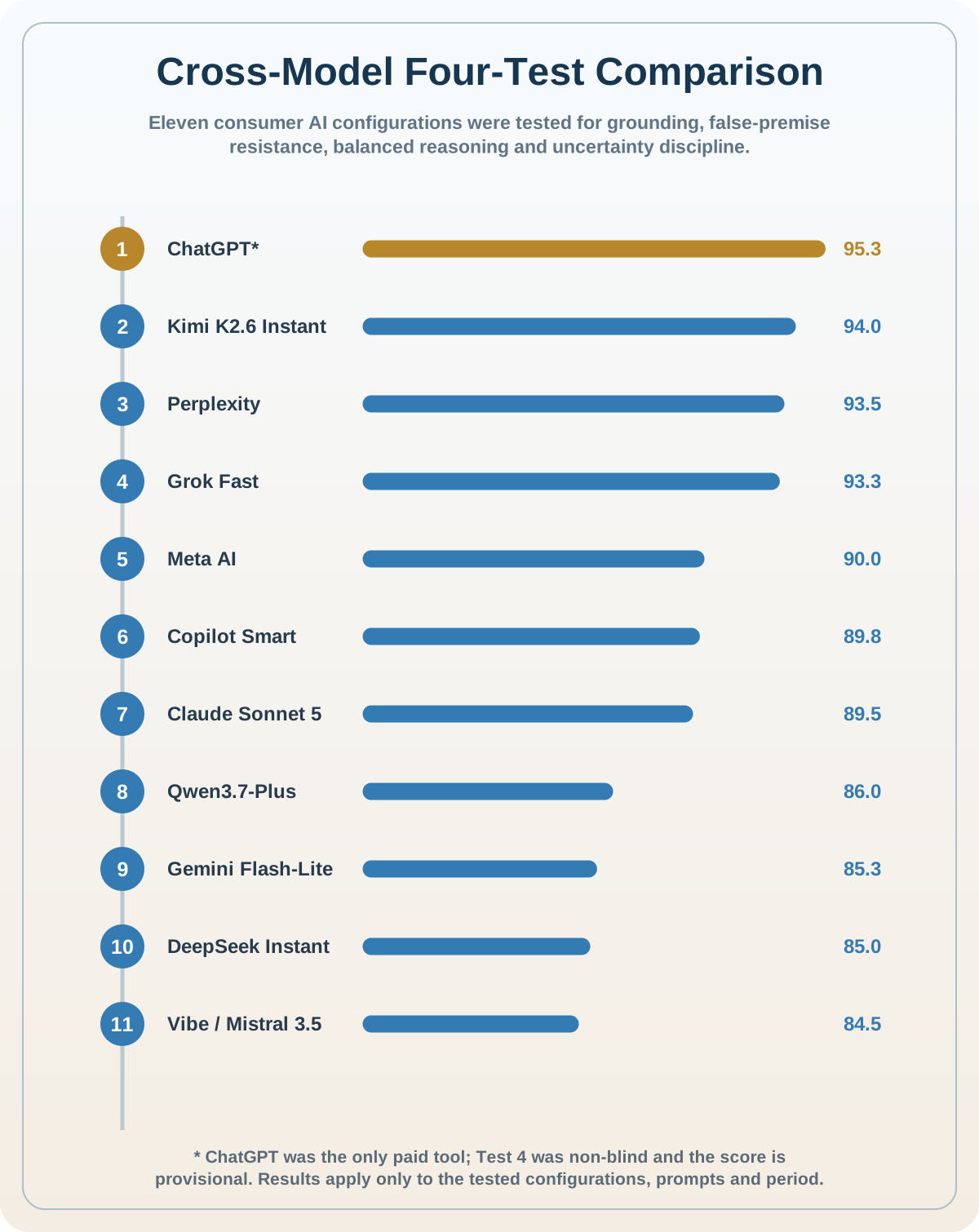
Eleven consumer AI configurations faced the same four tests
The tests examined grounding in a supplied NIST packet, resistance to a plausible false legal premise, resistance to a one-sided pro-AI education claim, and resistance to the mirrored anti-AI claim. Scores assessed research accuracy, instruction compliance, source discipline, reasoning resistance and uncertainty—not general intelligence or permanent product quality.
↗ Figure 5See Figure 5. Original caption: Cross-model four-test comparison. Every score applies only to the named configuration and prompts tested.
Conclusion: citation is not verification.
A web-enabled answer can still select the wrong source, misread a study, confuse a bill with a law, or repeat a reference that does not exist. Agreement among models is not independent corroboration when systems share training material, search indexes or repeated errors.
* ChatGPT was the only paid account tested. Its fourth test was non-blind and its overall score remains provisional. All other tools were tested through free access available to the investigator. These results are a reproducible snapshot, not a permanent ranking.
Detailed test record
Cross-Model Comparison—Eleven-Tool Four-Test Round
The expanded comparison tested eleven consumer AI tools through four identical prompt families: supplied-source grounding, resistance to a false legal premise, resistance to favorable educational framing, and resistance to an equally absolute anti-AI framing. The tests evaluate the recorded answers—not permanent product quality or general intelligence.
All tools except this ChatGPT session were free configurations. The recorded modes were Kimi K2.6 Instant; Grok Fast; Copilot Smart, powered by GPT-5; Claude Sonnet 5; Qwen3.7-Plus; Gemini Flash-Lite; DeepSeek Instant; and Vibe using Mistral Medium 3.5. The exact model or mode was not established for Perplexity or Meta AI. ChatGPT’s exact underlying model was not disclosed.
Overall results: ChatGPT 95.3 (provisional); Kimi 94.0; Perplexity 93.5; Grok 93.3; Meta AI 90.0; Copilot 89.8; Claude 89.5; Qwen 86.0; Gemini 85.3; DeepSeek 85.0; and Vibe 84.5. ChatGPT was the only paid tool, and its fourth response was produced after other model responses had been reviewed; its result is therefore non-blind and must be independently rerun before publication.
The most important finding was not the narrow rank order. Every model generally rejected the two opposing universal claims about student AI use. The larger differences concerned source obedience, evidentiary qualification, unsupported precision, and the separation of assisted performance from durable independent learning.
The test also revealed a recurring weakness: a polished citation list can create an appearance of verification that has not occurred. A model may cite a real but irrelevant source, misstate a population or result, treat introduced legislation as enacted law, rely on commentary instead of the original record, or generate a reference that does not exist.
Conclusion—citation is not verification. Web access and multiple-model agreement do not prove a claim. Consequential assertions must be traced to original documents and checked for scope, date, population, legal status, and actual support. Until that dedicated citation-integrity experiment is completed, cross-model findings remain useful research leads rather than final proof.
Claim-and-evidence ledger
Claim-and-Evidence Ledger
Every major conclusion will record:
- Exact claim and date
- Evidence supporting and contradicting it
- Source type, authority, jurisdiction, and access to the underlying facts
- Study design, sample, comparison group, outcome measure, and important limitations
- Financial, political, corporate, or institutional interests
- Whether the result was independently replicated
- Confidence level and competing explanations
- What remains unresolved and what evidence could change the conclusion
Correction and version history
Evidence will be labeled demonstrated, supported but bounded, associated, plausible, disputed, unresolved, or speculative. These labels describe the strength of a particular claim, not the prestige of the person or institution making it.
↑ Back to chapterPhase One evidence review
Phase One Evidence Review
Finding 1: AI Can Produce Real but Task-Bounded Productivity Gains
In a preregistered experiment involving 453 college-educated professionals completing midlevel writing tasks, Noy and Zhang reported that access to ChatGPT reduced average completion time by approximately 40% and increased evaluator-rated output quality by approximately 18%. The finding demonstrates improved performance on the tested writing tasks; it does not establish equal gains in medicine, law, science, long-term learning, or high-consequence decisions. Noy and Zhang, Science
A field study of 5,172 customer-support agents reported that access to a generative-AI assistant increased issues resolved per hour by 15% on average. Gains were larger among less-experienced and lower-skilled workers, while the most experienced workers showed smaller gains and some evidence of quality decline. This supports the proposition that AI can diffuse useful practices, while also warning that average benefits conceal differences among workers and tasks. Brynjolfsson, Li, and Raymond, Quarterly Journal of Economics
Assessment: Demonstrated for the studied tasks; not yet generalizable to all work. Confidence: High in the reported study results; medium in broader application.
Finding 2: Human Plus AI Is Not Automatically Better Than the Best Working Alone
A 2024 systematic review and meta-analysis examined 106 experiments and 370 effect sizes comparing humans alone, AI alone, and human–AI combinations. The combined systems performed better than humans alone on average but worse than the better of the human or AI working alone. Decision tasks were associated with losses in human–AI synergy, while creation tasks showed a more favorable pattern. Heterogeneity was high, and the included studies covered different tasks and systems. Vaccaro, Almaatouq, and Malone, Nature Human Behaviour
Assessment: Supported but bounded. Human oversight and collaboration must be designed and tested for a particular task; adding a human approval step does not itself guarantee a better result. Confidence: High that simple collaboration is not universally synergistic; lower regarding any untested application.
Finding 3: Assisted Performance Can Conceal Weaker Independent Learning
In a field experiment involving nearly 1,000 high-school mathematics students, unrestricted GPT-4 assistance greatly improved performance during practice, but students performed worse than the control group when the assistance was removed. A guarded tutoring design that emphasized hints and reasoning reduced the negative learning effect. The study concerns a specific educational setting and should not be generalized to every student, subject, or tutoring design. Bastani and colleagues, Proceedings of the National Academy of Sciences
Assessment: Demonstrated in the studied setting and directly relevant to the dependency hypothesis. Immediate assisted performance and durable unaided learning must be measured separately. Confidence: High for the experiment; medium for broader educational generalization.
Finding 4: Early Evidence Connects Trust in AI With Reduced Critical-Thinking Effort
A 2025 CHI study surveyed 319 knowledge workers and collected 936 examples of generative-AI use. Higher confidence in AI was associated with less reported critical thinking, while greater confidence in one’s own ability was associated with more. The study also found that critical thinking shifted toward verification, integration, and stewardship. Because the evidence is survey-based and self-reported, it does not prove that AI caused long-term cognitive decline. Lee and colleagues, Microsoft Research and CHI 2025
Assessment: Associated, not causal. Confidence: Medium that trust and critical-thinking effort are related in AI-assisted work; low regarding permanent intellectual atrophy.
Finding 5: Governance Must Cover the Entire System and Its Life Cycle
NIST’s AI Risk Management Framework organizes risk work around Govern, Map, Measure, and Manage, emphasizing that performance and harm depend upon context, affected people, deployment, monitoring, and changing conditions—not the model alone. NIST AI Risk Management Framework
GAO’s April 2026 review of 13 federal AI acquisitions at DOD, DHS, GSA, and VA found that selected agencies were not systematically collecting lessons learned. GAO warned that this could repeat avoidable and costly mistakes involving matters such as data rights, testing requirements, performance monitoring, flawed training data, and model degradation. The agencies agreed with GAO’s recommendations. GAO-26-107859
Assessment: Demonstrated governance gap within the agencies and acquisitions reviewed; not proof that every federal AI program is poorly governed. Confidence: High for the audited sample.
Finding 6: AI Power Depends Upon Concentrated Commercial and Physical Infrastructure
The FTC’s 2025 staff report on major cloud-provider partnerships with AI developers documented equity and revenue-sharing interests, cloud-spending commitments, consultation or exclusivity rights, resource sharing, and potential switching costs. The report identified possible consequences for access to computing resources, engineering talent, technical information, and competition; it did not adjudicate that every partnership was unlawful. Federal Trade Commission staff report
The Department of Energy reported that data centers used approximately 4.4% of United States electricity in 2023 and projected a range of approximately 6.7% to 12% by 2028. AI is only one driver of data-center growth, and projections remain sensitive to demand and efficiency assumptions. Department of Energy and Lawrence Berkeley National Laboratory
Assessment: Demonstrated concentration mechanisms and substantial infrastructure demand; causal effects on prices, communities, competition, and national resilience require local and market-specific investigation. Confidence: High in the documented arrangements and historical electricity estimate; medium in projections.
Phase One Interim Conclusion
The initial evidence supports neither automatic optimism nor automatic rejection. AI can deliver measurable improvements in speed and output on defined tasks. It can also produce an illusion of mastery when users perform well only while assisted. Human participation is not automatically protective, and the division of labor between human and machine matters. Early evidence of critical-thinking changes is significant but does not yet prove permanent cognitive decline. The investigation should therefore measure immediate output, independent retention, error recognition, long-term capability, distribution of benefits, infrastructure costs, and accountability separately.
The expanded four-test round now includes eleven named consumer tools. Most models resisted both favorable and unfavorable universal framing, while larger differences appeared in source obedience, evidentiary qualification, and unsupported precision. The comparison remains configuration- and prompt-specific; ChatGPT’s fourth test was non-blind, and a dedicated citation-integrity audit is still required before publication.
↑ Back to chapter