Isaias Recovery Advances as Gulf Production Remains Shut In
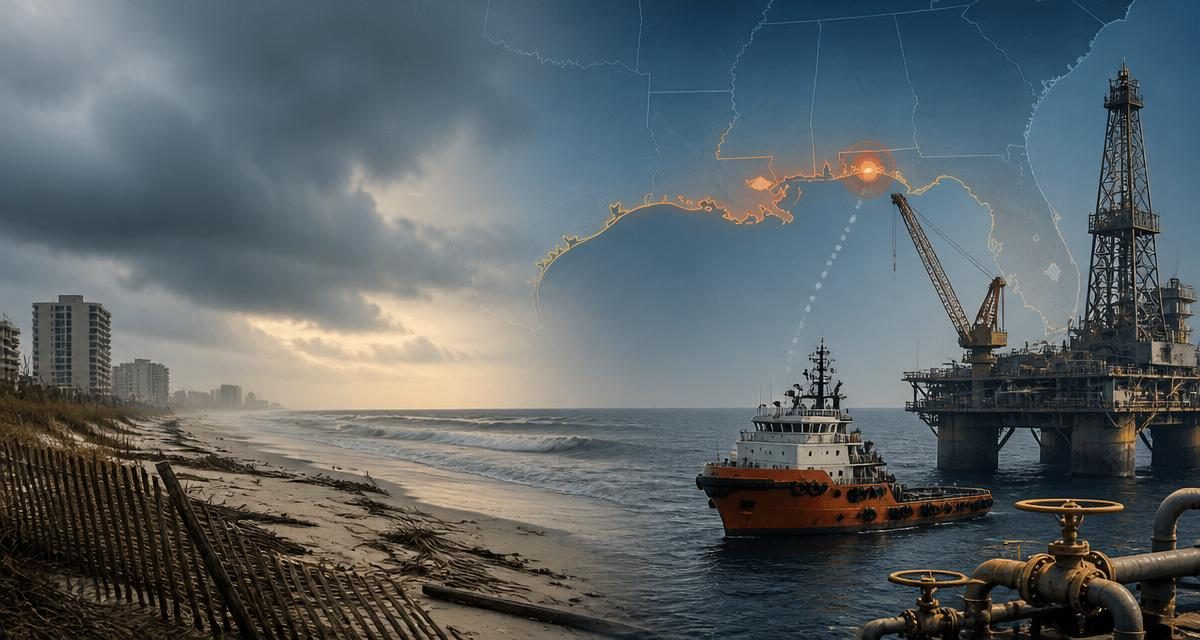
Hurricane Isaias made landfall near Destin, Florida, on October 9 as a Category 2 storm with 105 mph winds. By October 11, it was post-tropical and the federal forecast center had issued its final advisory, although flooding risks remained in parts of the Appalachians and Mid-Atlantic. Alabama reported fewer than 75,000 outages, while offshore operators still had more than half of current daily Gulf oil production shut in. Recovery now turns on restoring essential services and safely returning energy facilities to operation.
Article updated Oct 11, 2026, 1:36 PM Pacific
Recovery Replaces the Landfall Forecast
For Gulf Coast residents, the immediate story is restoring power, clearing damage and reopening essential services. The National Hurricane Center (NHC) placed Isaias’ landfall near Destin at about 8:30 p.m. Central on October 9, with maximum sustained winds of 105 mph. That observed Category 2 landfall supersedes the earlier forecast of a major hurricane coming ashore later that night.
Flooding Risks Move Inland
In its final advisory at 11 a.m. Eastern on October 11, the National Weather Service’s Weather Prediction Center (WPC) described Isaias as a 25 mph post-tropical cyclone. It said the flash-flood threat was decreasing but that localized flooding remained possible in parts of the Appalachians and Mid-Atlantic. Expected dissipation over West Virginia that evening was still a forecast; ending cyclone advisories did not end local warnings.
Essential Services Are Still Recovering
Alabama’s Emergency Management Agency reported on October 11 that outages had fallen below 75,000. Its Baldwin, Crenshaw and Conecuh county offices and several southern healthcare facilities were still relying on generators. Florida’s separate October 10 report counted 439,162 accounts without power at 1 p.m.; that earlier snapshot should not be combined with Alabama’s later figure as a current regional total.
Offshore Shutdowns Ease, but Remain Substantial
The Marine Minerals Administration (MMA) estimated from operator reports through 11 a.m. Central on October 11 that 57.54% of Gulf oil production and 49.11% of natural-gas production were shut in. Those shares were down from 68.76% and 57.44% a day earlier. They represent estimates of expected daily production held offline, rather than cumulative lost output or a damage assessment. Inspections determine when facilities can restart safely.
An Emergency Oil Exchange Supports Supply
The Department of Energy (DOE) authorized an exchange of up to 4 million barrels from the Strategic Petroleum Reserve (SPR) on October 10, with up to 2 million barrels each for ExxonMobil and BP America. Participating companies are to return the borrowed crude with additional premium barrels in 2027. The measure addresses supply disruption; authorization alone does not show that every barrel has been delivered or that consumer prices have fallen.
What Recovery Must Demonstrate
The next useful evidence is restored electricity at homes and critical facilities, verified water-system and transport conditions, completed offshore inspections and actual production restarts. Local emergency notices remain the right guide for residents facing flooding or damaged infrastructure. Final damage, casualty and economic-loss totals should be added only when dated, geographically defined records establish them.
What changed
Observed Category 2 landfall, post-tropical transition, October 11 recovery reports and daily offshore-production estimates replace October 9 future-landfall preparation language.
Why it matters
The storm’s effects now run through essential services, offshore production and fuel supply. Recovery measures have begun, but electricity restoration, safe facility restarts and measured deliveries determine their practical benefit.
What to watch next
Local flood warnings and verified restoration at homes, healthcare and emergency facilities; daily MMA offshore restart estimates; SPR deliveries and completed damage assessments.
What we know
- Observed landfall near Destin occurred October 9 at about 8:30 p.m. CDT with 105 mph sustained winds.
- WPC issued its final public advisory at 15:00 UTC October 11, with residual flooding risks.
- Alabama’s October 11 report put outages below 75,000; offshore estimates remained substantial.
Material unknowns
- Final regional damage, casualty and economic-loss totals are not established by the cited sources.
- Different-time outage snapshots are not a current multistate total.
- Shut-in shares are operator estimates of expected daily production, not cumulative loss.
U.S. strategic assessment
Critical interestOutcomes
- Observed landfall near Destin occurred October 9 at about 8:30 p.m. CDT with 105 mph sustained winds.
- WPC issued its final public advisory at 15:00 UTC October 11, with residual flooding risks.
- Alabama’s October 11 report put outages below 75,000; offshore estimates remained substantial.
Sources
01Dated primary record; forecasts and announcements remain distinct from measured outcomes.
Dated primary record; forecasts and announcements remain distinct from measured outcomes.
Dated evidence supporting the article; publication and observation periods remain distinct.
Dated evidence supporting the article; publication and observation periods remain distinct.
Dated evidence supporting the article; publication and observation periods remain distinct.
Dated evidence supporting the article; publication and observation periods remain distinct.
Dated evidence supporting the article; publication and observation periods remain distinct.
Dated evidence supporting the article; publication and observation periods remain distinct.
Dated evidence supporting the article; publication and observation periods remain distinct.