DOE Presses PJM for Cost Reforms After FERC Delays Backstop Procurement
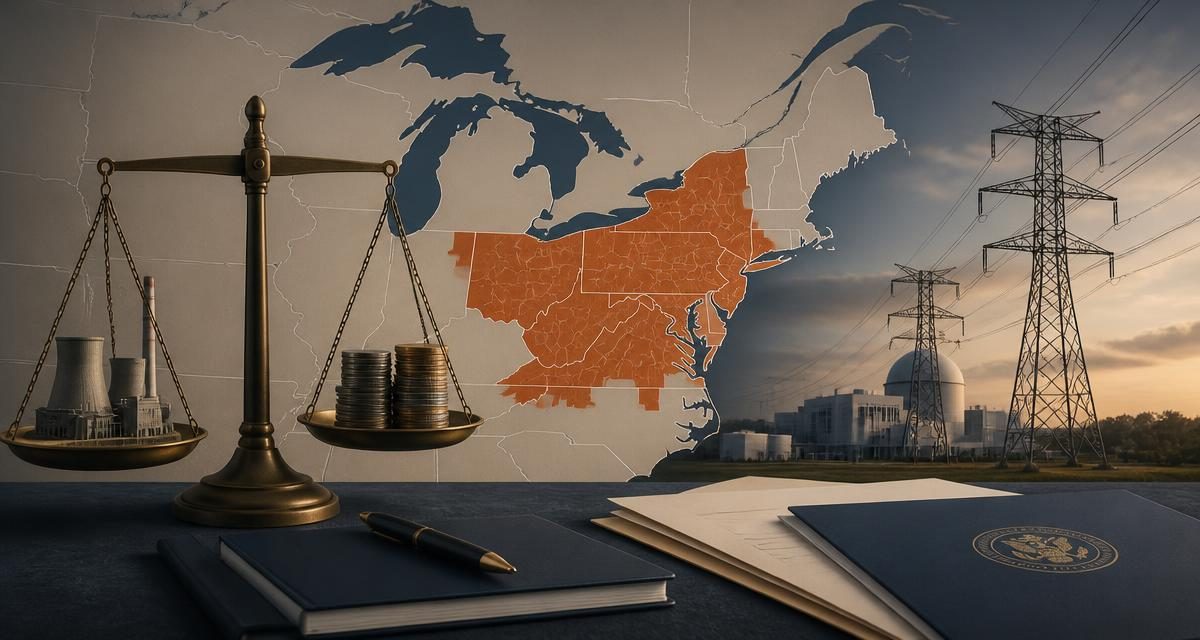
The Department of Energy (DOE) is urging PJM to revise how a proposed reliability backstop assigns the cost of new electricity supply. The Federal Energy Regulatory Commission (FERC) had already accepted the filing on September 29 but suspended its effective date to February 28, 2027, subject to refund and further proceedings. DOE’s statement, dated October 7 and announced October 9, urges revised tariff terms by October 29. The dispute concerns who pays for demand growth; it has not yet established lower household bills.
Article updated Oct 11, 2026, 1:36 PM Pacific
New Demand Brings a Ratepayer Question
Households and businesses share a grid with very large new electricity users. DOE’s latest PJM intervention argues that customers creating new demand should fund the generation and infrastructure needed to serve them. The practical dispute is how to identify that demand and allocate costs fairly as the region seeks more dependable supply.
FERC Has Acted, With Conditions
PJM’s September 30 explanation says FERC accepted its Reliability Backstop Procurement (RBP) filing on September 29 but suspended it for five months, to February 28, 2027, subject to refund and additional proceedings. The procurement consequently did not begin on September 30 as planned. Acceptance for filing is a regulatory step; it does not mean the proposed process is already operating.
DOE Urges a Revised Filing
DOE announced its position on October 9; the linked statement carries an October 7 certificate of service. It urges PJM to file revised tariff provisions by October 29 under section 205 of the Federal Power Act. The proposed changes would link costs to the customers driving them, use more accurate project-level demand information and allow large users to meet capacity needs by building, bringing or buying qualifying supply.
Forecasts Need to Match Real Projects
A forecast can include a project that later shrinks, is delayed or is canceled. DOE’s filing calls for tracking those changes so procurement and cost allocation follow actual needs. That is a proposed safeguard against charging existing customers for someone else’s growth, rather than evidence that every disputed cost has already been reassigned.
States Still Influence Retail Bills
In a separate concurrence, Commissioner David Rosner emphasized the role of states and retail authorities in large-load tariffs, collateral and curtailment rules. His statement explains his view of the order; it is not itself a nationwide retail-rate rule. Wholesale decisions must pass through specific utility and state arrangements before any household effect can be measured.
The Next Decision Points
The October 29 revised-filing path, further FERC orders and PJM’s updated procurement timetable are the immediate milestones. Actual supply commitments, commercial operation and approved retail treatment will show whether the response adds dependable capacity while protecting existing customers. The February 28 date is the suspended effective date described in the September order, not a guaranteed auction or construction date.
What changed
The article now includes the September29 FERC acceptance-and-suspension decision, the October7 date on DOE’s statement, the October 9 announcement and the October 29 revised-filing request.
Why it matters
The allocation rules determine whether households subsidize infrastructure built for large new users. Regulatory acceptance, an effective tariff, contracted capacity and retail-bill outcomes are separate stages.
What to watch next
PJM’s revised tariff filing by the October 29 path urged by DOE; further orders in ER26-3380-000/EL26-108-000; updated procurement timing and state retail-rate treatment.
Material unknowns
- The full FERC order PDF was not accessible in this research tool; its acceptance/suspension details are supported by PJM’s official explanation, with DOE’s actual filing and FERC concurrence as cross-checks.
- No measured household savings or completed procurement is established by these records.
Sources
01Dated primary record; announcement and implementation are kept distinct.
Dated evidence supporting the article; publication and observation periods remain distinct.
Dated evidence supporting the article; publication and observation periods remain distinct.
Dated evidence supporting the article; publication and observation periods remain distinct.
Dated evidence supporting the article; publication and observation periods remain distinct.