GLOBAL
INTELLIGENCE REPORT

GIB · GLOBEINTELREPORT.COM

Support GIBSite updatedOct 16, 2026•••
Full GIB infographic explaining the research platform
Latest headlines
GIB / Global Intelligence Brief

Canada–U.S. Trade Negotiations collapse into scheduled dollar-for-dollar retaliation
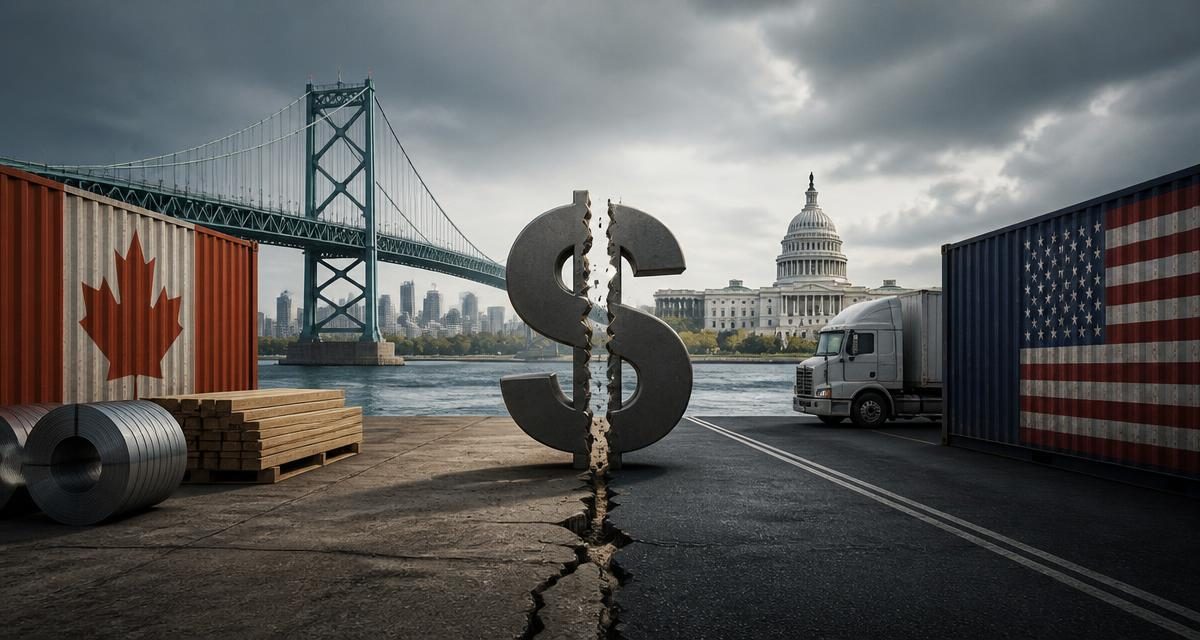
AI-generated editorial graphic for Canada–U.S. Trade Negotiations collapse into scheduled dollar-for-dollar retaliation
Preparing article image…

Washington wants broader reciprocal access and industrial concessions; Ottawa wants tariff relief, continued USMCA access and policy independence. Talks failed amid disputes over scope, reciprocity and sovereignty. Canada–China relations are a contributing U.S. security concern, but not a verified sole cause.

88% ConfidencePrimary records establish rates, dates and official positions; the unpublished negotiating text limits causal certainty.
01

Who carries the costs

Autoworkers, farmers, retailers, manufacturers and border communities face the immediate exposure. Integrated supply chains mean duties can hit both exporters and domestic users of imported inputs.

02

What Washington wants

The Trump Administration seeks broader reciprocal access, particularly in dairy, regulated alcohol distribution and industrial trade, while emphasizing sovereignty, economic security and treatment of U.S. products.

  • Covered products face additional duties
  • USMCA treatment and sectoral tariffs remain legally distinct
03

Canada’s objectives

Canada wants relief from U.S. tariffs, preservation of USMCA access and freedom to maintain domestic policy choices. Ottawa says the latest terms were unacceptable.

04

Why talks remain unresolved

The parties agree talks failed but describe responsibility differently. Because the draft text is unpublished, claims about last-minute language, scope and relative concessions remain unresolved.

05

China is a concern, not a proven single cause

Canada’s China relationship is a documented U.S. economic-security concern in wider North American policy. Available evidence does not establish it as the sole or controlling cause of this breakdown.

06

The operative measures

U.S. duties are effective. Canadian countertariffs are published and scheduled for September 8, making the next phase auditable at customs and in prices, trade volumes and firm responses.

  • Canadian rates: 15%, 25% and 50%
  • Affected value: C$27.6 billion
07

Economic mechanism

Tariffs may create negotiating leverage and substitution toward domestic suppliers, but can also raise machinery, metal, food and consumer-goods costs. Net effects require product-level trade and price data.

08

Next decision point

A resumption of talks before September 8 could limit damage. Otherwise the USMCA review will begin under substantially worse trust and investment conditions.

09

What changed

Canada finalized and published its detailed countertariff list while consultations with affected firms continued.

10

Why it matters

The United States and Canada operate one of the world’s most integrated production systems, so retaliation transmits quickly to workers, firms and households.

11

What to watch next

Whether talks resume before September 8 and the first customs, trade-volume and price evidence after implementation.

12

What we know

  • The United States imposed additional 50% duties on covered Canadian goods.
  • Canada published 15%, 25% and 50% countertariffs covering C$27.6 billion in U.S. imports, effective September 8.
  • Canada says negotiations were suspended because the United States asked too much and offered too little.
  • The final proposed negotiating text is not public.
13

Material unknowns

  • Exact rejected terms
  • Potential product exclusions
  • Price pass-through and trade diversion

Network investigation · Evidence grades B/C

Carney, London and transnational finance: what is proven—and what remains allegation

The public record establishes substantial links among Mark Carney, British central banking, international financial coordination, climate-finance institutions and Canada’s Liberal Party. It also establishes a personnel link between Carney’s current U.S.-stakeholder operation and Hillary Clinton’s 2016 campaign. Those facts justify investigation. They do not, by themselves, prove that London, the U.S. Democratic Party or a single “globalist” command structure directed the Canada–U.S. trade breakdown.

VerifiedUK and global-finance roles
Documented overlapLiberal and Clinton-linked personnel
Attributed thesisPromethean Action’s system-conflict analysis
Not establishedA unified command or deliberate U.S. election operation

01 · The UK and transnational-finance record

The institutional network is documented

Carney served as governor of the Bank of England, chaired the Financial Stability Board, and was appointed by the UK government to mobilize finance for COP26. He later co-chaired GFANZ with Michael Bloomberg. GFANZ said its participating institutions represented more than $130 trillion in assets; that figure described assets represented by member firms, not a fund Carney personally controlled.

In a public 2019 speech, Carney proposed considering a synthetic hegemonic currency, potentially supported by a network of central-bank digital currencies, that could reduce the international monetary system’s dependence on the U.S. dollar. This verifies a policy proposal—not a secret implementation plan.

02 · Liberal and Democratic connections

The overlap is real but narrower than the broadest claims

Carney formally chaired the Liberal Party’s economic-growth task force in 2024. A Canadian public record lists Maia Johnson as Senior Advisor, United States Stakeholder Strategy in the Prime Minister’s Office; a contemporaneous 2016 campaign record identifies her as Hillary Clinton’s director of scheduling.

This establishes a direct personnel connection to a major Democratic campaign and a Canadian center-left governing party. It does not establish that the Democratic National Committee, Democratic officeholders or the Clinton campaign directs Canada’s trade policy. That stronger claim would require communications, instructions, funding flows or an official investigative finding.

03 · What Promethean Action argues

A clash-of-systems thesis, presented as analysis

Promethean Action’s August 24 analysis argues that Carney’s trade posture is part of a wider attempt to preserve a London-centered, climate-directed financial order and to create U.S. political pressure ahead of the midterm elections through American stakeholders, many of them Democrats. Its July 22 article develops the same UK, Democratic-network and “globalist” interpretation.

GIB treats this as a hypothesis-generating political analysis, not independent proof. Promethean Action’s own mission statement says it was formed by former Lyndon LaRouche collaborators and renamed from LaRouche PAC Action. Repetition across the same outlet is not independent corroboration; each underlying factual assertion is tested here against primary records.

04 · Trump and Bessent’s counter-model

The policy conflict is documented; the label “globalist” is interpretive

The Trump Administration’s America First Trade Policy emphasizes reciprocity, domestic production, workers and national economic security. Treasury Secretary Scott Bessent has called for restoring balance to the international system and limiting institutional mission creep, while describing financial deregulation and private capital as a “re-privatization” of the economy. The administration also prohibited a U.S. central-bank digital currency while supporting private digital finance.

These policies conflict with parts of Carney’s transnational, climate-finance and synthetic-currency record. Promethean Action characterizes that conflict as Trump taking financial power away from “globalists.” Official U.S. documents instead describe the objective as rebalancing trade, protecting sovereignty, strengthening the dollar and shifting growth toward private productive investment; they do not identify a single globalist organization as the legal or operational target.

Open the investigation source ledger
01
Promethean Action — Carney’s War Isn’t About Trade and Bessent Knows It

Promethean Action’s August 24, 2026 thesis about Carney, U.S. political influence and a conflict between financial systems.

Attributed analysis ↗
02
Promethean Action — Carney vs. Trump

Earlier statement of the outlet’s UK, Democratic-network and global-finance theory.

Attributed analysis ↗
03
Promethean Action — Mission statement

Source-perspective disclosure: the organization says it was formed by former Lyndon LaRouche collaborators and renamed from LaRouche PAC Action.

Source disclosure ↗
04
Bank of England — Mark Carney biography

Primary record of Carney’s Bank of England, FSB, Goldman Sachs, Group of Thirty and World Economic Forum roles.

Primary ↗
05
UK Government — Carney appointed finance adviser for COP26

Primary record of the UK government role intended to mobilize private finance for climate policy.

Primary ↗
06
Financial Stability Board — History of the FSB

Primary institutional history confirming Carney chaired the international financial-coordination body from 2011 to 2018.

Primary ↗
07
GFANZ — Finance committed to net-zero alignment

Coalition record identifying Carney and Michael Bloomberg as co-chairs and describing member institutions representing more than $130 trillion in assets.

Primary organization ↗
08
Bank of England — The growing challenges for monetary policy

Carney’s 2019 public proposal to consider a synthetic hegemonic currency, potentially through a network of central-bank digital currencies.

Primary speech ↗
09
Liberal Party of Canada — Carney economic-growth task force

Primary party record of Carney’s formal Liberal economic-policy role before becoming party leader.

Primary party record ↗
10
Office of the Commissioner of Lobbying — PMO public-office holders

Canadian public record listing Maia Johnson as Senior Advisor, United States Stakeholder Strategy, in the Prime Minister’s Office.

Government record ↗
11
P2016 — Hillary Clinton campaign organization

Contemporaneous campaign reference identifying Maia Johnson as Hillary Clinton’s 2016 director of scheduling.

Historical record ↗
12
U.S. Treasury — Bessent on the international economic system

Official statement seeking to rebalance trade and return international financial institutions to their core mandates.

Primary ↗
13
U.S. Treasury — Bessent on re-privatizing the economy

Official statement describing private-sector growth, financial deregulation and tariff policy as parts of the administration’s economic model.

Primary ↗
14
White House — America First Trade Policy

Controlling statement of the administration’s trade, industrial, national-security and worker objectives.

Primary ↗
15
White House — Digital financial technology order

Primary record of the administration’s support for private digital finance and prohibition on a U.S. central-bank digital currency.

Primary ↗

U.S. strategic assessment

Critical interest

The administration has demonstrated coercive leverage but has not converted it into a signed concession. Canada’s retaliation reduces the near-term probability of measurable U.S. gains.

Objectives

  • Reciprocal market access
  • Reduced Canadian barriers
  • Domestic production
  • Economic-security alignment

Strategy

  • Section 338 and sectoral tariffs
  • Negotiating pressure
  • USMCA review leverage

Outcomes

  • Additional duties imposed
  • Talks suspended
  • Canadian retaliation scheduled

Risks

  • Input-price inflation
  • Export losses
  • Investment delay
  • Alliance spillover

Sources

01
White House proclamation

U.S. tariff authority and rate

Primary ↗
02
Department of Finance Canada

Countertariff schedule

Primary ↗
03
Department of Finance Canada—negotiations statement

Canadian account of breakdown

Primary ↗
04
Associated Press

Independent bilateral reporting

Anchor ↗
05
Axios

Original U.S. policy reporting

Anchor ↗
06
Le Monde

French economic cross-check

Cross-check ↗